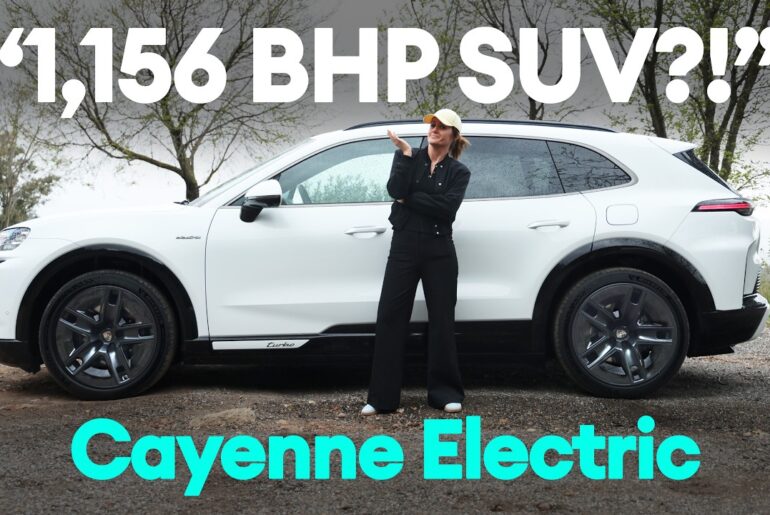
By every metric, the Cayenne delivers improvement over the smaller Macan—and so it should, given the price difference and Porsche’s vehicle hierarchy—but on paper, its range and charge speed are already behind what Chinese giant BYD has coming down the tracks. But cars from performance brands like Porsche, even fully electric SUVs, are about more than just the spec sheet. An electric Cayenne needs to drive like a Porsche, feel like a Porsche, and remind its owner why they’ve paid handsomely for that badge on the steering wheel.
Curved Screen
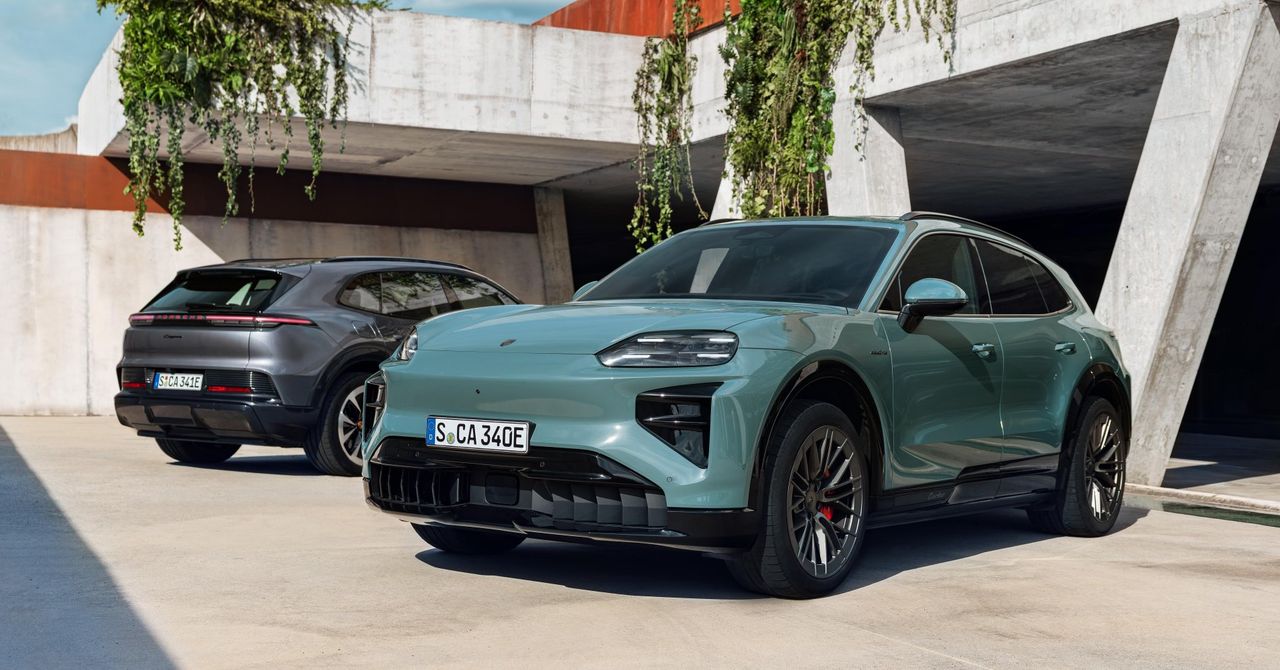
In that regard, the new Cayenne is up to the job. The styling is sharper and cleaner than before, thanks in part to reduced cooling requirements and a focus instead on a slipperier, more aerodynamic body. The front end is recognizably Porsche, and the active aero blades that protrude from the rear corners of the flagship Turbo variant are also on-brand, smoothing airflow and improving efficiency at speed.
The rear is otherwise bland, and since the only Porsche branding is an illuminated motif part of the light bar, when parked and turned off, the Cayenne is visually forgettable. That said, buyers bored by the Tesla trend of limiting paint options to the bare minimum will welcome the Cayenne’s 13 exterior color options and 11 wheel designs.
Inside, it’s recognizably Porsche but with a new curved display that cascades down the center of the dashboard. It’s an arched OLED panel that’ll remind you of the first time you saw a folding smartphone—thankfully without the crease. Discard it as a gimmick if you want, but I like Porsche’s approach here, since it allows the user interface to expand or split into two across the two planes of the curved screen. It also helps reduce glare, while a thoughtful panel below the screen acts as a rest to steady your hand while tapping the display. Physical switchgear controls the basics like temperature, fan speed, and media volume, and mercifully, there are proper buttons on the steering wheel, too, instead of hit-and-miss haptics.
Porsche’s infotainment system is one of the best I’ve used in recent years, and with the Cayenne, it’s been further refined to make menu navigation simpler and more intuitive. The navigation is also a delight compared to many other systems, but naturally, you’re likely to hook up Apple CarPlay or Android Auto instead. Porsche still hasn’t made the jump to CarPlay Ultra, despite stating its intention to do so back in 2022 and again a year later. That means your phone apps don’t appear on the Cayenne’s driver display, and CarPlay can’t handle the temperature or radio.
Since this is a full-size SUV, there’s plenty of space for four tall adults, plus a fifth if needed, and the trunk stretches from 27.6 to 56 cubic feet depending on the position of the rear seats. A frunk under the hood adds 3.2 cubic feet, handy for storing the charging cable.
Speed Demon
At launch, there are three variants of Cayenne Electric to choose from. The base model costs from $109,000 and has 435 horsepower, the midrange Cayenne S Electric starts at $126,300 and produces 657 horsepower, and the flagship Cayenne Turbo Electric is $163,000 and has 1,139 horsepower with 1,106 lb-ft (1,500 Nm) of torque. Yes, that last stat is absolutely enormous for any car, let alone a big SUV. It gives the Turbo more power than a Bugatti Veyron, and with double the torque of a V12-engined Ferrari Purosangue.
Zero-to-sixty times for the Cayenne family are 4.5, 3.6, and 2.4 seconds, respectively. Again, the Turbo is in a league of its own, and if anything, the zero to 124 mph (200 km/h) is even more absurd, at 7.4 seconds. That matches a Veyron and is about on par with a Tesla Model S Plaid. But honestly, comparing tenths of a second here is meaningless. Switch the Cayenne Electric Turbo to Sport Plus mode, engage Launch Control, and the result is genuinely unpleasant. As ever, my advice is to save tens of thousands of dollars and buy the one that goes furthest.