Electric Two-Wheeler Market
Market Overview:
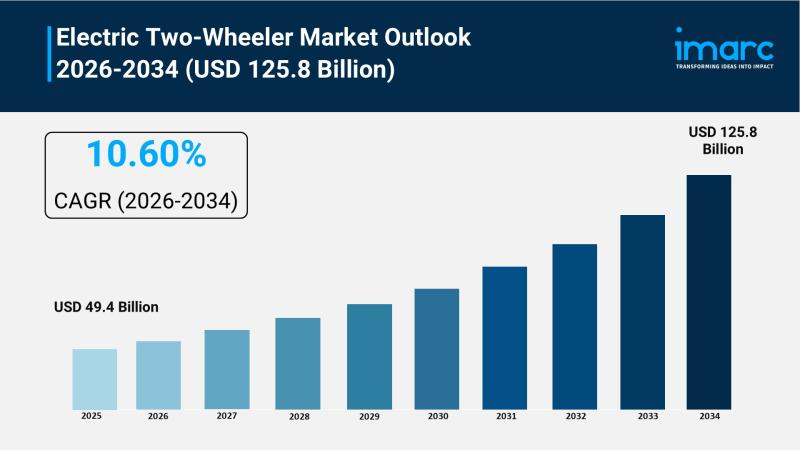
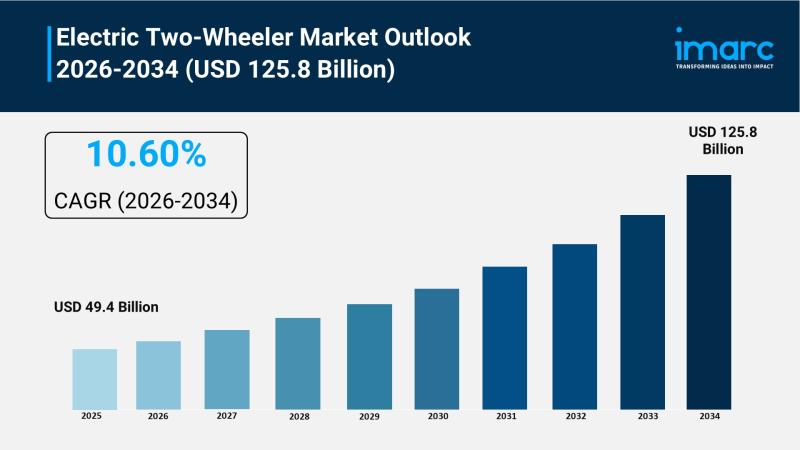
According to IMARC Group’s latest research publication, “Electric Two-Wheeler Market: Global Industry Trends, Share, Size, Growth, Opportunity and Forecast 2026-2034”, The global electric two-wheeler market size was valued at USD 49.4 Billion in 2025. Looking forward, IMARC Group estimates the market to reach USD 125.8 Billion by 2034, exhibiting a CAGR of 10.60% during 2026-2034.
This detailed analysis primarily encompasses industry size, business trends, market share, key growth factors, and regional forecasts. The report offers a comprehensive overview and integrates research findings, market assessments, and data from different sources. It also includes pivotal market dynamics like drivers and challenges, while also highlighting growth opportunities, financial insights, technological improvements, emerging trends, and innovations. Besides this, the report provides regional market evaluation, along with a competitive landscape analysis.
How AI is Reshaping the Future of Electric Two-Wheeler Market
● AI-driven battery management systems predict charge cycles and optimize energy distribution in real-time, extending battery life by up to 30% and reducing maintenance costs for fleet operators through intelligent monitoring of temperature, voltage, and usage patterns across thousands of vehicles.
● Machine learning algorithms analyze sensor data from motors, drivetrains, and critical components to flag potential failures before breakdowns occur, helping manufacturers cut warranty claims by 25% and reducing service downtime by 40%, significantly improving vehicle reliability and customer satisfaction.
● AI-powered navigation tools process live traffic, weather, and delivery data to enable electric two-wheeler fleets to reduce energy consumption per route by up to 20% compared to traditional routing, while predictive analytics optimize charging schedules based on route demands and energy availability patterns.
● Advanced computer vision systems integrated with electric two-wheelers enable features like collision detection, lane departure warnings, and adaptive cruise control, with AI algorithms processing camera feeds in real-time to enhance rider safety and reduce accident rates by 35% in urban environments.
● Personalized riding experience optimization through AI analyzes individual rider behavior, terrain conditions, and weather patterns to automatically adjust power delivery, regenerative braking, and suspension settings, improving energy efficiency by 15% while enhancing comfort and performance across diverse riding conditions.
Download a sample PDF of this report: https://www.imarcgroup.com/electric-two-wheeler-market/requestsample
Key Trends in the Electric Two-Wheeler Market
● Explosive Electric Vehicle Adoption: Global EV sales reached 10 million units in 2022, reflecting 55% growth from 2021, with the International Energy Agency projecting electric two/three-wheelers will account for a third of all sales by 2030 in Southeast Asia, marking a pivotal shift toward sustainable urban transportation driven by environmental awareness and government support.
● Advanced Battery Technology Revolution: Innovations in battery design including silicon anode, lithium-sulfur, and solid-state technologies offer quicker charging times and extended durability. Yadea’s 2025 launch of sodium-ion battery technology demonstrates industry commitment to improving energy density, charging speed, and overall longevity, making electric two-wheelers more practical for everyday use.
● Government Incentives and Policy Support: India’s PM E-Drive scheme allocates Rs 10,900 crore to support 2.48 million electric two-wheelers, triggering 8.2% surge in EV manufacturer share prices. Delhi’s draft EV Policy 2.0 proposes subsidies up to ₹36,000 for women buyers, while the U.S. allocated $521 million in federal grants expanding EV charging networks across 29 states.
● Urban Congestion Driving Adoption: Traffic congestion costs urban economies an average of 1% of GDP according to the International Transport Forum, with approximately 1 billion bicycles in use globally. Electric two-wheelers offer practical solutions for navigating crowded streets efficiently, reducing commuting times and alleviating frustrations associated with urban traffic congestion.
● Cycling for Fitness and Recreation: The rising popularity of cycling for health and recreational purposes, enhanced by electric assistance, encourages broader adoption. Electric two-wheelers allow riders to overcome physical limitations and tackle challenging terrains, making cycling accessible to individuals of varying fitness levels while promoting active lifestyles and outdoor exploration.
Growth Factors in the Electric Two-Wheeler Market
● Environmental Awareness and Emission Reduction: Growing consciousness about climate change and air pollution drives consumers to choose electric two-wheelers as cleaner transportation options. These vehicles produce zero tailpipe emissions, reduce air pollution levels, and contribute to greener urban environments, aligning perfectly with global sustainability goals and renewable energy transitions.
● Rising Fuel Prices and Economic Advantages: Escalating fuel costs make electric alternatives more economically attractive, with electric two-wheelers requiring less maintenance and having lower operating costs than conventional counterparts. Cost-effective charging (often under $1 per full charge) compared to gasoline expenses provides compelling financial incentives for daily commuters and fleet operators.
● Rapid Urbanization and Traffic Solutions: Increasing urban population density and traffic congestion favor compact, maneuverable two-wheelers for efficient city navigation. Electric scooters and motorcycles easily weave through traffic, find parking spaces more readily, and bypass long queues of stationary vehicles, reducing commuting times significantly in congested metropolitan areas.
● Charging Infrastructure Expansion: The Biden-Harris Administration’s $521 million investment deploying over 9,200 charging ports across 29 U.S. states demonstrates global commitment to EV infrastructure. Publicly available chargers doubled to over 192,000, with approximately 1,000 new chargers added weekly, addressing range anxiety and improving accessibility nationwide.
● Technological Advancements and Performance Improvements: Continuous innovations in motor efficiency, lightweight materials, improved aerodynamics, and smart connectivity features enhance overall vehicle performance. Advanced features including GPS navigation, theft prevention, smartphone integration, and over-the-air updates attract tech-savvy consumers seeking modern, connected transportation solutions.
Ask analyst of customized report: https://www.imarcgroup.com/request?type=report&id=2215&flag=E
Leading Companies Operating in the Global Electric Two-Wheeler Industry:
● AIMA Inc.
● Ather Energy Limited
● Bajaj Group
● BMW AG
● Greaves Electric Mobility Limited
● Helbiz
● Jiangsu Xinri E-Vehicle Co., Ltd
● Kawasaki Motors Corp., U.S.A
● Niu International
● Ola Electric Mobility Ltd
● TVS Motor Company
● Vmoto Limited
● Yadea Technology Group Co., Ltd
● Zero Motorcycles Inc.
Electric Two-Wheeler Market Report Segmentation:
Breakup By Vehicle Type:
● Electric Scooter/Moped
● Electric Motorcycle
Electric scooter/moped accounts for 86.4% of market share in 2025, driven by their versatility, ease of use, affordability, and practicality in urban environments for short to medium distance commuting.
Breakup By Battery Type:
● Lithium-Ion
● Sealed Lead Acid (SLA)
Sealed Lead Acid (SLA) dominates with 74.6% market share in 2025, owing to cost-effectiveness, widespread availability, robust design, easy recyclability, and reliable performance in standard conditions.
Breakup By Voltage Type:
● 96V
48-60V leads with 60.4% market share in 2025, representing mid-power electric two-wheelers that provide optimal balance between affordability, performance, speed capabilities, and increased range for urban commuting.
Breakup By Peak Power:
● 10 kW
Breakup By Battery Technology:
● Removable
● Non-Removable
Non-removable batteries account for 69.8% market share in 2025, offering streamlined design, enhanced security against theft, better integration, improved durability, and user convenience without carrying extra battery packs.
Breakup By Motor Placement:
● Hub Type
● Chassis Mounted
Breakup By Region:
● North America (United States, Canada)
● Asia Pacific (China, Japan, India, South Korea, Australia, Indonesia, Others)
● Europe (Germany, France, United Kingdom, Italy, Spain, Others)
● Latin America (Brazil, Mexico, Others)
● Middle East and Africa
Asia Pacific dominates with 97.3% market share in 2025, driven by growing environmental concerns, supportive government initiatives, significant battery technology advancements, and massive urbanization creating demand for efficient transportation solutions.
Recent News and Developments in Electric Two-Wheeler Market
● April 2025: Ampere Electric Scooters launched Ampere.AI, India’s first EV AI buddy, revolutionizing electric vehicle customer support with 24/7 real-time assistance offering accurate information on electric scooter range, pricing, specifications, dealer locations, and sustainability discussions through simple, user-friendly interface.
● March 2025: Microchip Technology launched comprehensive Electric Two-Wheeler (E2W) ecosystem featuring pre-validated reference designs accelerating development of e-scooters and e-bikes with automotive-grade solutions addressing power efficiency, advanced battery management, high-performance motor control, and connected user interfaces with cloud diagnostics.
● March 2025: Hero MotoCorp announced plans to invest up to INR 525 crore ($61 million) in Euler Motors, acquiring 32.5% stake through primary and secondary investments. Euler Motors operates in over 30 Indian cities with more than 500 charging hubs across major locations.
● March 2025: Yadea unveiled latest smart electric motorcycle Velax at Bangkok International Motor Show, featuring advanced technology including smart features and fast-charging capabilities, positioning as modern, eco-friendly option for urban mobility across Southeast Asian markets.
Note: If you require specific details, data, or insights that are not currently included in the scope of this report, we are happy to accommodate your request. As part of our customization service, we will gather and provide the additional information you need, tailored to your specific requirements. Please let us know your exact needs, and we will ensure the report is updated accordingly to meet your expectations.
About Us:
IMARC Group is a global management consulting firm that helps the world’s most ambitious changemakers to create a lasting impact. The company provide a comprehensive suite of market entry and expansion services. IMARC offerings include thorough market assessment, feasibility studies, company incorporation assistance, factory setup support, regulatory approvals and licensing navigation, branding, marketing and sales strategies, competitive landscape and benchmarking analyses, pricing and cost research, and procurement research.
Contact Us:
IMARC Group
134 N 4th St. Brooklyn, NY 11249, USA
Email: sales@imarcgroup.com
Tel No:(D) +91 120 433 0800
United States: +1-201-971-6302
This release was published on openPR.