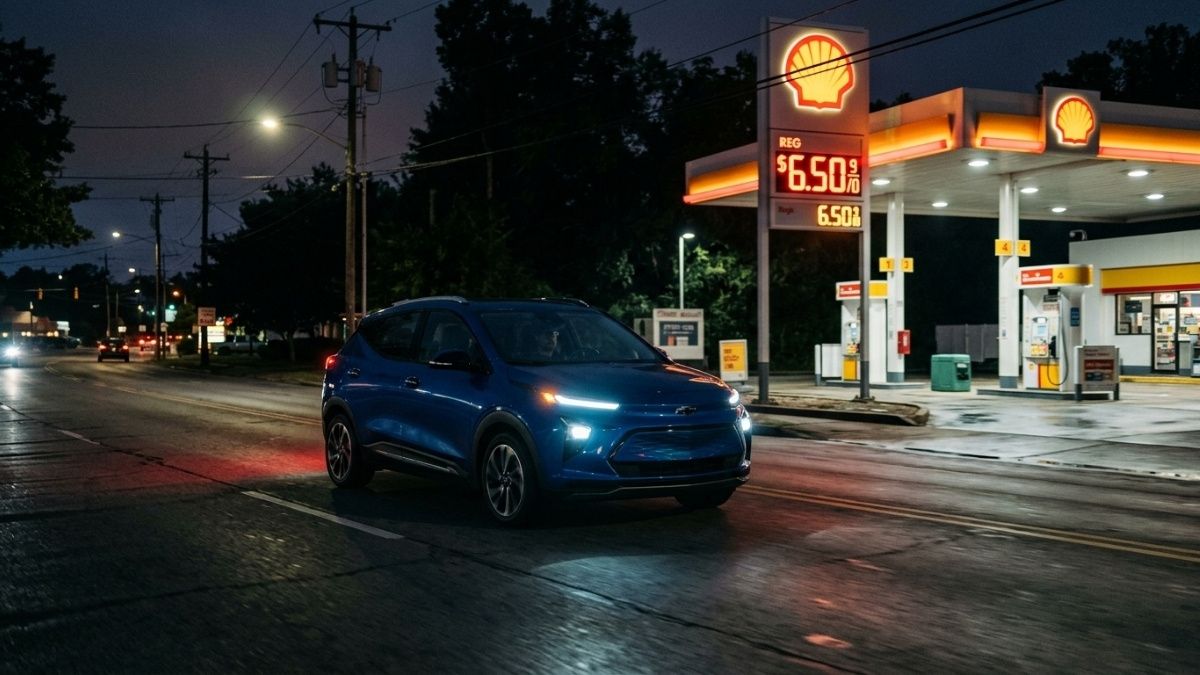
Back when I was working at IBM in the 1980s, we learned a brutal lesson about market disruption: if you abandon the entry-level market because the margins are too thin, a hungrier competitor will happily use that foothold to eventually destroy your core business. The automotive industry is currently staring down the barrel of that exact same dynamic. As legacy automakers pivoted almost entirely to massive, six-figure electric trucks and luxury SUVs, they left the affordable commuter segment wide open.
Now, General Motors is attempting to correct that strategic error with the 2027 Chevrolet Bolt. Starting at an estimated $28,995, equipped with durable Lithium Iron Phosphate (LFP) batteries, and featuring a native NACS (Tesla) charge port, this revamped hatchback is being hailed as the “affordable savior” of the U.S. market. But is it too little, too late?
The Rocky History of the Chevrolet Bolt
To understand the importance of the new Bolt, you have to look at the turbulent history of the original. Launched for the 2017 model year, the first-generation Bolt was a pioneer. It offered over 230 miles of range for a relatively reasonable price long before the Tesla Model 3 hit mass production. It was a brilliant piece of engineering that proved GM could build a compelling, everyday electric vehicle.
Unfortunately, the narrative was hijacked by a catastrophic battery defect. Sourced from LG Energy Solution, a rare combination of manufacturing flaws—specifically a torn anode tab and a folded separator—caused a series of battery fires. This triggered a massive, billion-dollar recall covering every single Bolt EV and EUV manufactured between 2017 and 2022. GM was forced to halt production, implement software limitations, and eventually replace entire battery modules. The Bolt name was heavily tarnished, and GM unceremoniously killed the platform to make room at its Orion assembly plant for the Silverado EV. It seemed the Bolt was dead forever.
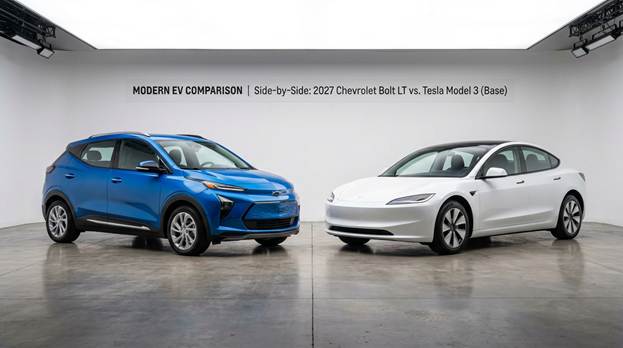
How the 2027 Bolt Stacks Up Against the Competition
Fast forward to today, and the 2027 Chevrolet Bolt is back, built on updated architecture that promises to right the wrongs of the past. GM has ditched the problematic older pack designs for a 65 kWh LFP battery. LFP chemistry is cheaper, significantly less prone to thermal runaway, and allows owners to routinely charge to 100% without degrading the pack over time.
In the current market, this new Bolt is positioned brilliantly. If you look at 2026’s most anticipated electric vehicles, there is a glaring lack of sub-$30,000 options. The Nissan Leaf is still hobbled by the outdated CHAdeMO charging standard and poor thermal management. The upcoming Chevrolet Equinox EV is fantastic, but it plays in a higher price bracket. Even the cheapest Tesla Model 3 still commands a premium over the Bolt. By including the NACS port straight from the factory, the 2027 Bolt instantly gains access to the flawless Tesla Supercharger network, completely neutralizing the charging anxiety that previously deterred budget EV buyers.
The 2026 Global Oil Shortage and the Bolt’s Perfect Timing
Timing is everything in the auto industry, and the Bolt’s return coincides with a severe macroeconomic tailwind: the 2026 global oil shortage. With the ongoing conflict in Iran and massive disruptions to shipping through the Strait of Hormuz, we are seeing crude oil prices sustain levels well over $100 a barrel.
Living in Bend, Oregon, where driving long distances for basic amenities or outdoor recreation is just a fact of life, the pain at the pump is palpable. When fuel prices spike aggressively, consumer interest in EVs skyrockets. However, the average family struggling with expensive gasoline cannot simply go out and buy a $70,000 luxury electric SUV to solve their fuel crisis. The economic math doesn’t work. The 2027 Bolt, starting under $29k, offers an immediate, mathematically sound escape hatch from the fossil fuel trap. It is exactly the right product for an economy desperate for relief from volatile energy markets.
Who Should Consider Buying a Chevrolet Bolt?
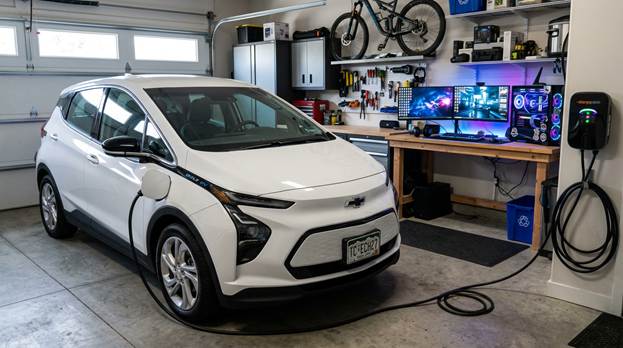
The Bolt is not designed to be a cross-country road-trip warrior, though its 150 kW DC fast-charging capability makes occasional trips viable. Instead, it is the ultimate utility player.
Anyone with a predictable daily commute should have the Bolt at the top of their list. It is also the perfect secondary household vehicle. When we recently looked at upgrading my wife’s daily driver, we skipped the gas pumps entirely and ordered the new Volvo EX60 because the advanced EV tech and premium features make sense for a primary family hauler. But for running quick errands, picking up groceries, or tackling the daily grind to the office, you don’t need a premium midsize SUV. The Bolt’s 255-mile range and remarkably spacious interior make it an incredibly pragmatic choice for first-time EV buyers, young professionals, and two-car households looking to slash their operational costs.

The Chinese EV Threat: Can GM Hold the Line?
While the Bolt is a strong domestic play, the elephant in the room is China. Companies like BYD, MG, and Zeekr are manufacturing EVs at a scale and cost that western automakers simply cannot match right now.
The BYD Seagull is the ultimate clarion call. It is a highly capable, well-built compact EV that sells for roughly $10,000 to $12,000 in its domestic market. It achieves this through ruthless vertical integration—BYD makes its own LFP batteries, its own motors, and almost every sub-component of the vehicle. While heavy 100% tariffs currently protect the U.S. market from the Seagull and cars like the European-market MG4, these barriers will not hold forever. Chinese automakers will inevitably establish manufacturing footprints in Mexico or elsewhere to bypass tariffs.
Is GM doing enough? Barely. The Bolt is a defensive maneuver. If BYD manages to bring a federalized version of the Seagull or the Dolphin to the U.S. market for under $20,000, even the $29,000 Bolt will suddenly look expensive. GM needs to be acutely worried about BYD’s aggressive global expansion and Xiaomi’s rapid iteration in the smart-vehicle space.
What GM Should Be Doing Given Global Trends
To survive the impending Chinese wave and capitalize on the current oil crisis, GM must radically alter its development strategy.
First, they must fully embrace vertical integration. I still build a couple of desktop PCs a quarter as a summer project, and the sheer efficiency of owning and controlling exactly how standard components interface is undeniable. GM needs to stop relying on fractured supply chains and third-party software vendors. The software-defined vehicle requires a unified, stable architecture, much like a well-built workstation.
Second, GM needs to leverage its Ultium platform to aggressively drive down battery costs. LFP chemistry is a great start, but they need to scale it domestically to secure critical mineral independence. Finally, while the Bolt is a great pure EV, GM should intelligently deploy plug-in hybrids (PHEVs) across their heavier truck lines as a bridge technology until solid-state batteries mature. The market needs affordable, functional tech right now, not just massive screens slapped into heavy, expensive chassis.
Wrapping Up
The automotive landscape is shifting faster than it has in a century. Battered by the legacy of battery fires and the looming specter of a Chinese market invasion, General Motors is betting heavily on a familiar nameplate.
The 2027 Chevrolet Bolt is a testament to the idea that practicality still matters. By pairing an affordable starting price with a durable LFP battery and standard NACS compatibility, GM has created a highly compelling lifeboat for consumers drowning in the 2026 oil shortage. While it remains to be seen if GM can scale production fast enough to permanently fend off companies like BYD, the new Bolt is exactly the right car at exactly the right time. It is affordable, it is proven, and it is a necessary step toward true electric independence.
Disclosure: Images rendered by Artlist.io
Rob Enderle is a technology analyst at Torque News who covers automotive technology and battery developments. You can learn more about Rob on Wikipedia and follow his articles on TechNewsWord, TGDaily, and TechSpective.
Follow us today…