Tesla published on Thursday its first-quarter delivery estimates based on Wall Street consensus, one week before it is set to report the number of EVs manufactured and delivered in the first three months of 2026.
According to the consensus from 23 sell-side analysts, Tesla is expected to report 365,645 vehicles delivered between January and March.
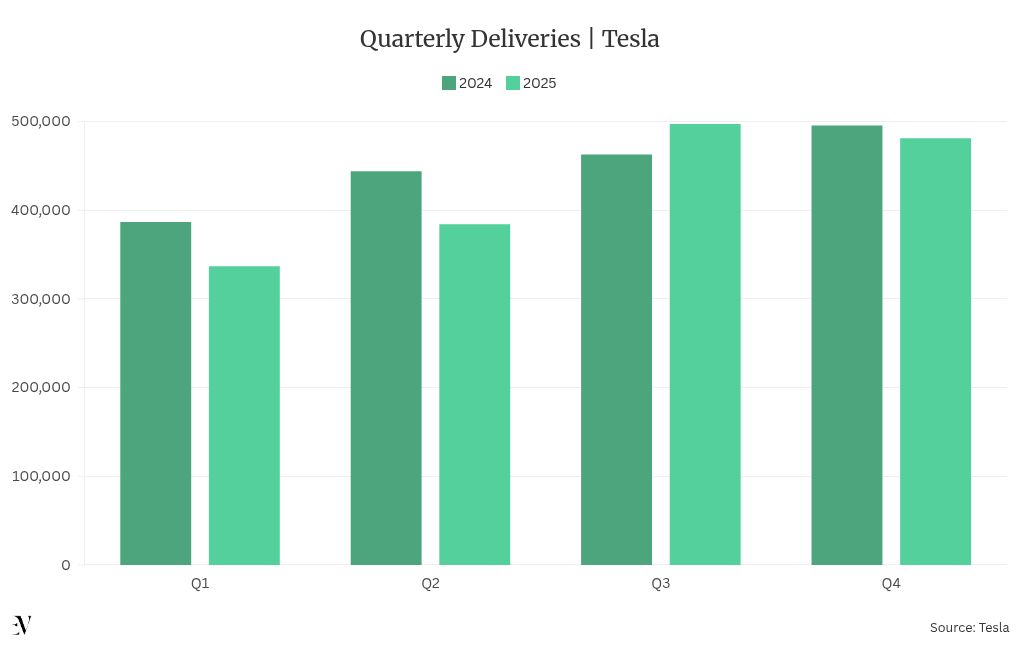
The figures imply an 8% increase from the 336,681 units delivered a year ago, when Tesla was transitioning to the new iteration of the Model Y — the world’s best-selling vehicle in 2025 across all powertrains, according to Musk.
Sequentially, the consensus implies a 24.0% drop.
Tesla is expected to disclose global figures for the first quarter on April 2 — including energy deployment.
Analysts expect 351,179 of these vehicles to be Model 3 and Model Ys, with all other models — including the Model S, Model X and Cybertruck — accounting for 13,946 units.
In the final quarter of 2025, deliveries of the three models stood at 11,642 vehicles. The consensus for the January-March period represents a 19.8% sequential increase.
In January, Tesla announced it would stop producing the Model S and Model X as it shifts its manufacturing lines to the Optimus humanoid robot.
The company expects to only produce autonomous vehicles and the second generation of the Roadster model — for which the unveiling is expected in “late April” — in the future.
Additionally, it introduced a more affordable version of the Cybertruck pick-up last month — priced from $59,990 for the first ten days, then increased to $69,990 — as it aimed to increase demand for the model.
Yearly Estimates
The estimates published by Tesla show that analysts are expecting its deliveries to reach 1,689,691 vehicles in the full-year 2026.
If achieved, the figures would represent a 3.3% increase from the 1,636,129 units delivered in 2025.
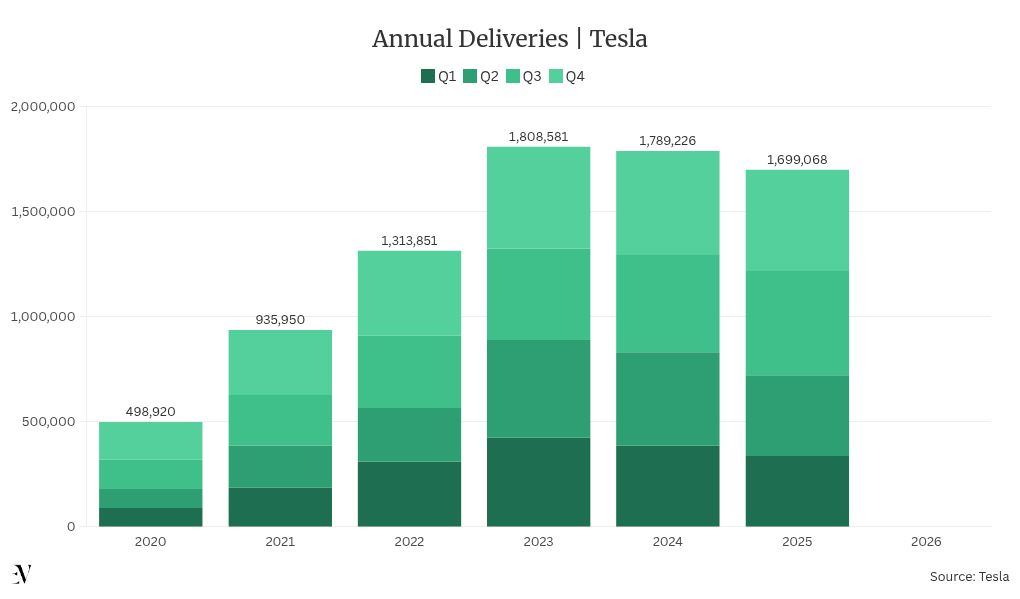
Last year, Tesla‘s sales were impacted by the production disruption caused by the global transition to the new Model Y, alongside increased competition from Asian manufacturers in the EV segment.
The expiration of the $7,500 federal EV tax credit last September drove sales to an all-time quarterly record in the third quarter, and then to a steep decline in the fourth quarter — going against the industry’s typical pattern of it being the strongest period of the year.
Last year marked the second consecutive year of sales decline for Tesla, after peaking in 2023 with over 1.8 million vehicles delivered.
Based on the 2026 delivery consensus, the first quarter is estimated to account for just 21.6% of its deliveries this year.
Wall Street is forecasting a modest growth to Tesla‘s sales increase in the following two years.
The consensus shows estimates of 1.69 million vehicles in 2026, 1.89 million in 2027 (+200,000 units), 2.13 million in 2028 (+200,000).
In 2029, the company expects sales to jump by 400,000 units year over year and to reach 3 million vehicles in 2030.
However, only 13 of the 23 analysts provided estimates for the final two years of the decade.
Prior Estimates
The company began sharing the compilated figures on its investor relations website in the final quarter of 2025.
Such figures were previously shared only with analysts and often leaked on social media.
Estimates have shifted since the final quarter of 2025 — as developments related to vehicle production and the timeline for the upcoming Roadster have changed the outlook for Tesla.
At the time, analysts already expected a return to growth in 2026.
However, they had forecast a higher figure of 1,750,243 vehicles, representing a 7.0% rise.
Estimates for the upcoming years saw 2,010,459 vehicle deliveries in 2027, 2,350,451 in 2028, and 3,019,902 in 2029.