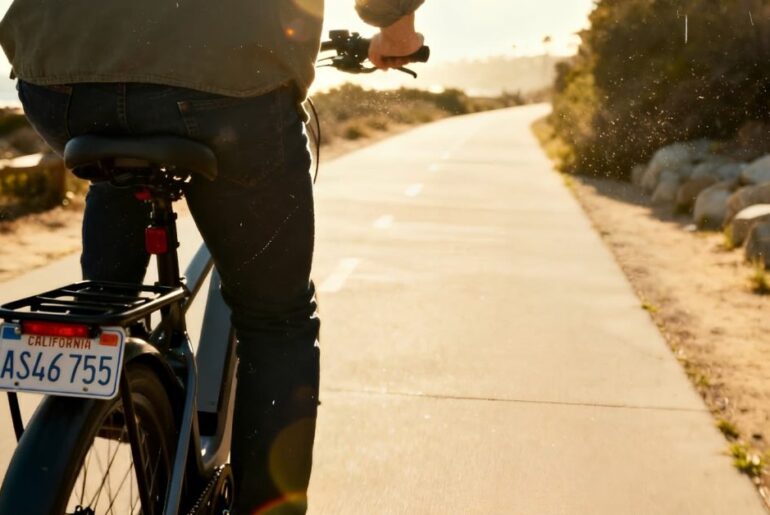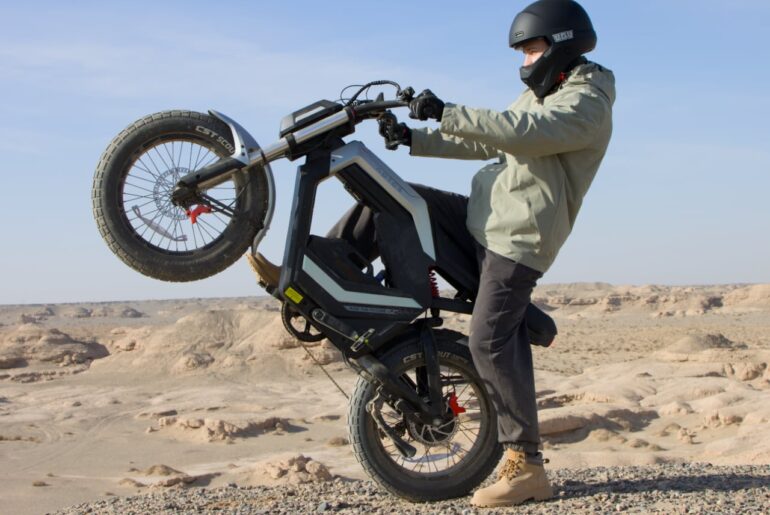
U.S. Rep. Jared Huffman has co-authored a bipartisan bill for tighter federal regulations on electric bicycles, electric motorcycles and other small, electric-powered vehicles.
Huffman and three other lawmakers introduced the bill, called the Safe Standards for Personal E-bike and E-moto Device Specifications Act, or the Safe SPEEDS Act.
“I just don’t want to see something tragic happen when we can hopefully save some lives and keep people safe with common sense standards,” said Huffman, a Democrat from San Rafael.
“It’s not in any way a concern about the technology,” he said. “E-bikes are amazing. I see the incredible benefits of this technology, but we really need guardrails.”
Federal consumer standards for e-bikes have been mostly unchanged since 2002, despite the rise in injuries and young riders being hospitalized, the bill’s proponents said.
The U.S. Consumer Product Safety Act was amended 24 years ago to define e-bikes as low-speed vehicles that are pedal-operated, powered by a 750-watt motor that assists the vehicle up to 20 mph. However, federal regulations don’t apply to the operation of e-bikes, which are instead regulated by states.
The Safe SPEEDS Act calls for the U.S. Consumer Product Safety Commission to create new product safety standards on classifying e-bikes and other “electric micromobility devices.” The bill also wants the commission to create labeling requirements for vehicles and set minimum age recommendations for riders.
The bill would require the commission to conduct studies on crashes, injuries and deaths related to e-bikes and e-motorcycles by vehicle class.
Rep. David Min, a Democrat whose district is in Orange County, was a co-author.
“The lack of oversight regarding e-bikes pose serious safety risks to our children and our communities,” Min said.
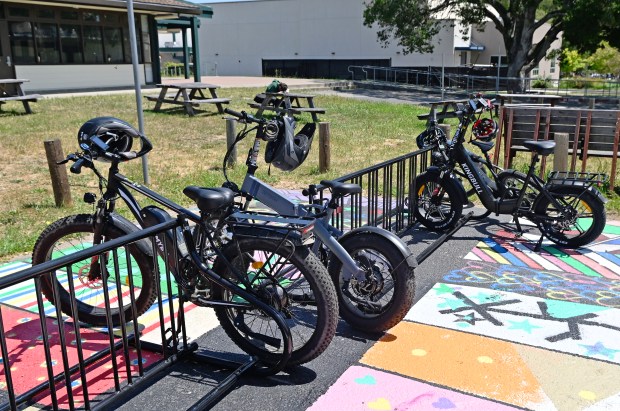 E-bikes occupy a parking rack at San Marin High School in Novato, Calif., on Thursday, May 1, 2025. (Alan Dep/Marin Independent Journal)
The bill was announced nearly a year after Assembly Bill 1778, by Assemblymember Damon Connolly of San Rafael, went into effect in Marin County. AB 1778 created a voluntary pilot program that implemented new age restrictions on class 2 e-bikes within the county.
California law defines class 2 e-bikes as throttle bicycles designed to assist the vehicles up to 20 mph.
Eleven Marin municipalities adopted AB 1778 regulations that prohibit youths under 16 from riding class 2 e-bikes and also require class 2 riders of all ages to wear helmets.
Class 1 e-bikes are pedal-assisted vehicles that are limited to 20 mph. Class 3 e-bikes are also pedal-assisted, but can travel up to 28 mph. State law does not allow riders under age 16 to operate class 3 e-bikes.
In 2024, Connolly told the state Senate Transportation Committee about his interest in new regulations on class 2 e-bikes.
“With a simple thumb push on a handle, a class 2 e-bike can go from 0 to 20 mph in just about 10 seconds,” he said. “While class 2 e-bikes are regulated to go no more than 20 mph, too often they are modified by users to go to a higher speed.”
Connolly also noted that reported injuries from e-bike incidents are similar to injuries suffered from high-speed vehicle crashes.
Under AB 1778, Marin County is required to report data on traffic stops and citations for e-bike law violators to the state Legislature by 2028.
The Marin County Health and Human Services Department reports data on injuries and crashes related to e-bikes and conventional bicycles. Since 2023, the county has recorded 187 e-bike crashes, or 27% of all bicycle crashes. In the same period, 57 e-bike cases involved riders ages 10 to 15.
Huffman helped introduce the Safe SPEEDS Act at a time when bicycle safety advocates continue to raise concerns over motorized, two-wheeled vehicles that are illegally altered to break state regulations.
Last year, a review funded by the Transportation Authority of Marin and conducted by E-Bike Access and Safe Routes to Schools examined 277 bicycles parked at 12 middle and high schools in the county.
The study discovered that 37 of the vehicles followed state requirements. The remaining bikes exceeded state regulations on engine power and potential speed.
Marin County Supervisor Mary Sackett said the Safe SPEEDS Act will bring “much needed clarity” to the e-bike industry.
“Federal consumer product safety standards for e-bikes and e-motos are currently nonexistent, resulting in confusion and the inadvertent purchasing of e-motos for young riders,” she said.
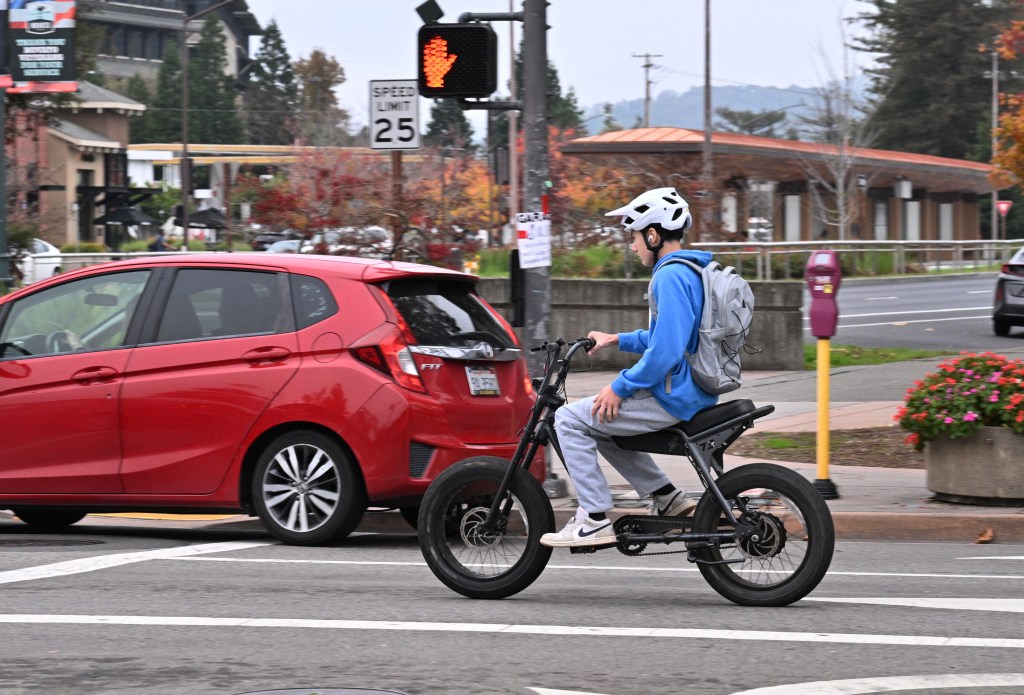
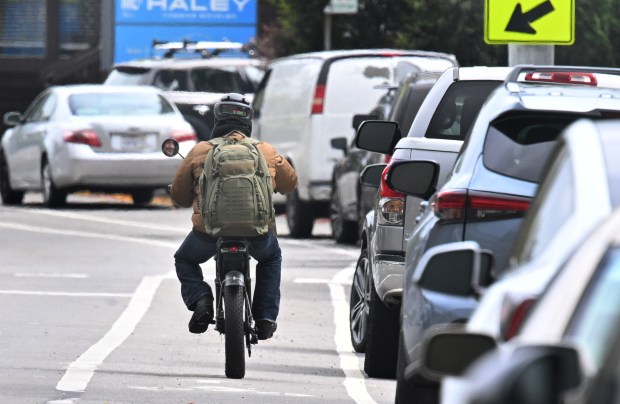 A rider on a electric bike travels on Sir Francis Drake Boulevard in Kentfield, Calif., on Wednesday, March 26, 2025. (Sherry LaVars/Marin Independent Journal)
The Marin County Bicycle Coalition also supports the bill.
“To this point, e-bike regulations have been left to the states, which resulted in a patchwork of laws across the country,” said Warren Wells, the organization’s policy and planning director. “Federal regulation, as well as improved data collection, will ensure that consumers are riding legal e-bikes rather than illegal and dangerous e-motos, and will provide insights into the safety needs for riders.”
Dr. John Maa, a Marin County surgeon who has treated patients who sustained injuries in e-bike crashes, has a mixed view on the bill. He said the bill is “directionally correct,” but more needs to be done.
Maa said the U.S. Consumer Product Safety Commission should end the deceptive sales of “overpowered devices” that enable riders to exceed the vehicle’s specifications.
He also argued that Congress should redefine e-bikes as motorized vehicles, move oversight on e-bikes to the U.S. Department and Transportation and reduce motor power.
Huffman said his bill has bipartisan support in Washington, which improves its chances of getting a hearing.
“Things don’t move quickly in any Congress, and in this Congress it’s even slower and harder to move things,” he said. “But this is the beginning of what will hopefully culminate, in this Congress or the next one, in some positive change at the federal level.”