The automotive industry is undergoing one of the most transformative periods in its history. As governments, consumers, and corporations align toward sustainability, the demand for cleaner transportation solutions is accelerating at an unprecedented pace. Among the many innovations shaping this transition, plug-in hybrid electric vehicles (PHEVs) have emerged as a critical bridge between traditional internal combustion engines and fully electric vehicles.
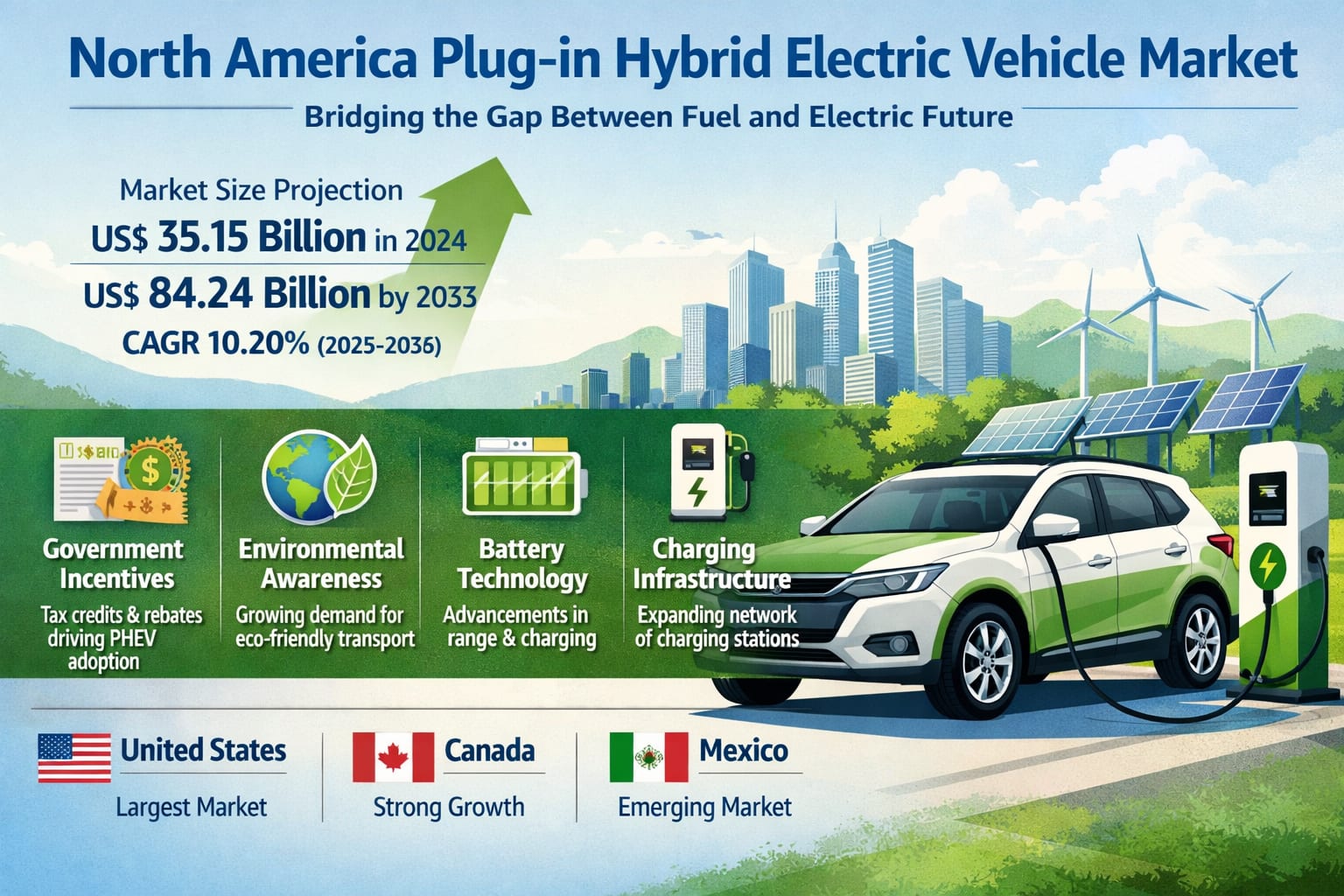
According to Renub Research, the North America Plug-in Hybrid Electric Vehicle Market is projected to grow significantly, reaching US$ 84.24 billion by 2033 from US$ 35.15 billion in 2024, expanding at a compound annual growth rate (CAGR) of 10.20% from 2025 to 2033 . This robust growth highlights the increasing relevance of PHEVs as both a transitional and practical solution for consumers navigating the shift toward electrification.
Understanding Plug-in Hybrid Electric Vehicles
Plug-in hybrid electric vehicles combine two power sources: a conventional internal combustion engine and an electric motor powered by a rechargeable battery. Unlike traditional hybrids, PHEVs can be charged externally via electric outlets, allowing them to operate in fully electric mode for shorter distances.
This dual-power capability offers a unique advantage. Drivers can rely on electric power for daily commutes while retaining the flexibility of gasoline for longer trips. This reduces range anxiety—a common concern with fully electric vehicles—while still lowering emissions and fuel consumption.
Another notable feature of PHEVs is regenerative braking. During braking, the electric motor captures energy that would otherwise be lost and converts it into electricity, recharging the battery. This enhances efficiency and further supports sustainable driving.
Market Drivers Fueling Growth
1. Government Incentives and Policy Support
Government support remains one of the most powerful catalysts for PHEV adoption across North America. Federal and state-level incentives, including tax credits, rebates, and subsidies, significantly reduce the upfront cost of purchasing these vehicles.
Policies aimed at reducing carbon emissions—such as stricter fuel efficiency standards and investments in clean energy infrastructure—are also encouraging both consumers and automakers to shift toward electrified mobility. These initiatives are not only making PHEVs more accessible but also creating a favorable ecosystem for long-term market growth.
2. Rising Environmental Awareness
Consumers today are increasingly aware of the environmental impact of their choices. Transportation is a major contributor to greenhouse gas emissions, and many individuals are actively seeking ways to reduce their carbon footprint.
PHEVs offer a practical solution by enabling partial or complete electric driving for short distances. This hybrid approach appeals to environmentally conscious buyers who are not yet ready to fully commit to electric vehicles but still want to make a meaningful impact.
As sustainability becomes a mainstream priority, the demand for PHEVs continues to rise, reinforcing their role in the broader clean energy transition.
3. Advancements in Battery Technology
Technological improvements are significantly enhancing the performance and appeal of PHEVs. Modern batteries are more efficient, durable, and capable of delivering longer electric-only ranges compared to earlier models.
In addition, ongoing innovation is reducing battery costs, making PHEVs more affordable for a wider audience. Improved energy density and faster charging capabilities are also contributing to a better overall driving experience.
These advancements are not only boosting consumer confidence but also encouraging automakers to expand their electrified portfolios.
4. Expanding Charging Infrastructure
The growth of charging infrastructure across North America is another key factor driving PHEV adoption. Public and private investments are increasing the availability of charging stations, making it easier for drivers to recharge their vehicles.
While PHEVs are less dependent on charging infrastructure than fully electric vehicles, the availability of convenient charging options enhances their usability and appeal. This is particularly important in urban areas where daily commuting distances are well within the electric range of most PHEVs.
5. Increased Automaker Investment
Major automotive manufacturers are investing heavily in electrification, and PHEVs are a significant part of their strategy. Companies are introducing a wider range of models across different price segments, including SUVs, sedans, and compact cars.
This diversification ensures that PHEVs cater to various consumer preferences, from budget-conscious buyers to luxury enthusiasts. As more models enter the market, competition intensifies, leading to better features, improved performance, and competitive pricing.
Challenges Facing the Market
Despite their advantages, PHEVs are not without challenges.
Limited Electric-Only Range
One of the primary limitations of PHEVs is their relatively short electric-only driving range compared to fully electric vehicles. For some consumers, especially those with longer daily commutes, this may reduce the perceived benefits of switching to a hybrid system.
If drivers do not regularly charge their vehicles, they may rely more on gasoline, diminishing the environmental advantages.
Competition from Fully Electric Vehicles
The rapid rise of fully electric vehicles (EVs) presents strong competition for PHEVs. EVs offer zero tailpipe emissions and increasingly longer driving ranges, making them an attractive option for environmentally conscious consumers.
As battery technology continues to improve and charging infrastructure expands, EVs are becoming more accessible and practical. This shift may lead some buyers to skip PHEVs altogether in favor of fully electric alternatives.
Country-Level Insights
United States
The United States remains the largest market for PHEVs in North America. Strong government incentives, growing environmental awareness, and a wide range of available models are driving adoption.
Consumers are increasingly drawn to the flexibility of PHEVs, especially in regions where charging infrastructure is still developing. While challenges such as competition from EVs persist, ongoing technological advancements and policy support are expected to sustain market growth.
Canada
Canada is experiencing significant growth in the PHEV market, supported by provincial incentives and federal programs like the Incentives for Zero-Emission Vehicles (iZEV).
Regions such as British Columbia and Quebec are leading the adoption due to favorable policies and strong environmental commitments. As Canada continues to prioritize emission reduction, PHEVs are playing a crucial role in achieving national sustainability goals.
Mexico
Mexico’s PHEV market is also gaining momentum, driven by increasing environmental awareness and supportive government initiatives. Urban areas, particularly Mexico City, are witnessing higher adoption rates due to incentives such as tax benefits and reduced registration costs.
The introduction of new models and improvements in charging infrastructure are further strengthening the market. As Mexico continues its transition toward greener transportation, PHEVs are expected to remain a key component of this shift.
Market Segmentation Overview
The North America PHEV market can be segmented based on vehicle class, car type, and country.
By Vehicle Class:
Low-priced
Mid-priced
Luxury
By Car Type:
SUVs
MPVs & Vans
Midsize & Large Cars
Small & Compact Cars
By Country:
United States
Canada
Mexico
Rest of North America
This segmentation highlights the diversity of the market and its ability to cater to a wide range of consumer needs.
Competitive Landscape
The competitive landscape of the North American PHEV market is characterized by the presence of both established automotive giants and emerging players. Companies are focusing on innovation, strategic partnerships, and product diversification to gain a competitive edge.
Key players include:
Nissan North America, Inc.
Tesla
Ford Motor Company
BMW Group
General Motors Company
Toyota Motor North America, Inc.
BYD Company Ltd.
Mercedes-Benz USA
These companies are continuously investing in research and development to enhance vehicle performance, improve battery technology, and expand their electrified portfolios.
The Road Ahead: A Balanced Transition
The future of the North America Plug-in Hybrid Electric Vehicle Market lies in its ability to balance practicality and sustainability. While fully electric vehicles represent the ultimate goal of zero-emission transportation, PHEVs offer a realistic and accessible pathway for millions of consumers.
They address key concerns such as range anxiety, infrastructure limitations, and affordability, making them an essential part of the transition toward cleaner mobility.
As governments continue to implement supportive policies and automakers push the boundaries of innovation, the PHEV market is poised for sustained growth. The projected increase to US$ 84.24 billion by 2033 underscores the strong demand and long-term potential of this segment .
Final Thoughts
Plug-in hybrid electric vehicles are more than just a temporary solution—they are a strategic stepping stone in the journey toward a sustainable future. By combining the reliability of traditional engines with the efficiency of electric power, PHEVs provide a practical and scalable approach to reducing emissions.
For consumers, they offer flexibility and peace of mind. For governments, they represent progress toward environmental targets. And for the automotive industry, they serve as a critical link in the evolution of mobility.