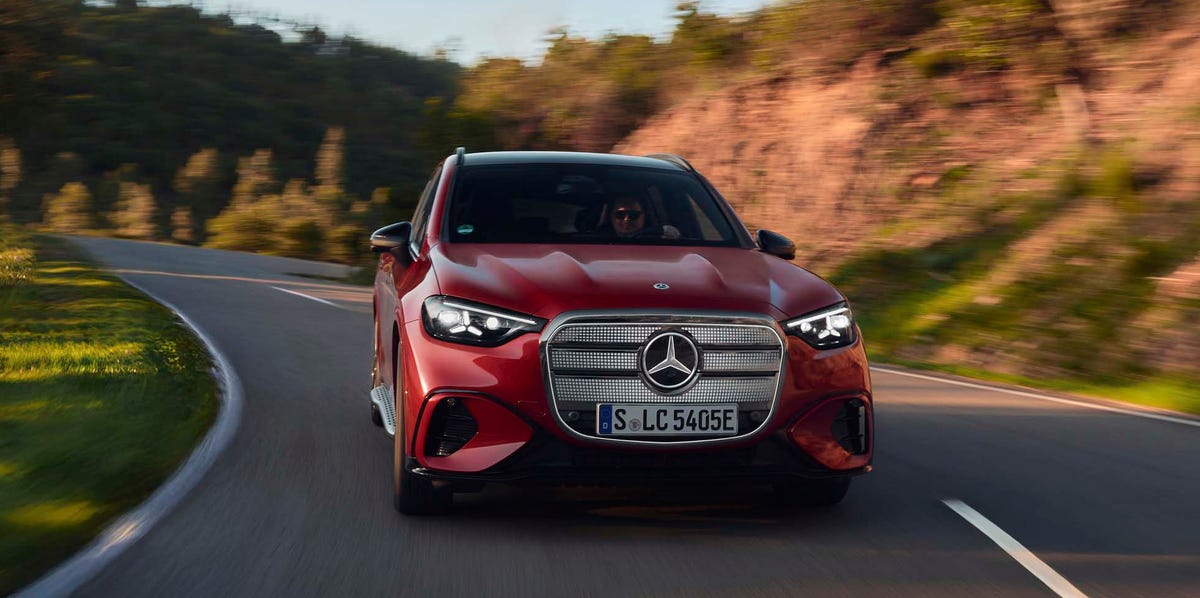
Mercedes-Benz is putting a stamp on its latest model in the form of an enormous grille. Never mind that this sucker is electric and doesn’t really need a gaping maw for the usual reasons; the GLC400 4Matic Electric proudly wears one just the same. The GLC400’s piehole harks back to 1959’s Mercedes-Benz W111, right down to the fine detailing, which in this case is an available matrix of small LEDs that light up in a startup sequence. It sounds corny, but the grille looks fantastic. There’s always room for a little flamboyance.
The rest of the GLC400 Electric (Benz finally ditched the “with EQ Technology” balderdash) flows back from this bit of rhinoplasty in a way that looks sleek. There are three-pointed DRLs in the headlights and power bulges on the hood. The roof arcs back and tapers down in somewhat of a teardrop shape, yet the front- and rear-seat passengers have ample head- and legroom far exceeding that of gas-powered GLC SUVs, even though the EV stands a measly 0.1 inch taller. That’s because the GLC Electric is on a whole new platform that’s 5.0 inches longer, with a wheelbase that’s been stretched by 3.9 inches to 117.0; there’s also an extra 0.9 inch in the hips. The standard glass panoramic roof helps with headroom too.
Under the floor, there’s a battery with 94 kWh of usable energy that comprises flat lithium-ion NMC cells assembled into four modules. The electronics that monitor the cells are located in a small compartment at the back of the pack and accessed from below, so any required work is divorced from the main part of the pack. It’s an 800-volt system, which not only gives it faster charging capabilities but also cuts down on the weight of the various cabling. According to Mercedes, the battery can ingest electrons at up to 330 kilowatts and go from 10 to 80 percent in just 22 minutes. It’ll be capable of NACS or CCS charging too, with the appropriate plug adapter. EPA-based range figures have not been released, but the GLC400 4Matic is said to be good for 715 kilometers of WLTP range, which suggests an EPA range of about 380 miles—we’ll see, but it’s promising.
A pair of permanent-magnet electric motors provides the motive power, with a combined output of 483 horsepower and 590 pound-feet of torque, good for a 60-mph dash in a conservative claim of 4.2 seconds. The rear one is the primary driver, making 402 horsepower and 369 pound-feet. It routes through a two-speed gearbox, extending its efficiency range closer to its 130-mph top speed. (They have autobahns in Germany, after all.) If you’re taking off from a rest, or accelerating, or simply existing in Sport mode, the single-speed front motor joins in with a maximum output of 215 horses and 221 pound-feet. The front unit takes less than a quarter-second to join the party, during which time it spools up to a synchronous speed before being clutched in.
More on the GLC EV
Indeed, the GLC felt very smooth and endlessly effortless on the highway. It pounced when given the beans, but there was never a hint of the front motor springing into action. It should prove especially interesting in our 75-mph range test, as the shifting from the 11:1 first gear to the 5:1 second gear happens around 55 mph. The front motor should be largely dormant during that test too.
Mercedes-Benz
Our GLC400 4Matic was equipped with the optional Agility & Comfort package, which includes an air-spring suspension, intelligent adaptive dampers, and rear-axle steering. The intelligence comes into play as you approach certain large obstacles that have been driven over by another Benz with the brand’s car-to-X communication, which relays position and severity information to the cloud. When your GLC arrives at said obstacle, the damping is switched to something more appropriate. All we know is that the ride was smooth and supple, and when we got to such a point, the car was quite agreeable. It’s impossible to say how much it helped take the edge off, but it does allow the engineers to tune the base damping more for the normal case, rather than the edge case. That’s a plus.
The thing is, the feeling in Comfort was not that different than in Sport. The anti-roll bars aren’t active, which explains part of it, but the steering feel didn’t tighten up much when we switched between modes. Yes, you can feel the road a bit more through the dampers, but the overall effect is fairly insignificant. That’s not a bad thing, though, because most of our running was in Comfort, even over the technical stuff that looked like a tarmac rally stage. The car didn’t lean over much—possibly because of the low-mounted battery—and it turned in with aplomb, which is a journalist’s word for something that is not quite sporty but very well mannered.
We were impressed with the brakes, as they had a consistently firm feel. But there’s more to it than that. There are three levels of regeneration, which we liked, plus an Auto setting, which we didn’t much like because you never knew how much regeneration you were going to get (in this environment, anyway). Better to choose one of the three fixed settings. D+ is no regeneration, D is normal recuperation, and D- is maximum recuperation. D- is a true one-pedal-drive setting, too, and the maximum recuperation rate of 300 kilowatts means you will rarely need to touch the brake pedal. We like D- for everyday usage, but when the road gets fun, it’s D for us. You choose your setting with the steering-wheel paddles, and the really cool part is that the car remembers your preference at the next startup.
Inside, the scene is pure comfort. The seats are well fashioned, and they come tailored in sumptuous nappa leather. Real open-pore wood, carbon fiber, and fine-looking metal accompany the soft hides. You can also opt for a fully vegan interior, which is certified by the cleverly named Vegan Society—a first in the industry. Some others use the term rather loosely, neglecting the various glues and dyeing agents in use, but this takes everything into account.
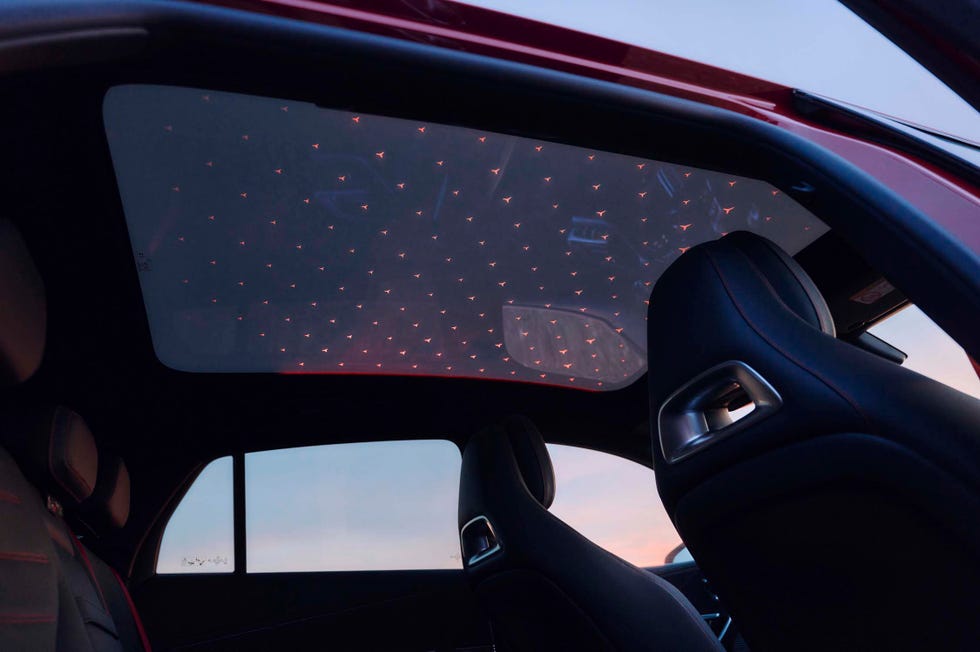
The (quite obvious) elephant in the room is the available 39.1-inch Hyperscreen, which stretches across the cabin from one climate vent to the other. It’s fantastic, no matter how much you want to hate it. For one, it’s not three separate screens (that would be the standard screen layout) but one large unbroken screen. Sure, the instruments float on one end, the infotainment hovers in the middle, and the passenger features appear at the far end, but it all seems integrated into a whole. You can choose various themes and tailor the ambient lighting to match in a way that’s dead simple. The standard panoramic roof can be optioned with 162 three-pointed Mercedes-Benz stars in matching ambient coloring, as well as Sky Control, which grants the ability to make the panel opaque across nine separate segments.
What’s more, the controls are very intuitive and placed in locations that seem to match function. The steering-wheel controls look familiar but have been entirely redone for greater simplicity. The voice controls are very powerful, thanks to a new MB.OS artificial-intelligence operating system, so you don’t feel like you’re talking at your car, but rather with it. “Can you up the temperature a couple of degrees?” It does it. The voice recognition can tell the passenger from the driver, so if the passenger makes a request to turn on the steering-wheel heater, it’ll politely decline, because they’re sitting in the wrong seat. Conversely, if the driver takes a peek at the passenger screen while that person is playing Angry Birds or watching a YouTube video, the operating system will pause the video, darken the screen, and politely remind the driver that they should be looking forward.
The 2027 Mercedes-Benz GLC400 4Matic Electric is coming to the U.S. in the second half of this year. The price hasn’t been announced yet, but seeing as how the EQE SUV just had a price cut, we think this one will come in at $63,000. A two-wheel-drive version will follow, but we don’t know the specs of that one yet. All we do know is that it’s plenty shouty, despite that mouth being mostly for show purposes.
➡️ Skip the lot. Let Car and Driver help you find your next car.
 Specifications
Specifications
2027 Mercedes-Benz GLC400 4Matic Electric
Vehicle Type: front- and rear-motor, all-wheel-drive, 5-passenger, 4-door wagon
PRICE (C/D EST)
Base: $63,000
POWERTRAIN
Front Motor: permanent-magnet synchronous AC, 215 hp, 221 lb-ft
Rear Motor: permanent-magnet synchronous AC, 402 hp, 369 lb-ft
Combined Power: 483 hp
Combined Torque: 590 lb-ft
Battery Pack: liquid-cooled lithium-ion, 94 kWh
Peak Charge Rate, AC/DC: 9.6/330 kW
Transmissions, F/R: direct-drive, 2-speed automatic
DIMENSIONS
Wheelbase: 117.0 in
Length: 190.7 in
Width: 75.3 in
Height: 64.7 in
Passenger Volume, F/R: 56/51 ft3
Cargo Volume, Behind F/R: 61/20 ft3
Front Trunk Volume: 5 ft3
Curb Weight (C/D est): 5200 lb
PERFORMANCE (C/D EST)
60 mph: 4.0 sec
100 mph: 12.2 sec
1/4-Mile: 12.7 sec
Top Speed: 130 mph
EPA FUEL ECONOMY (C/D EST)
Combined/City/Highway: 95/100/90 MPGe
Range: 380 mi

Dan Edmunds was born into the world of automobiles, but not how you might think. His father was a retired racing driver who opened Autoresearch, a race-car-building shop, where Dan cut his teeth as a metal fabricator. Engineering school followed, then SCCA Showroom Stock racing, and that combination landed him suspension development jobs at two different automakers. His writing career began when he was picked up by Edmunds.com (no relation) to build a testing department.