Originally launched as a startup focused on upcycling—that is, the high-value reuse of lithium-ion batteries—R3 Robotics has since evolved considerably. The company now automatically dismantles entire electric vehicles, including the powertrain, to recover critical raw materials for recycling.
By expanding its use of AI-driven robotics, computer vision, and adaptive tools beyond batteries to include electric motors, power electronics, and associated subsystems, R3 Robotics can now perform automated disassembly with the consistency and reliability required for continuous industrial operations.
This progress has also attracted investors: the company secured €20 million in funding. Of this, €14 million came from a Series A financing round led jointly by HG Ventures and Suma Capital, with an additional €6 million from European grants.
In the German Handelsblatt, co-founder and CEO Antoine Welter states: “Battery recycling and parts recovery have so far been expensive, labour-intensive, and manual processes.” However, R3 Robotics is betting on an extremely high degree of automation using robots: “On an industrial scale, there is no comparable provider worldwide,” Welter claimed.
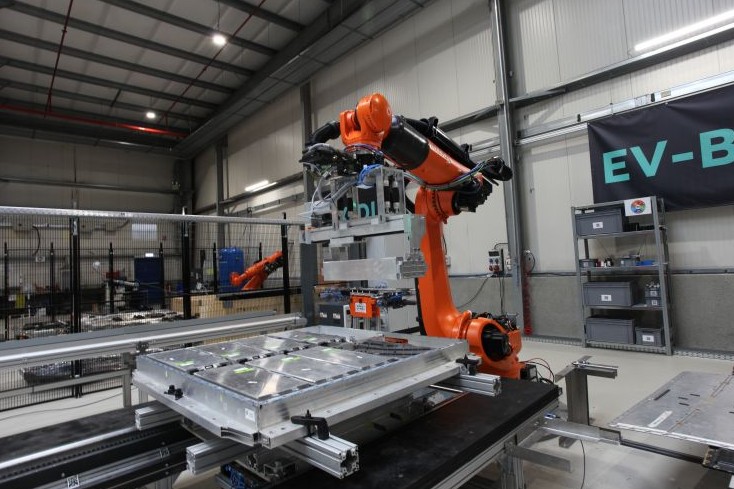
R3 Robotics relies on robots from Kuka—and its former CEO, Peter Mohnen, sits on the startup’s advisory board. “Automated disassembly at a high level of complexity represents one of the most challenging tasks in industrial robotics,” said Mohnen.
Pilot facilities in Karlsruhe and Luxembourg already use Kuka robots, among others. While demand may not yet be enormous, the market is steadily growing: R3 Robotics currently estimates there are more than 250,000 decommissioned electric vehicles in Europe, with that number expected to exceed one million by 2030.
“Our goal is the entire vehicle: battery, motor, every component, automatically dismantled and recovered. That is our massive opportunity,” said founder Welter.
handelsblatt.com (in German), linkedin.com