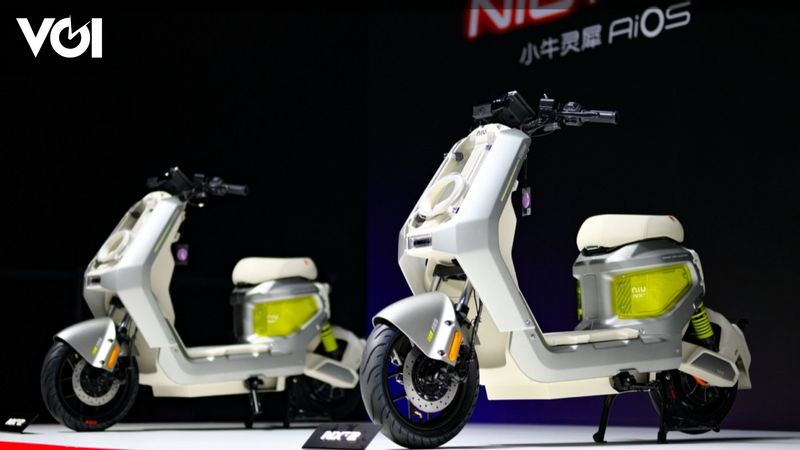
JAKARTA – Chinese lidar manufacturer Hesai officially partnered with Niu Technologies on March 18 to supply lidar sensors for electric two-wheel vehicles. This collaboration is an important milestone as it marks the expansion of lidar technology from passenger cars to the electric scooter and motorcycle segments.
Hesai revealed that the FTX solid-state lidar sensor for blind spot detection has been selected to improve the safety perception capability of Niu vehicles, especially in complex urban traffic conditions. This technology will be first embedded in the newly launched NXT2 model, as well as used on the high-performance electric motor NX2.
The announcement coincided with the launch of Niu’s latest product for 2026. On that occasion, the company also introduced NIU AIOS, an artificial intelligence-based operating system for two-wheeled vehicles, as well as showcasing a new model line supported by AI technology.
According to Hesai, FTX has a field of view of up to 180° × 140°, allowing the system to detect pedestrians, other vehicles, and increasingly complex road conditions in various weather conditions. The resolution of this sensor is claimed to have increased more than twice compared to the previous generation, while the weight has been reduced by 66 percent.
Reported by Carnewschina, Monday, March 23, the lidar sensor is designed to detect blind spots and close distances, including recognizing low obstacles that often go unnoticed. In Niu’s omnidirectional perception system, FTX is combined with the Sunrise series smart computing chip from D-Robotics to deliver more accurate and fast responses.
Niu CEO Li Yan, assessed that the complexity of urban traffic today makes a single perception solution no longer sufficient to meet the demands of safety and driving intelligence. Meanwhile, Hesai CEO Li Yifan, called this partnership a step towards a new standard in the industry, while paving the way for safer and smarter two-wheeled mobility.
One of the main factors driving the adoption of lidar to two-wheeled vehicles is a significant cost reduction. Hesai stated that the price of lidar has now dropped drastically from hundreds of thousands of yuan to about 200 US dollars thanks to chip integration and mass production, or shrunk by about 99.5 percent.
For comparison, a decade ago the price of similar lidars could exceed 300,000 yuan. Hesai also noted that the penetration rate of lidars in the Chinese passenger car market had reached 19 percent by the end of 2025, indicating that this technology is beginning to enter the mass adoption phase.
The cooperation with Niu is said to be the first large-scale integration of lidar in the electric two-wheeled vehicle sector. This development shows that lidar is no longer exclusive to premium electric vehicles or robotaxi fleets, but is beginning to penetrate consumer products at more affordable prices.
As one of China’s largest lidar suppliers, Hesai has supplied long-range sensors for various robotaxi programs such as Baidu, Pony.ai, WeRide, and Zoox. The partnership with Niu is proof that the decline in production costs opens up a much broader market opportunity, including in the two-wheeled vehicle segment.
Niu Technologies itself is known as a major player in two-wheeled electric vehicles from China that produces scooters, electric bicycles, and motorcycles. The company had tried to enter the electric car market in early 2020, but the effort did not continue.
The English, Chinese, Japanese, Arabic, and French versions are automatically generated by the AI. So there may still be inaccuracies in translating, please always see Indonesian as our main language.
(system supported by DigitalSiber.id)