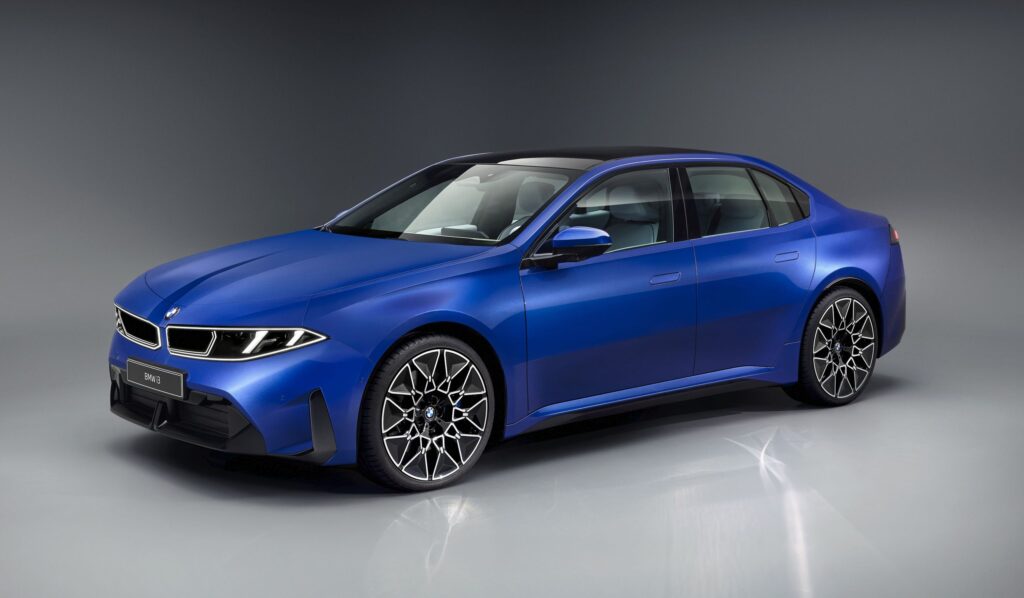
BMW has recently unveiled an all-new BMW i3 model. It shares a name with some older all-electric cars (the retired BMW i3 city car from 2013 and a China-only BMW i3 sedan from 2022), but it has nothing in common with them.
The new BMW i3 is the second Neue Klasse (or “New Class”) EV after the new BMW iX3, and is based on the 6th-generation BMW eDrive technology. Both models share the battery system and powertrain, offering very compelling specs.
Production of the new BMW i3 will begin in Munich, Germany, in August 2026, with first customer deliveries in Europe planned in late 2026. The factory itself will be gradually switched to exclusively fully electric vehicles. We expect the US market launch to follow, probably in 2027 (the iX3 is coming in mid-2026).
According to BMW Blog, both cars will also be produced in North America — at the San Luis Potosí plant in Mexico (the iX3 from 2027 and i3 from 2028). Meanwhile, China is to get a long-wheelbase version, produced locally in Shenyang.

BMW i3 50 xDrive (Image credit: BMW)

BMW i3 50 xDrive (Image credit: BMW)
BMW i3 50 xDrive
Initially, the new BMW i3 will be available only in the dual-motor, all-wheel-drive version: the BMW i3 50 xDrive. Other powertrain options will be introduced at a later point.
Battery
The new BMW i3 50 xDrive has an 800-volt class battery system. Electrically, the battery can be split into two 400-volt modules, enabling the use of 400-volt DC fast chargers as needed.
The battery pack with cell-to-pack (CTP) design consists of 4695-type cylindrical lithium-ion cells (46 mm in diameter and 95 mm high). The 6th-gen BMW eDrive batteries can also use taller cells measuring 120 mm.
BMW has not yet disclosed the battery capacity. It’s believed the usable capacity is 108.7 kWh, as in the iX3.
Range
The preliminary driving range, based on the EPA’s test procedure standards, is estimated at up to 440 miles. That’s 40 miles, or 10% more than the BMW iX3, and the highest number in the BMW lineup so far.
In Europe, the WLTP range rating is up to 559 miles (900 km).

BMW i3 50 xDrive (Image credit: BMW)
Powertrain
The BMW i3 50 xDrive features a dual-motor all-wheel-drive setup with a peak system output of 345 kW and 645 Nm of torque. The numbers are the same as in the iX3 SUV, which can accelerate from 0 to 60 mph in 4.7 seconds. The i3 sedan should be even quicker.
The rear motor (the primary one) is an electrically excited synchronous machine, while the front motor is an asynchronous motor. Neither type contains permanent magnets.
BMW promises exceptionally high efficiency of the drive units and a very precise regenerative braking control for smooth deceleration, without any jerks or braking noise.

BMW i3 50 xDrive (Image credit: BMW)
Charging
The new BMW i3 in North America will be equipped with a NACS (SAE J3400) charging port for both AC and DC charging.
The cars will come standard with a CCS1-to-NACS charging adapter for use with CCS1 chargers. Access to SAE J1772 AC charging points will require a J1772-to-NACS (AC) adapter.
BMW EVs already gained access to the Tesla Supercharging network in North America (Supercharging stalls, available to Tesla’s NACS partners).
Intelligent Charging Flap
The i3 comes with a smart charging flap that opens and closes automatically (depending on settings). It might be useful at known charging locations. The feature is demonstrated in the video attached below (the European version has a CCS2 charging port).
“The charging port is located on the rear right side of the new BMW i3. It is possible to open the charging flap manually by simply pressing, but this is no longer necessary. Because the intelligent charging flap of the new BMW i3 opens automatically as soon as the customer’s charging request is detected. One of the triggers for opening is AI-supported: If the customer walks towards a known or learned charging point, the movement path reveals the charging intention, whereupon the flap opens. If no charging cable is connected, the charging flap closes automatically – as it does after the charging process is complete or when the vehicle is ready to drive.”
DC Charging: 400 kW
According to BMW, the new BMW i3 50 xDrive can accept DC charging power of up to 400 kW (from 800-volt chargers) and half of that at 400-volt chargers. However, the press release does not include the 10-80% SOC charging time (it’s 21 minutes in the iX3).
The European press release states that the car can replenish 249 miles (400 km) of range, out of a total of 559 miles (900 km) (WLTP), in 10 minutes. That’s 44 percent points of the battery. We can assume that charging from 10% SOC to 54% SOC will take about 10 minutes.
If we translate this to the EPA-estimated range, then 10 minutes of charging should result in 195 miles of range replenished. That’s an outstanding average of 19.5 miles per minute (compared to 17.5 miles/minute in the iX3).

BMW i3 50 xDrive (Image credit: BMW)
AC Charging
We expect the onboard charger to be rated at 11 kW (with a 19.2 kW option), which should be sufficient to fully recharge the vehicle overnight. In Europe, the charger is 22-kW (three-phase).
Power Export
The BMW i3, like the iX3, comes with a set of power-export and bidirectional charging features: Vehicle-to-Load (V2L), Vehicle-to-Home (V2H), and Vehicle-to-Grid (V2G).
We assume that, similar to the iX3, the i3 will offer V2L (via a special charging port adapter) and up to 3.7 kW (AC outlets), and V2H/V2G power export (up to 11 kW DC) via a BMW Wallbox Professional (DC).

BMW i3 50 xDrive (Image credit: BMW)