Support CleanTechnica’s work through a Substack subscription or on Stripe.
XPeng’s first profitable quarter is being framed, almost reflexively, as a scale story: more cars, better utilization, stronger margins. That is the standard manufacturing narrative, and it is reflected in both the earnings presentation and the surrounding coverage.
But reading XPeng purely through volume is incomplete.
CleanTechnica attended the Beijing press conference online where more stories are buried under ROI layers. This article is an attempt to unpack what the author believes are the real stories.
“In 2025, XPENG delivered a total of 429,445 vehicles, representing a 125.9% year-over-year increase,” CEO He Xiaopeng said, linking that growth to the company’s ability to “push the boundaries of Physical AI” and expand globally. More telling, however, was his emphasis on what comes next: bridging L2+ to L4 autonomy, deploying its second-generation VLA model internationally, and scaling advanced humanoid robots.
This suggests profitability was not simply the result of selling more vehicles. It reflects a deeper shift: using automotive margins to fund a vertically integrated, intelligence-driven stack that extends beyond the car itself. Volume enabled the milestone; innovation made it meaningful.
XPeng is no longer operating as a conventional automaker—or even a typical EV startup. It is positioning itself as a systems company, focused on controlling the intelligence layer that defines how vehicles operate.
The clearest expression of this is its push into in-house compute. By developing its own AI chips, XPeng is targeting one of the core constraints in next-generation mobility: processing power, latency, and energy efficiency. Autonomous driving and advanced driver assistance systems are bounded by compute. Relying on third-party silicon means inheriting those limits; designing its own allows XPeng to optimize the full stack, from hardware through software. This is not incremental improvement, but a structural shift in where value is created.
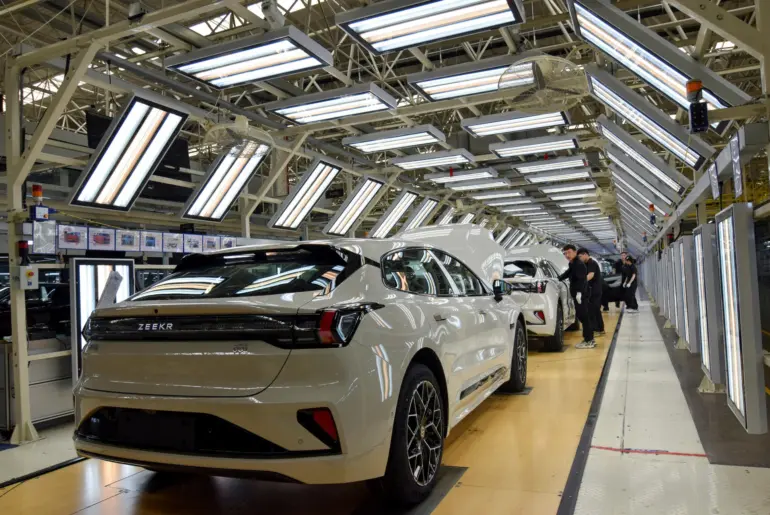
That same logic extends into manufacturing through its “Iron” system. This is not automation for its own sake, but the integration of AI and real-time data into production. The goal is to compress development cycles, improve quality, and continuously optimize cost. Traditional manufacturing delivers incremental efficiency gains; an AI-enabled system can compound them. In that context, profitability is less about scale alone and more about producing each unit more efficiently.
XPeng’s ambitions also extend beyond the road. The Land Aircraft Carrier concept signals a willingness to redefine the boundaries of mobility itself. Through XPeng AeroHT, the company is exploring aerial platforms—not as a near-term revenue driver, but as a strategic position in an emerging category. The regulatory and technical barriers are significant, and commercialization remains distant. But the intent is clear: participate early in markets that are not yet saturated.
These parallel efforts—compute, manufacturing intelligence, and new mobility platforms—serve a common objective: reducing dependence on external constraints, whether suppliers, legacy processes, or established market definitions. If successful, they create the potential for structurally higher margins and differentiated capabilities.
This is how XPeng is attempting to avoid a trap facing many EV makers: becoming low-margin hardware producers in an increasingly price-driven market.
None of this guarantees success. The strategy increases execution risk. Developing chips, reengineering manufacturing, and investing in new mobility platforms simultaneously is capital-intensive and operationally complex. It also requires maintaining competitiveness in the core EV business, where pricing pressure remains intense.
XPeng’s first profitable quarter, then, is not just validation of its current model. It is a signal that the company now has the financial capacity to pursue a broader transformation.
If this were only a volume story, the path forward would be straightforward: scale production, manage costs, defend margins. But XPeng is pursuing something more ambitious—a vertically integrated, intelligence-led mobility platform unfolding across multiple fronts.
The question is no longer whether XPeng can sell cars profitably. It is whether it can execute this multi-layered strategy while the EV landscape continues to evolve. That is the more difficult challenge—and the one that will ultimately define the company.
I will try to break down the relevant numbers. Although, a list is available in the press release.
Sign up for CleanTechnica’s Weekly Substack for Zach and Scott’s in-depth analyses and high level summaries, sign up for our daily newsletter, and follow us on Google News!
Advertisement
Have a tip for CleanTechnica? Want to advertise? Want to suggest a guest for our CleanTech Talk podcast? Contact us here.
Sign up for our daily newsletter for 15 new cleantech stories a day. Or sign up for our weekly one on top stories of the week if daily is too frequent.
CleanTechnica uses affiliate links. See our policy here.
CleanTechnica’s Comment Policy