Stay up to speed with stories written by drivers, for drivers.
Get automotive news, DIY tips, market trends, in-depth car profiles, and more right in your email inbox.
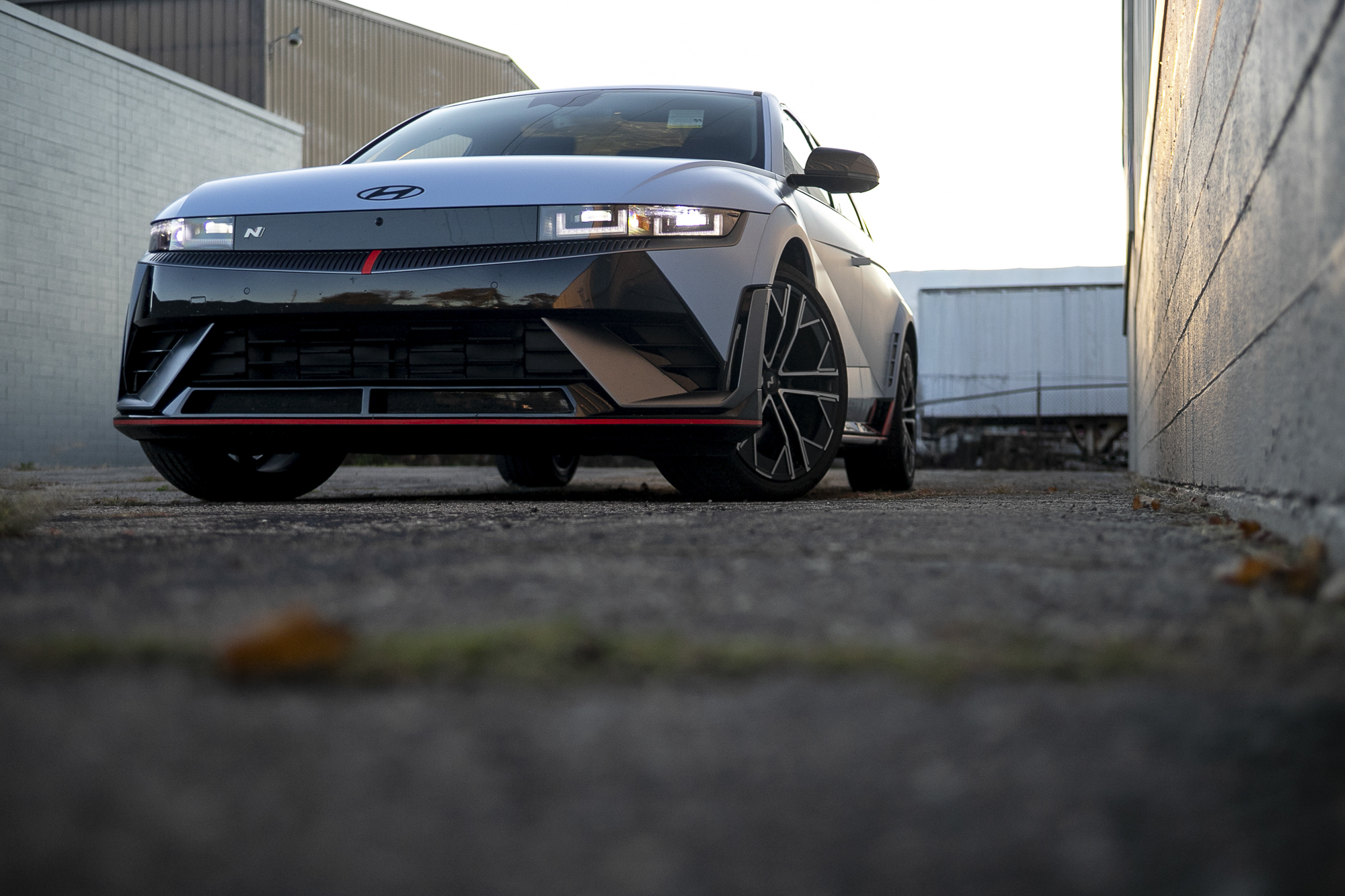
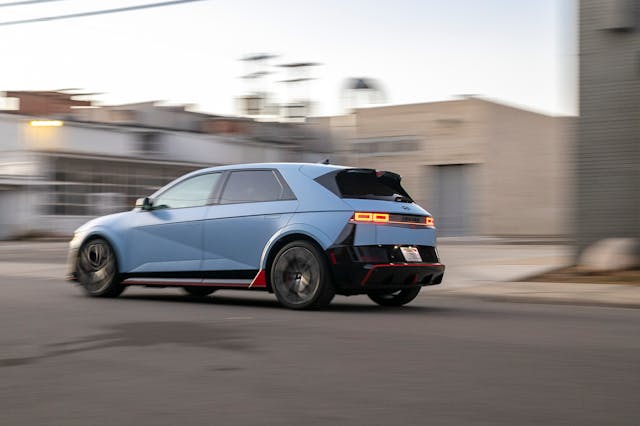
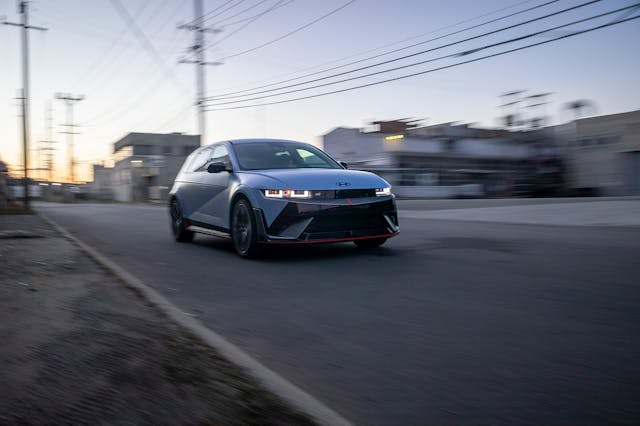
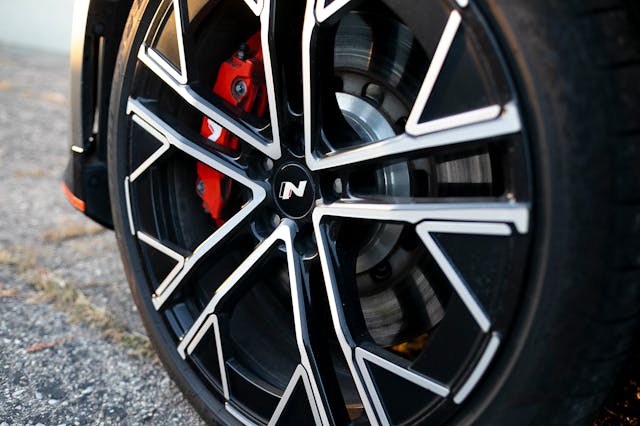
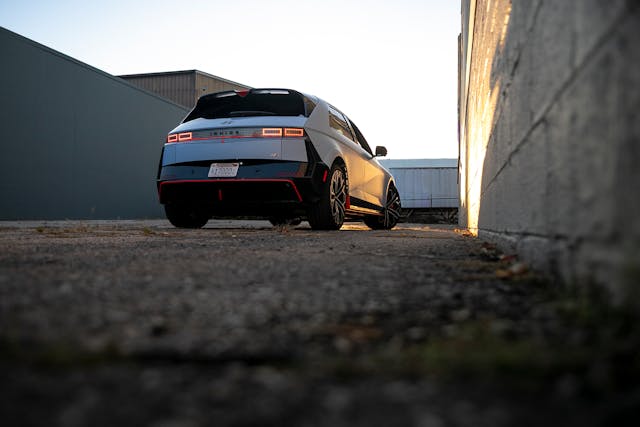
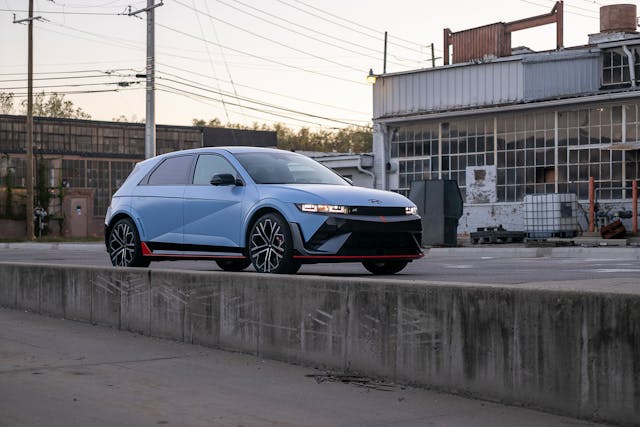
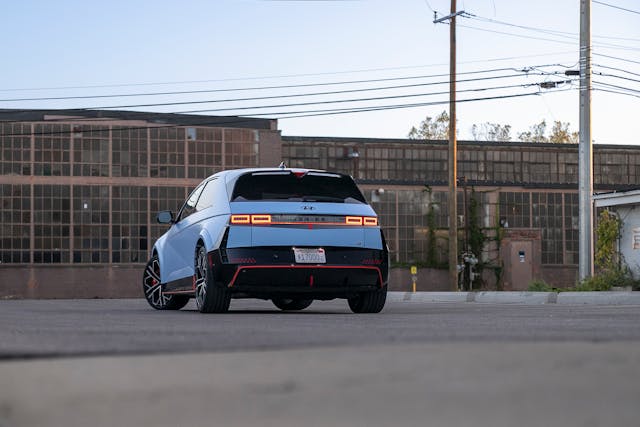
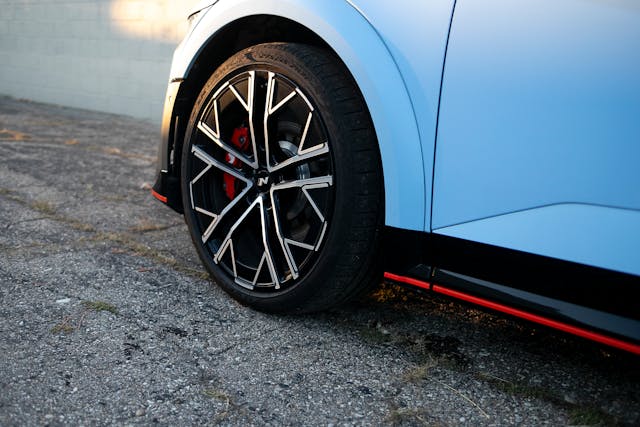
Optimism surrounding the so-called electric revolution, blindingly bright just a few years ago, is dimming. Across the industry, automakers are rethinking hawkish portfolio pivots and writing down enormous EV investments. But even with electric cars facing cold corporate realities, there are some genuinely great ones on the market today. Precious few of them are true sports cars. Only one is a matte-blue five-seat family hatchback with 641 hp, all-wheel drive, four-piston monobloc front brake calipers with nearly 16-inch front rotors, and suspension honed on the Nürburgring. That car is the Hyundai Ioniq 5 N—proof electric cars can make you giggle so hard you involuntarily slap the steering wheel.
Most performance-oriented EVs are one-trick ponies, serving up neck-snapping acceleration in spades but little in the way of feedback or driver engagement. I am of the opinion that battery-electric cars are most compelling when they are small, modest-performing city cars with a starting price of about $30,000. Heavy batteries and range depletion under high load make it especially challenging for automakers to engineer a sweet-driving sports car with enough range for buyers to consider useful. The Ioniq N is the exception—$68,000 for a low-slung SUV that weighs 4861 pounds and has 221 miles of range. None of these numbers quantify the Hyundai’s tactile steering, lovely chassis balance, and tractable ride quality.
 Chris Stark
 Chris Stark
 Chris Stark
Launching for the 2025 model year, the Ioniq 5 N is the fourth U.S. model to get a full performance overhaul from Hyundai’s in-house tuning and motorsport division, and the first with an all-electric drivetrain. Like the standard Ioniq 5 EV, the 5 N’s fundamental bones are Hyundai’s modular, skateboard-style E-GMP platform that also underpins the Kia EV6 and Genesis GV60.
Specs: 2025 Hyundai Ioniq 5 N
Price: $67,475 / $68,685 (based / as-tested)
Powertrain: Permanent-magnet synchronous electric motors; 84-kWh lithium-ion battery
Horsepower: 601 (641 with temporary boost)
Torque: 545 lb-ft (568 with temporary boost)
Layout: All-wheel-drive, four-door, five-passenger crossover
Weight: 4861 pounds
EPA-rated fuel economy: 78 MPGe combined city/highway
Range: 221 miles
0–60 mph: 3.2 seconds
Competitors: Tesla Model Y Performance, Ford Mustang Mach-E GT, Kia EV6 GT
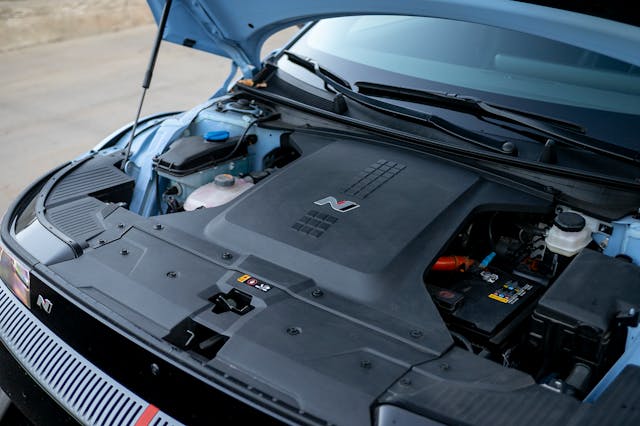
N-specific upgrades include a whole mess of rigidity improvements, including an extra 42 welding points and nearly 7 feet of structural adhesives. The 84-kWh lithium-ion battery powers a permanent-magnet synchronous electric motor on each axle for all-wheel drive. Hyundai reinforced the motor and battery mounting points, while also strengthening the front and rear subframes. The drive axles are also beefed up to handle the 5 N’s high torque.
 Chris Stark
About that output: The electric motors deliver 601 hp and 545 lb-ft of torque in ordinary driving. For reference, that’s 50 hp and 35 lb-ft more than a 2012 Mustang GT500. Shove arrives right off the bat—typical for electric motors. But the Ioniq N’s e-motors stay on the boil past the triple-digit mark: not usually the case for EVs, which tend to lose steam as revs climb. The ability to exit a corner with brutal acceleration, almost before you’ve completed the thought, satisfies on a primal level.
 Chris Stark
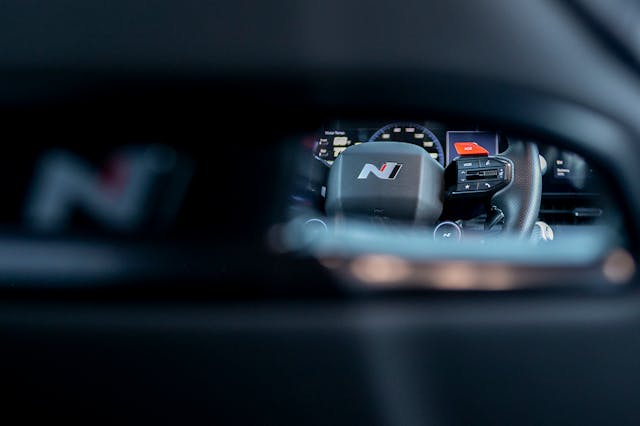
Pressing the “N Grin Boost” button on the steering wheel punches output up by 40 hp and 23 lb-ft for a period of 10 seconds. Even in hard corner carving on a twisty road, the standard thrust is already so overkill that more barely registers. The extra zip is mostly noticeable in the way it helps the Ioniq 5 N launch; it is stupid, silly fast. “The off-the-line performance made me laugh like an idiot,” said associate editor Chris Stark. “Scat Packs were vanquished at stoplights in relative silence.” Sixty miles per hour from a stop comes in 3.2 seconds, which is what a Ferrari 458 Italia and a Ferrari 488 GTB can lay down. But this is no exotic wedge with an operatic exhaust; it’s a hushed rocket skate on forged 21s.
 Chris Stark
Well, not entirely hushed. One of the more controversial features in the Hyundai arsenal is its artificial “engine noise,” which is electronically synthesized and pumped into the cabin via the car’s speakers. The so-called N Active Sound+ system offers three very different-sounding themes: “Evolution” emulates the futuristic-sounding whine of electric motors, “Ignition” does its best impression of N’s rowdy 2.0-liter turbo-four intake and exhaust note, and “Supersonic” evokes the aggressive whoosh of fighter jet engines. The whole thing is at best corny and at worst misleading, but credit to Hyundai for attempting to solve the problem of EVs offering almost nothing in the way of sensory feedback. “The objective of N Active Sound+ is to provide drivers with an acoustic reference to gauge the power being utilized,” says Hyundai’s press release. After about an hour playing around with the soundtrack, I switched it off and refused to turn it back on.
There are more digital cornball cues. N e-shift is a selectable power delivery mode that simulates the gearshifts of an eight-speed dual-clutch transmission. A computer manipulates motor torque to produce a “jolt” between “shifts.” Again, the intention is to enhance the driving experience to something approximating that of an internal combustion engine, complete with the sensations that help the driver understand what the car is doing at any given moment.
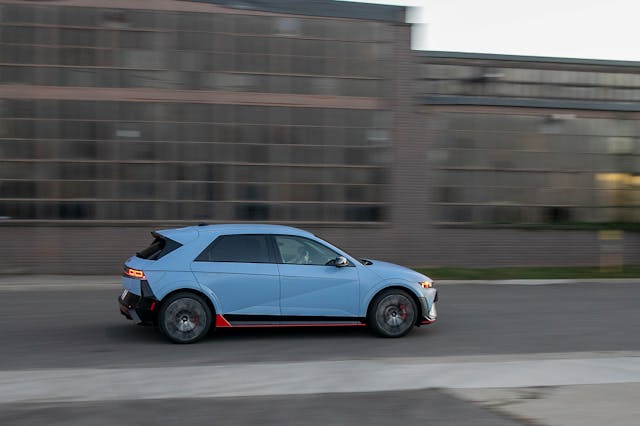
People may find these features helpful or, at the very least, endearing. It is, I’ll allow, refreshing to be in a car that doesn’t take itself as seriously as an AMG Black Series. But the Ioniq 5 N fails as a simulacrum of an ICE performance car. Because it isn’t one. Where the Hyundai truly surprises and delights is in those novel moments when it acts like an electric car. When a subtle lift off the go pedal is enough to command a dose of regen, enough to scrub speed and set the nose without ever having to touch the brake pedal. When you blast down country roads at night with the windows down, ears keen to the howl of Pirelli P-Zero tires and the rush of the wind.
 Chris Stark
The Ioniq 5 N is a rare thing—an electric car shaped by people who obviously love to drive. Gentle body movements help you sense the car’s center of gravity during hard cornering and braking. A rack-mounted and reinforced electronic power steering setup, tuned with unique feedback logic, offers sharp turn-in feel and natural weight from lock to lock. The result is more nuanced and talkative than what you get in a BMW M3.
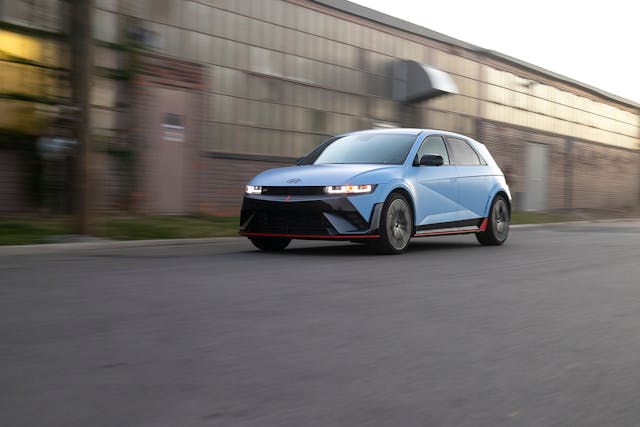
The chassis’s rigidity, combined with the electronically controlled dampers, bless this two-ton South Korean brick with some real agility. Grip is astonishing when you take a set, and traction out of corners lends confidence, the electronic limited-slip differential helping tame wheelspin and slam torque to pavement. The car has a way of constantly impressing and surprising you, egging you on from entry to exit to entry, while constantly keeping the driver at the center of the drama. Stark hit the nail on the head: “Despite the piles of grip, it’s still playful. Never does it drive like a video game car.”
 Chris Stark
 Chris Stark
 Chris Stark
 Chris Stark
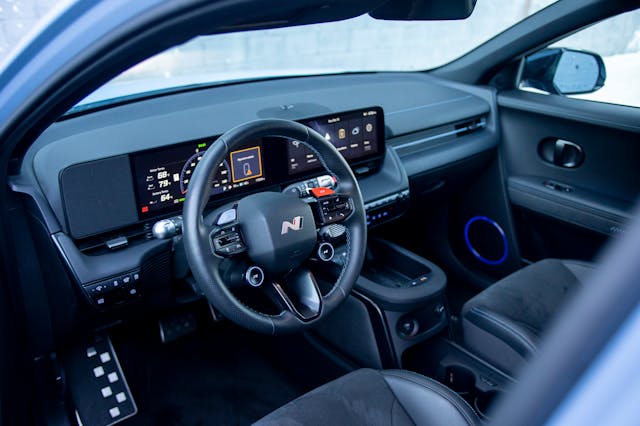
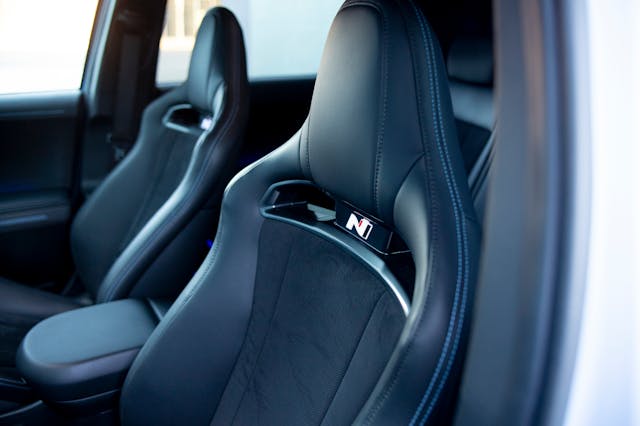
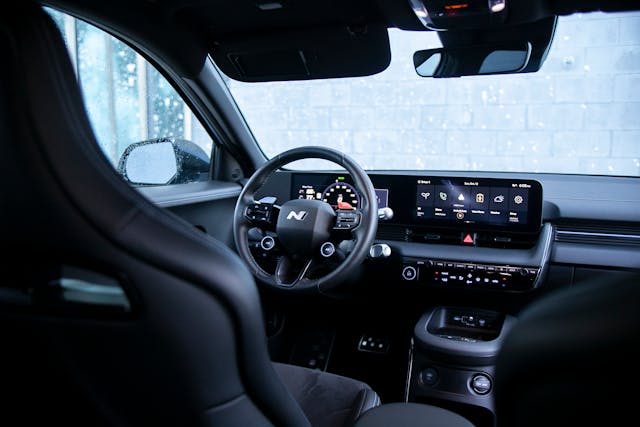
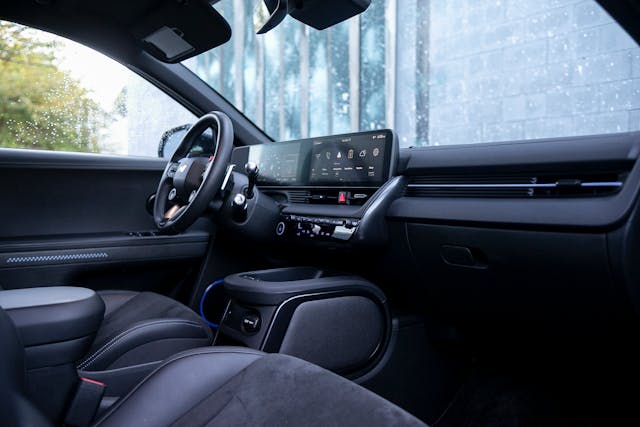
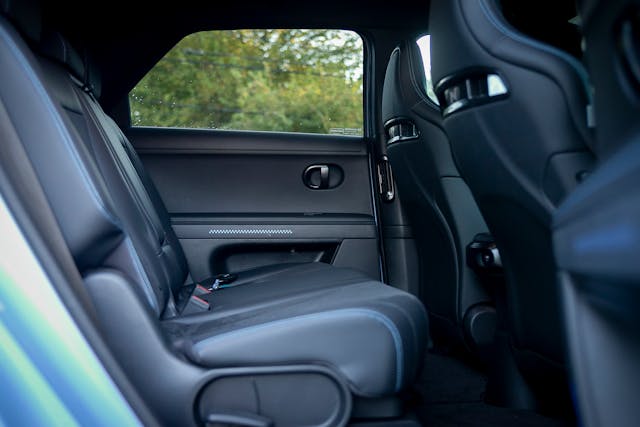
It helps that critical driver touchpoints are ergonomically dialed. The seats are generously bolstered but allow for reasonable daily comfort, even on longer highway drives. (Hyundai says it positioned them about 0.79 in lower than in the regular Ioniq 5 to improve the car’s weight balance. There’s room for a helmet, too.) The steering wheel fits well in the hands, its rim neither obnoxiously thick nor cheap-feeling. Even the pedals are set up nicely for left-foot braking. And none of these upgrades compromises the inherent practicality of the Ioniq 5, a family car well suited to daycare pickup, grocery hauls, and basketball practice.
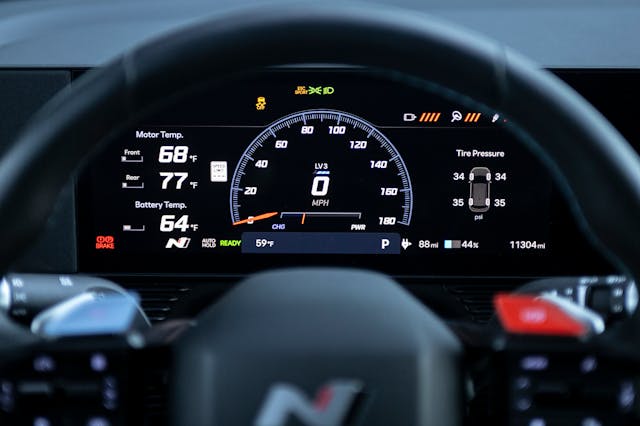
As a pure EV, though, the Ioniq 5 N suffers from familiar pitfalls. The biggest one is range. Fact is, 221 miles is little enough to discourage a lot of people from even considering this vehicle. Yes, the NACS charge port for 2026 makes Tesla Supercharger stations usable. But the Tesla Model 3 Performance boasts 303 miles of range, which is a big difference if a road trip is even a twice-annual affair. Gas-powered cars like the similarly priced Audi RS3 or a Mercedes CLA45, it must be said, don’t come with range anxiety whatsoever. (On the plus side, Hyundai’s software does an excellent job of quickly adjusting its estimate of remaining range, especially after whipping the 5 N around back roads. And the independent radiators for the battery and motor keep everything nice and cool, as visible on the real-time temperature gauges that can be cued up in the instrument cluster.)
 Chris Stark
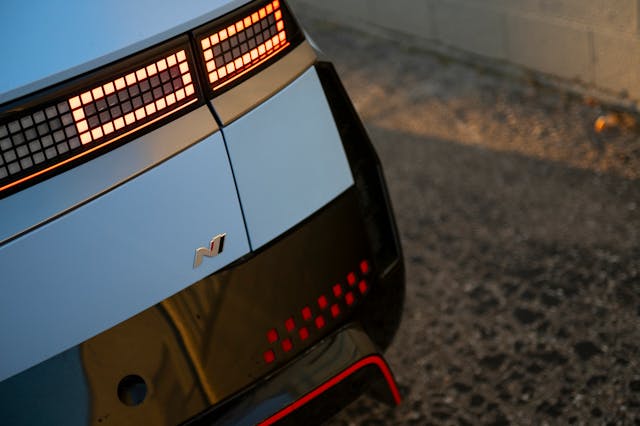
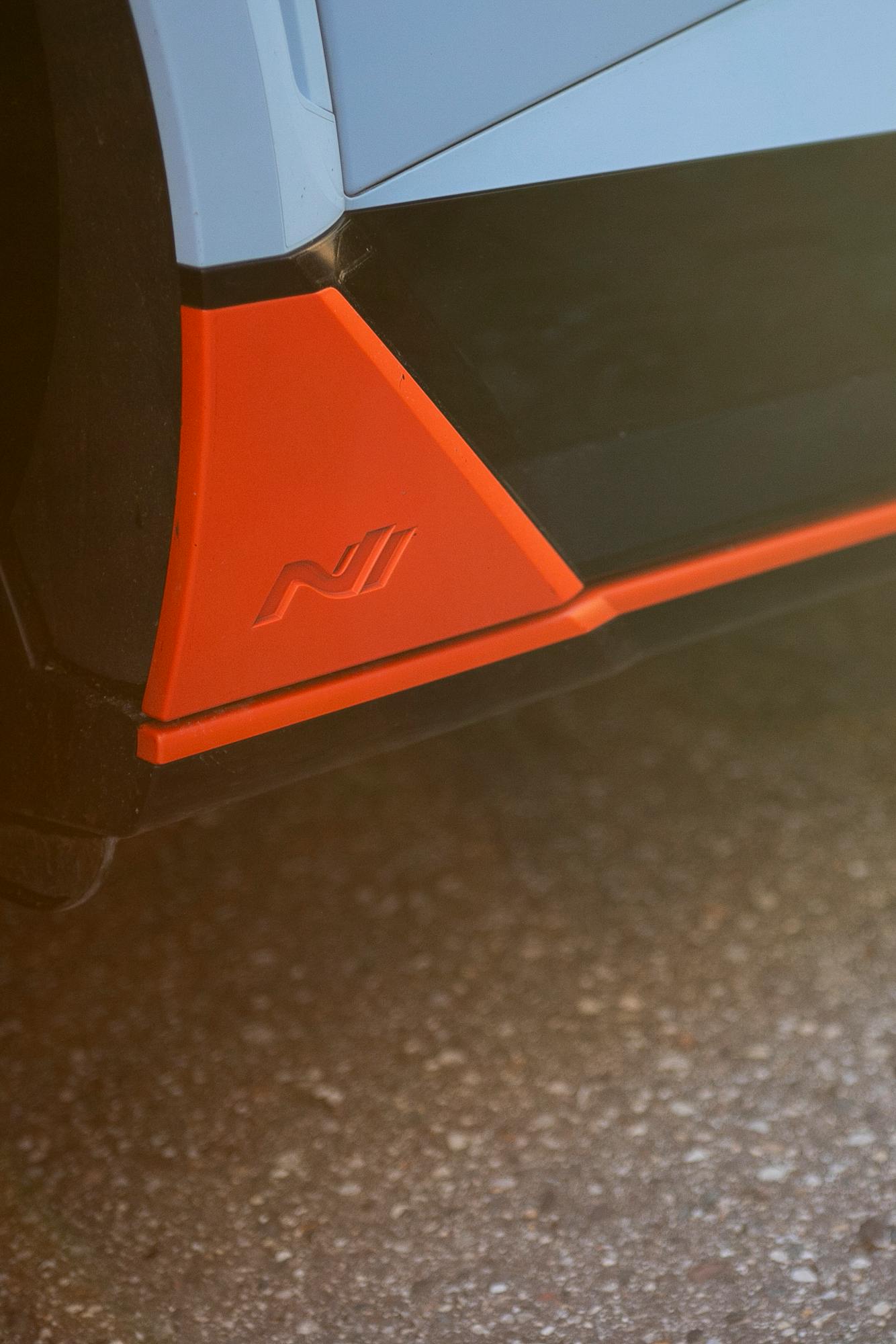
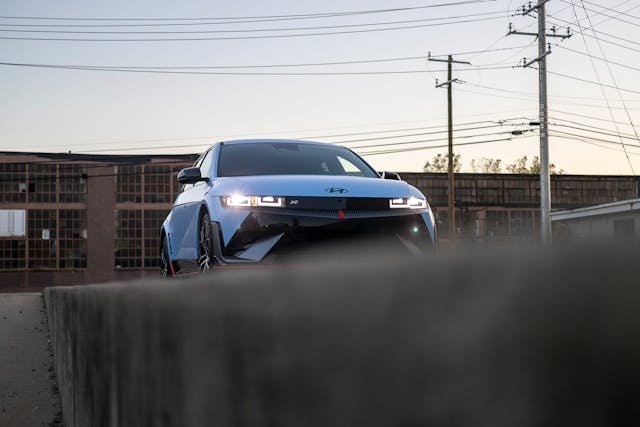
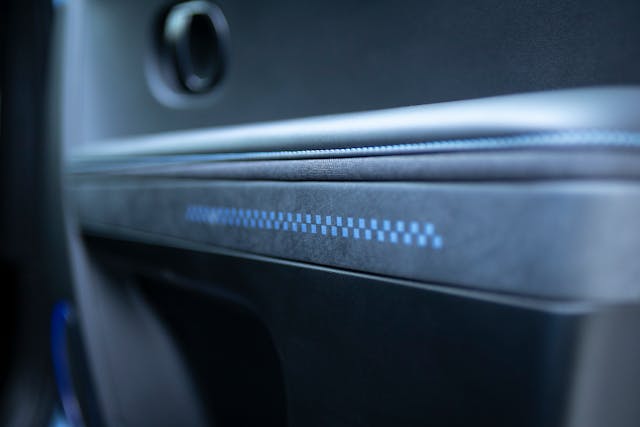
Other quibbles: low-speed creeping can be difficult to control, which makes parallel parking this deceptively long and wide vehicle harder than it needs to be. The turn radius is pretty poor. High-speed, deep-pedal braking can feel unnatural and inconsistent at times. A lot of the interior materials are cheap and plasticky. Subtlety is not this exterior design’s strong suit, combining the Ioniq 5 N’s retrofuturistic Tron vibe with the heft and stance of a Pikes Peak hill climber. But twenty minutes behind the wheel of the Ioniq 5 N is enough to make irrelevant all but the range concerns.
This is a different breed of performance car that delivers a unique flavor of driving joy. That it’s all-electric neither distracts from nor utterly defines the experience. Gas cars aren’t vanishing any time soon, as many full-throated EV evangelists once professed, but the sports car world is nevertheless richer with a car like the Ioniq 5 N in it. It’s ambitious, creative, thoughtfully engineered, and expertly executed. If this is the tip of the iceberg, we should all be optimistic about what Hyundai and N have lying in wait under the surface.
 Chris Stark
2025 Hyundai Ioniq 5 N AWD
Highs: Brilliant chassis balance, sharp steering, ruthless power. Fun, fun, fun, and more fun.
Lows: High price for a hot hatch of any kind. Attempts to imitate an ICE car come across as cheesy. Range is piss-poor in a world where the new BMW i3 has double the range.
Takeaway: The most engaging, most entertaining EV on the market today. Though not without its drawbacks, the Ioniq 5 N has the soul of a driver’s car.
 Chris Stark
 Chris Stark
 Chris Stark
 Chris Stark
 Chris Stark
 Chris Stark
 Chris Stark
 Chris Stark
 Chris Stark