Porsche has been all in on the ‘electric future’ for its utility vehicles ever since it announced its plans for a Porsche EV SUV back in 2019. The next-generation Macan introduced was built from the ground up on a brand-new platform called the Premium Platform Electric (PPE) and was meant to carry Porsche into the all-electric future of SUVs. Recently, the brand’s bigger SUV, the Cayenne, has also gone electric for its fourth generation, with a completely new design and powertrain.

Founded
1948
Headquarters
Stuttgart, Germany
Founder
Ferdinand Porsche
Owned By
Volkswagen
Current CEO
Oliver Blume
So where does Porsche go from here, or have the 2026 Porsche EV SUVs already perfected the formula? Here is everything we know about Porsche’s electric SUVs so far, and what is on the horizon for the Stuttgart-based manufacturer.
What We Have So Far
Porsche Macan Electric
2026 Porsche Macan Electric
Base Macan
Macan 4
Macan 4S
Macan GTS
Macan Turbo
Engine
Single-motor Electric
Dual-motor Electric
Battery Size
100 kWh
Drivetrain
2WD
4WD
Power (Overboost)
335(355) hp
382(402) hp
442(509) hp
509(563) hp
576(630) hp
Torque (Overboost)
415(415) lb-ft
479(479) lb-ft
578(604) lb-ft
563(704) lb-ft
811(833) lb-ft
Range
315 mi
308 mi
288 mi
N/A
288 mi
MSRP
$80,300
$84,400
$89,900
$105,300
$112,700
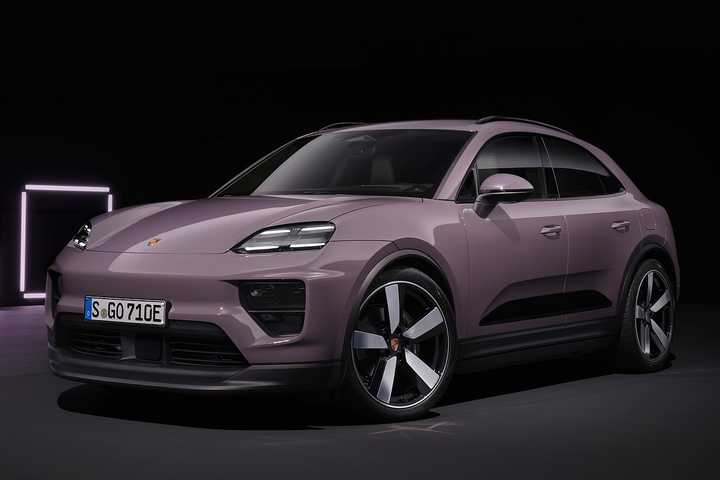
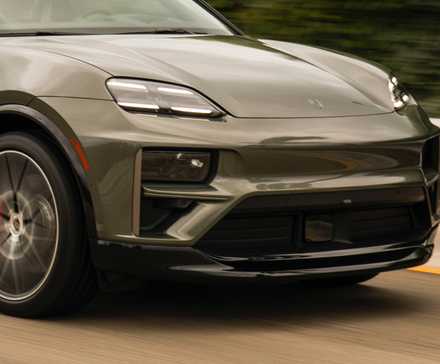
The second-generation Macan was the first all-electric Porsche SUV and was launched back in January 2024. The Porsche Macan EV SUV has five powertrain options; the base model with a maximum of 355 hp, the Macan 4 at 402 hp, the Macan 4S with 509 hp, the Macan GTS 563 hp, and the flagship Macan Turbo with an all out 630 hp. The base model of the Macan is a rear-wheel-drive SUV. The 4, 4S, GTS and Turbo all feature all-wheel drive due to having a motor on each axle. The Macan also has an ‘overboost’ function that increases the maximum power from the electric motors for a short period of time.
As this is a Porsche SUV, it benefits from Porsche’s Active Suspension Management (PASM) system and custom damper tuning, both working hand-in-hand to disguise the car’s 5,400-pound curb weight. The GTS goes above and beyond and gets an electronically controlled limited-slip differential. We drove the Macan GTS in Los Angeles as a First Drive and were pleasantly surprised by its ride and handling dynamics. The Macan can also be optioned with rear-wheel steering, aiding in tight cornering and high speed stability.
Base Trim Engine
Electric
Base Trim Transmission
1-speed automatic
Base Trim Drivetrain
Other
Base Trim Horsepower
335 HP
Base Trim Fuel Economy Equivalent (city/highway/combined)
108/90/99 mpge
Base Trim Battery Type
Lithium ion (Li-ion)
Infotainment & Features
9 /10
The Macan EV has an EPA-estimated range of between 288–315 miles, and is based on 800-volt architecture. This allows estimated charging times from 10% to 80% in 21 minutes on a 270 kW charger.
The interior of the Macan features a 12.6-inch digital driver’s display and a 10.9-inch central touchscreen with wireless Apple CarPlay and Android Auto. There is also an optional 10.9-inch passenger display on offer for seat and HVAC controls. The car also comes standard with a 10-speaker Porsche stereo sound system, with an option to upgrade to a 14-speaker Bose or a 21-speaker Burmester system.
Like any Porsche EV SUV, price is on the punchier side, especially as this is the company’s first ever electric SUV. The Macan starts at $80,300, but the Turbo is well north of $100,000.
Related
The Updated 2026 Porsche Macan Electric Can Tow Your Boat And Entertain Your Toddler
The new Macan gets an AI voice assistant, available in-cabin gaming, and a higher towing capacity, but is that enough to win over skeptics?
Porsche Cayenne Electric
2026 Porsche Cayenne Electric
Cayenne Electric
Cayenne S Electric
Cayenne Turbo Electric
Engine
Dual-motor Electric
Battery Size
113 kWh
Drivetrain
4WD
Peak Power
435 hp
657 hp
1,139 hp
Peak Torque
615 lb-ft
797 lb-ft
1,106 lb-ft
MSRP
$109,000
$126,300
$163,000
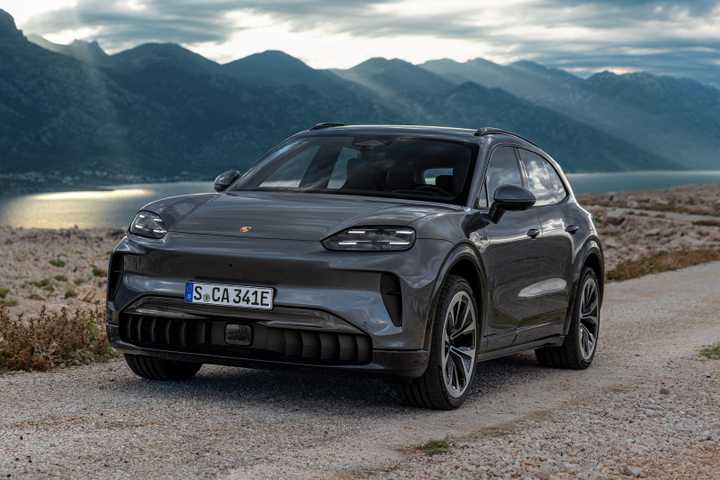
The Porsche Cayenne Electric was the company’s second all-electric SUV, recently launched in late 2025. The Cayenne has been a pivotal car for Porsche. It saved the company from potential bankruptcy and created a segment called the luxury ‘sports SUV’ that many manufacturers have now entered. So, no doubt, this fourth-generation Porsche EV SUV Cayenne has a lot riding on its shoulders. Just how impressive is the latest Porsche EV SUV – the Cayenne Electric?
On paper, the numbers are certainly promising. The standard Cayenne produces 435 hp from a dual-motor setup. However, the Turbo turns things up several notches, boasting 1,139 horsepower. This makes the new Cayenne Turbo the most powerful production Porsche and the fastest SUV from 0 to 60 mph with a sprint of just 2.4 seconds. Like the Macan, the Cayenne also gets PASM, along with adaptive air suspension. However, this is standard on all models, unlike the Macan, which requires some upgrades to attain such. Rear-wheel steering is yet again an option for this car. A unique suspension trick for the Cayenne is the ability called Active Ride on the Turbo. It pairs the air springs with an active hydraulic damper system that controls and cancels chassis roll, pitch and heave.
Base Trim Engine
Electric
Base Trim Transmission
Single-speed Automatic
Base Trim Drivetrain
All-Wheel Drive
Base Trim Horsepower
402 HP
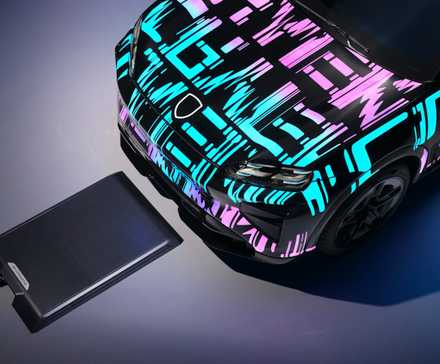
The Cayenne electric is based on a completely new chassis and has a 113-kWh battery pack capable of charging at speeds of up to 400 kW DC, thanks to its 800 volt architecture. However, what is new for the Cayenne is the ability to wireless charge the car, with the ‘park-over’ charging system. Wireless charging times will be quite slower than regular charging, which is expected to get the car from 10% to 80% in about 15 minutes.
The interior of the Cayenne has been thoroughly changed as well. It features what is called a ‘Flow Display,’ which is a single curved OLED screen in the center. This screen is supported by a 14.25-inch digital driver’s display with an option for a 14.9-inch passenger display. However, Porsche claims that the Cayenne’s interior retains physical buttons for some controls, for tactility and ease of use.
New Kid On The Block: Porsche Cayenne S Electric
The newest member of the Cayenne family is the Cayenne S Electric, announced earlier this month. If you know your Porsche nomenclature, the S model usually sits in the middle of the range, priced higher than the base, but not the highest possible spec. The Cayenne S fills the gap between the base Cayenne electric and the immensely fast Cayenne Turbo.
The Cayenne S has a maximum output of 657 hp, which is apt for a middle-of-the-range Cayenne. However, it does get the Turbo’s direct oil cooling for the rear axle as standard. Priced at $126,300, it is almost $17,000 more than the base Cayenne, but also almost $37,000 cheaper than the Turbo.
Not much has changed on the inside, with a new Interior Style package, which is actually a series of packages that will eventually roll out to all Cayenne Electric models.
Related
Porsche’s Tech Makes Charging Your Car As Easy As Charging You Phone
No plugs needed, because wireless charging for cars is finally here!
What’s Coming
Porsche D-segment SUV Codenamed ‘K1’
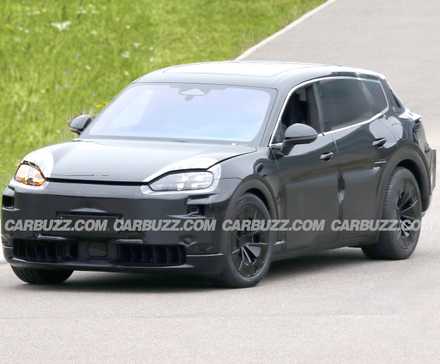
Porsche is working on a seven-seater SUV, which will likely go on sale in 2028. Codenamed the ‘K1,’ it will rival the likes of the BMW X7 and the Mercedes-Benz GLS. It was originally meant to be fully electric. However, there are rumors that Porsche is now going to start the sales of the K1 with gasoline and hybrid V6 or V8 options, with a later launch for an all-electric seven-seater.
Porsche, like almost every manufacturer in early 2019, made big plans for its future SUVs. However, the automotive landscape has changed ever since companies announced their bold EV plans. The demand for EVs has not seen the astronomical increase that companies were hoping for. Oliver Blume, the CEO of Porsche at the time, admitted that abruptly switching to an all-electric Macan was a misjudgment of the situation.
“Our strategy was to offer a range of combustion engine, hybrid, and electric sports cars in each of our three segments – but not necessarily for every single product. We misjudged the situation with the Macan. Based on the data and market assessments available at the time, we would have made the same decision again. Today, the situation is different. And we have reacted accordingly, adding both combustion engine and hybrid options.”
– Oliver Blume, per Frankfurter Allgemeine Zeitung.
Originally, the Macan Electric and Cayenne Electric were meant to completely replace their ICE-powered counterparts. However, after seeing the fall in demand for all-electric SUVs, Porsche has decided to keep the Macan and Cayenne ICE model range on offer alongside the EVs. To prevent the same situation with the ‘K1,’ Porsche will offer conventional ICE powertrains for the car first, test the response of the market, and then release an all-electric ‘K1.’
Related
Porsche Needs To Redesign Its 3-Row SUV From Scratch And Fast
Poor sales of electric vehicles have Porsche scrambling to find a way to save the K1 program.
Sources: Porsche