When fleet operators or public officials evaluate commercial vehicle purchases, the upfront price usually dominates the conversation. An electric delivery van or heavy-duty truck costs more to buy than its diesel counterpart, and that gap is hard to ignore when budget cycles are short and procurement decisions come under pressure.
What rarely enters the conversation—because it requires careful analysis to make visible—is what happens over the full lifetime of the vehicle. Battery electric vehicles (BEVs) cost substantially less to fuel and maintain because they are more energy efficient and have fewer moving parts than diesel vehicles. Over 5 to 10 years of operation, those savings can offset the higher purchase price—and in many scenarios, exceed it—meaning that BEVs end up being more budget-friendly than diesel. But without a structured framework for calculating a vehicle’s total cost of ownership (TCO), those long-run economics remain opaque, and the sticker price wins by default.
This problem is not unique to any one market or vehicle type. Instead, it is structural: the upfront costs that favor diesel are immediate and visible, while the costs that favor BEVs accumulate over time and depend on factors that may vary widely by location, such as fuel prices, electricity rates, and incentives. Without tools to make those variables transparent and interactive, buyers end up paying for it in the long run.
Why TCO matters more today than it did a year ago
The U.S. policy environment for commercial vehicle electrification has shifted significantly over the last year. Federal purchase incentives that once formed part of the economic case for zero-emission vehicles are no longer available. Sales requirements across nearly a dozen states are also no longer in effect, creating uncertainty about the availability of zero-emission products. In this environment, fleet operators and regulators are right to ask the hard questions: does electrification make economic sense on its own merits in our state and for the vehicle types we care about?
TCO analysis is precisely the right tool for answering these questions. It generates a complete accounting of costs over time—capital, energy, maintenance, financing, infrastructure, insurance, and residual value—and allows that accounting to be run under different assumptions. What happens if electricity prices go up? Or if the residual value of BEVs is higher than that of diesel vehicles? What about if states lower or remove sales taxes on BEVs? TCO analysis provides a structured way of understanding where electrification is economically competitive today, where it is approaching competitiveness, and what policy levers most affect the outcome.
The problem is that rigorous TCO research, while plentiful, has not been easily accessible to fleet owners, procurement officials, and state regulators who need it most. It lives in technical reports with fixed assumptions that may not match a given operator’s circumstances. That gap between available research and usable insight is what the ICCT TCO Calculator is designed to close.
Introducing the ICCT TCO Calculator
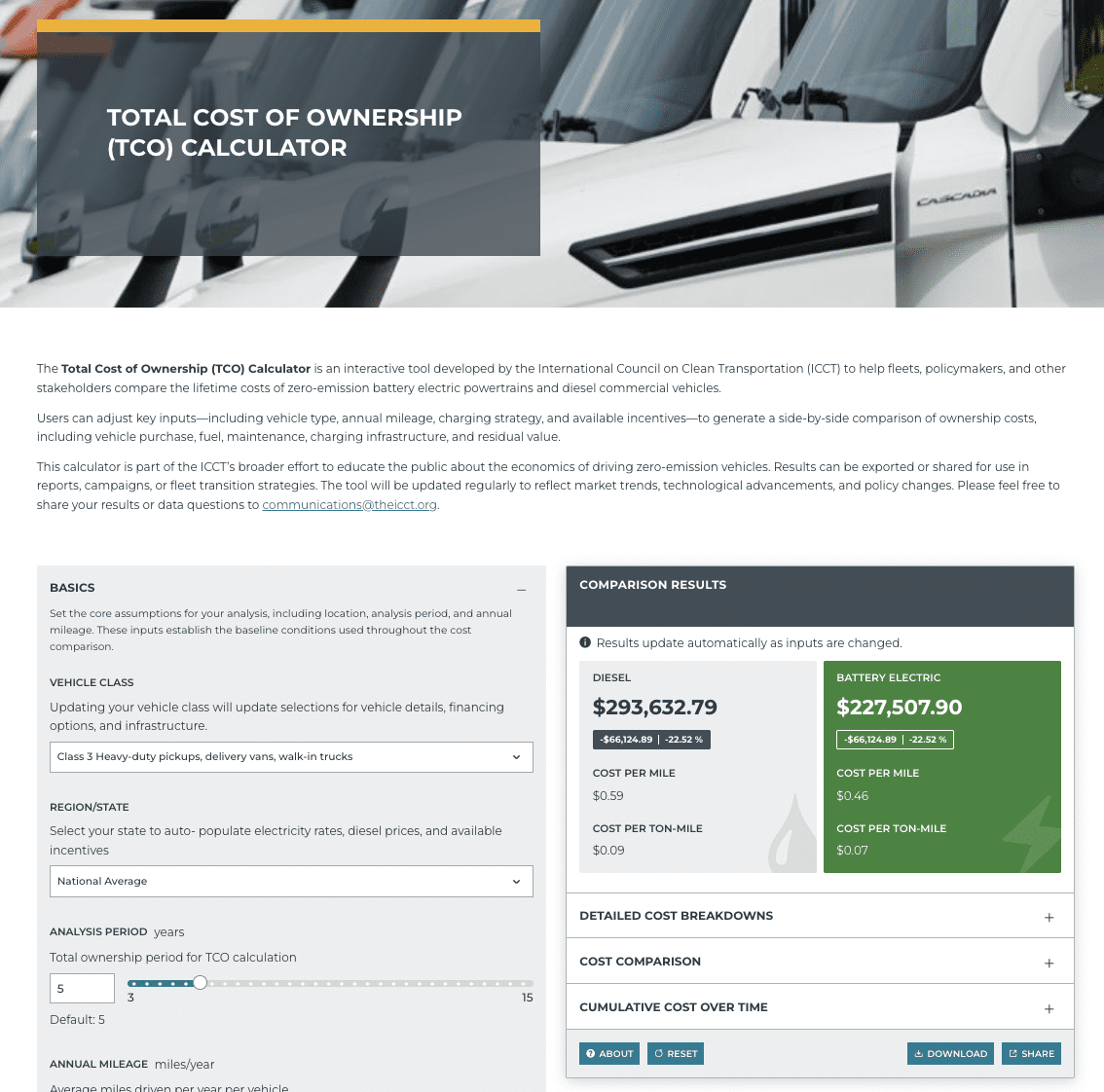
The ICCT TCO Calculator is a free, interactive web tool that compares the TCO for diesel and battery electric vehicles across all commercial vehicle classes, from Class 2b–3 medium-duty delivery vans to Class 8 long-haul trucks. The tool was built using ICCT research and pre-populates key variables from a range of data sources, such as the U.S. Energy Information Administration, the National Laboratory of the Rockies, and state and vehicle manufacturer websites.
Users can either view national averages or select one of seven states—California, New York, Texas, Illinois, Florida, Washington, or Georgia—and the tool automatically populates regional electricity rates, diesel prices, and other state-level data. From there, users can explore how differences in annual mileage, charging configuration, financing method, vehicle specifications, and operational assumptions affect the comparative TCO between diesel and battery-powered vehicles.
The TCO for each vehicle type updates in real time, and the results also show the cost per mile and ton-mile and the vehicle’s payback period, along with a breakdown of where every dollar goes.
What the numbers look like in practice: California vs. Texas
To illustrate the value of this tool, consider a Class 2b–3 electric delivery van—a vehicle type increasingly common in last-mile logistics—purchased in two states with widely differing EV policies: California and Texas. In each case, the vehicle is purchased without financing for a fleet that runs delivery vans 45,000 miles per year and uses depot charging. The vehicle reaches TCO parity in both states (Figure 1), but for different reasons. The input values used to produce these results are shown in Table 1.