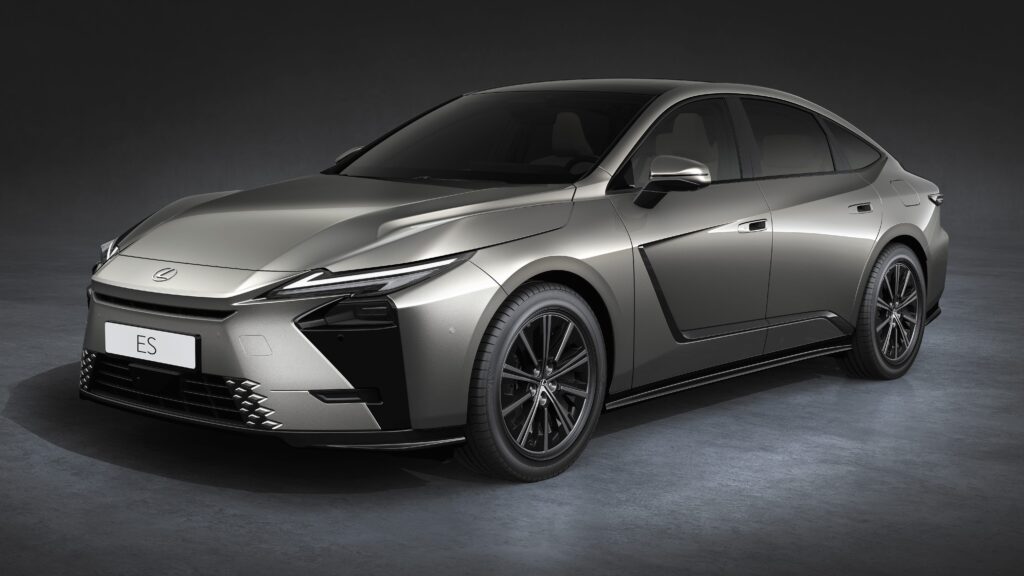
The all-new Lexus ES is coming, and it brings a bit of a surprise along with it. No, we’re not talking about the new all-electric version that launches for the first time, but the fact the electric ES will be nearly the same price as the hybrid. Hovering around the $50,000 mark, the Lexus luxury sedan shows that price parity between the two types of powertrains is possible without the car being an SUV.
2025 was the last year you could buy a purely internal combustion engine version of the Lexus ES. Starting from 2026 onward, the ES will come as a hybrid or a pure battery electric vehicle (BEV, or just plain EV). Usually in the auto industry, a purely electric car carries a much higher price point, but Lexus found a way to bring some parity to the party, and then some. The base prices of both ES versions hover around $50,000, with the ES 350e Premium (the single-motor all-electric version) starting at a cheaper $48,795, while the ES 350h Premium (the FWD hybrid) adds $2,200 to that figure.
ADVERTISEMENT – CONTINUE READING BELOW
Both ES versions will share nearly identical dimensions. This includes the 116.1-inch wheelbase, but the weight differences are significant with the ES hybrid FWD base starting at 4,012 pounds versus the 4,640-pound base weight of the single-motor EV.
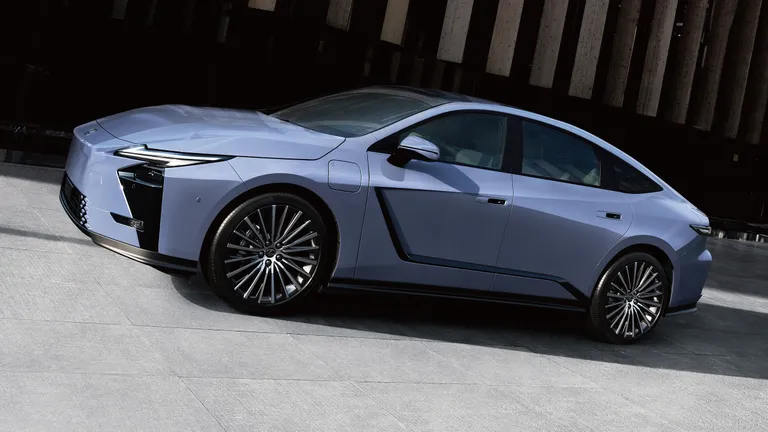
The 2026 Lexus ES 350e is limited to a 307-mile range with its single-motor front-wheel-drive layout and 74.7-kWh battery pack. The dual-motor ES 500e will come with a much shorter 292-mile range due to retaining the same battery pack size while driving the additional rear motor. Meanwhile, its direct BMW EV midsize sedan competitor, the 2027 i3 sedan, will have an estimated range of 440 miles.
ADVERTISEMENT – CONTINUE READING BELOW
There is good news as the ES EV will use the NACS charging port and also include a J1772-CCS adapter, and finding a Tesla Supercharger or DC fast charger shouldn’t be an issue. But in the Toyota way, the ES will be hamstrung with a 150-kW DC charging rate. That will mean 10–80 percent recharges will take 28 minutes at best. Comparing that to the 2027 BMW i3, that is a huge disadvantage as the BMW EV will be able to hit up to 400-kW during its DC charging.
The hybrid ES will also come as FWD or all-wheel drive, but it will of course add a fuel tank to power its 2.5-liter I-4 combustion engine. It will also use a significantly smaller battery pack that is located under the rear seat. But just like the EV, there won’t be a driveshaft running the rear wheels as that task is accomplished by an electric motor. It’s the same hybrid platform the Toyota Camry utilizes, and this also means it isn’t a plug-in hybrid system. Battery charging will only be done with the engine running and will limit the ES hybrid’s EV mode to neighborhood speeds and distances.
ADVERTISEMENT – CONTINUE READING BELOW