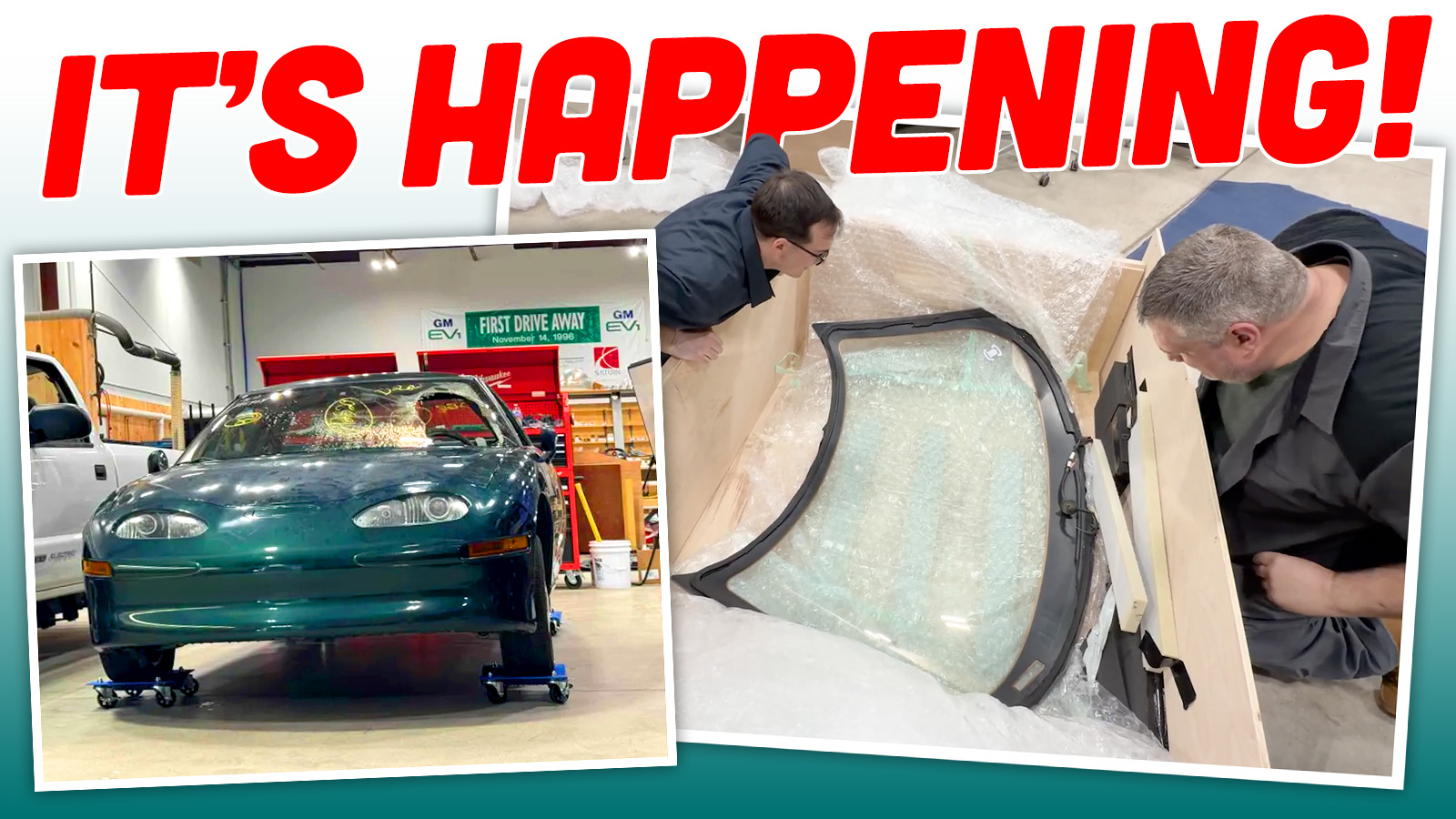
If you haven’t been following the saga of the General Motors EV1 that was abandoned by a university in Atlanta, sold at a tow pound, and became the first EV1 to legally fall into private hands, you’re really missing out. I’ve been covering the story since the car was marked as abandoned and sold for over $100,000, with its new owners planning a full restoration.
Since the news broke of this EV1’s existence and subsequent sale, everyone involved wondered if GM would step in to take the car back, as they’ve been known to do in the past when EV1s end up in the wild. But in a shocking about-face, President Mark Reuss actually invited the new owner, Billy Caruso, and his team to General Motors, and even gave them an interview in which he promised to assist with the rebuild in any way he could.


What Reuss didn’t say was exactly how GM would help, or what parts would be supplied. Now, though, it’s clear that the company is going to great lengths to ensure this car gets back on the road by the end of the year, going as far as to sacrifice an EV1 of its own to make it happen.
For One EV1 To Live, Another Must Die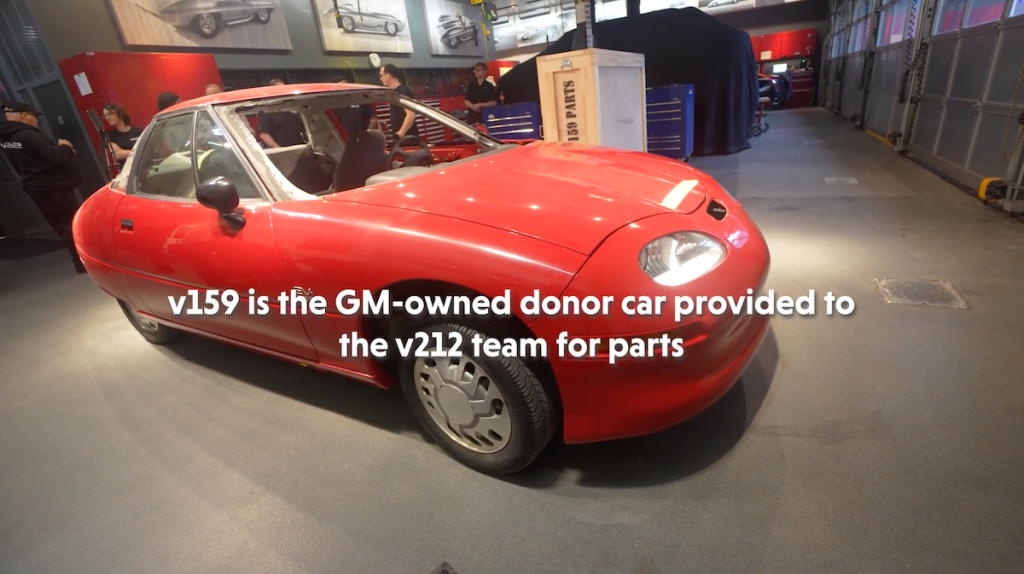 Source: The Questionable Garage
Jared Pink, host of The Questionable Garage on YouTube, has been working closely with Caruso to document and help rebuild the green EV1 in question, nicknamed VIN212. Since Caruso acquired the car, he and his team have stripped it down and had the chassis dry-ice blasted to ensure the restoration was starting from the cleanest slate possible.
Still, Caruso had issues. The EV1 was built using lots of unique parts that couldn’t be found anywhere else. Usually, model-specific parts for rare cars are more expensive and difficult to find, but in the case of the EV1, sourcing replacement parts is legitimately impossible, since most of them were crushed by GM in the ’90s, and the remaining cars are either leased out to museums or universities. So spare parts quite literally do not exist.
As a part of the “decommissioning” process GM performed on the EV1s it donated to universities, many of these unique parts, including the batteries and many of the control modules for the car’s electronics, were unceremoniously ripped out of the car and disposed of. As a result, Caruso was without many of these vital, EV1-only modules, leaving him in a tough spot for the restoration. Also, the car needed a windshield, which would’ve cost more than the price of the car to have custom-made.
But with GM stepping in to help supply some of these parts, the restoration is about to get a whole lot easier. In the video above, the VIN212 team pays a visit to GM’s design center and talks to a trio of employees who normally work on concept car development. It’s here where another EV1, VIN 159, comes into play.
According to Pink, VIN 159 is an EV1 that never left General Motors’ hands. The car was never leased to an individual or to a university or museum, so it was never subject to a decommissioning process. Going by the condition of the car, it doesn’t look like it was kept in tip-top shape since rolling off the line in ’96, either, as it was covered in dust. One of the GM employees says this car was picked as a donor because the rear window—an equally unobtainium part—was shattered. They figured that combining this car and VIN212 would be enough for one complete car, as VIN 159 had a bunch of other components intact and ready to be pulled and installed on the green car.
 Source: The Questionable Garage
“The level of support offered has been unbelievable,” Pink told me. “We went in with fairly high expectations with our visit to Detroit, but they exceeded them 10-fold. Seeing a company as big as GM so excited about the project is amazing, [and] knowing so many impossible parts problems have been solved, at the instruction of Mark, the President of GM, blew my mind.”
It’s not just parts where GM is helping out. The company went as far as to hook up the VIN212 crew with engineers who worked on the EV1 program back in the ’90s, just to make sure they get everything right.
“They organized a round table of original project engineers, for an unfilmed, absolutely raw question-and-answer time, just to make sure we had the knowledge required, which has already saved us from three mistakes,” Pink added.
All The Stuff You Wouldn’t Even Think Of
As it turns out, the industrial parts liquidation listing I wrote about last week, where GM sold a bunch of EV1 parts to an undisclosed buyer, was in fact meant for Caruso and his team. Pink says their agreement with GM means they can’t tell me anything about how much they paid (if anything), and the exact acquisition process. Pink also noted that the list of parts wasn’t everything they’re getting from GM, and that more parts (and another visit to the GM campus) are on the horizon.
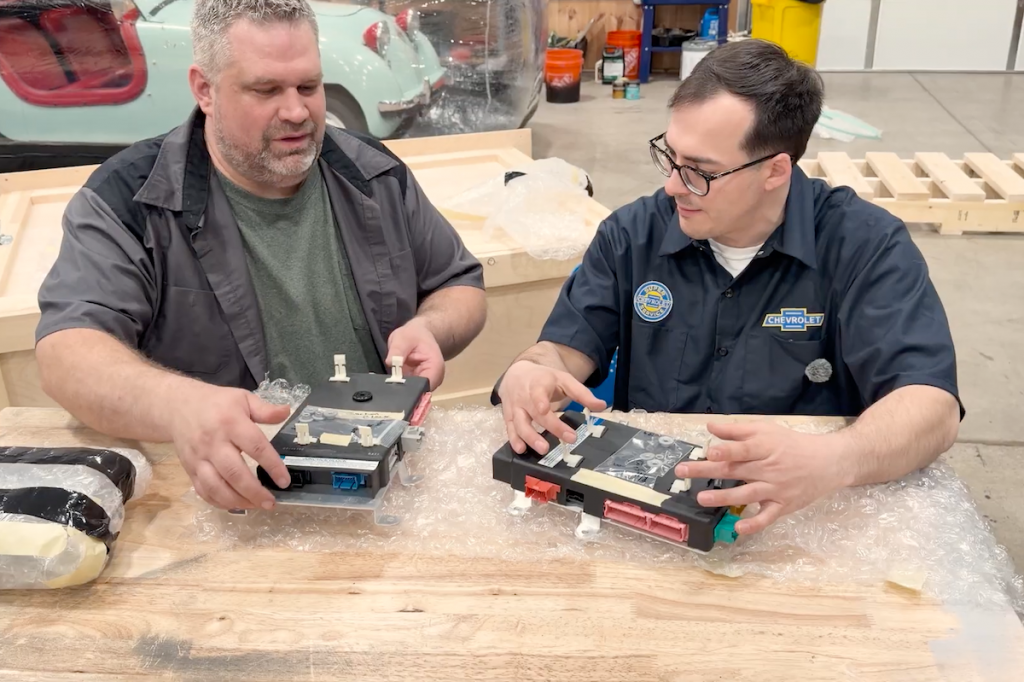 Jared Pink, left, and Billy Caruso, right, holding priceless EV1 modules. Source: The Questionable Garage
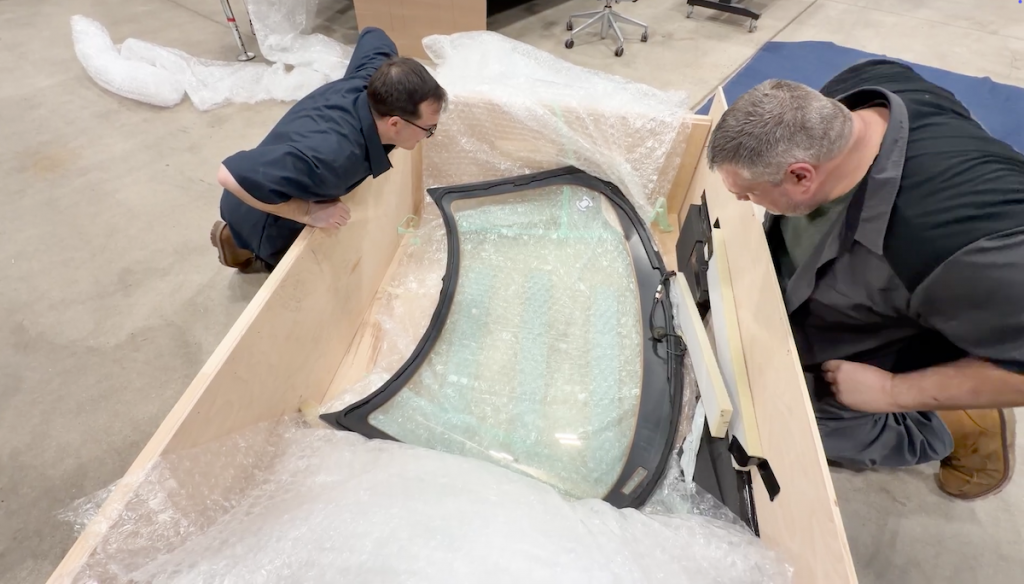
Towards the end of the video, the VIN212 team cracks open a crate with a bunch of parts from the donor EV1. In addition to the most important part, like the windshield, there’s also a rear quarter window complete with its track and rubber gaskets. There’s also a radio, since the one in Caruso’s car was damaged and rusty. Hilariously, even the radio on GM’s donor car didn’t have knobs, as it was a common issue for all GM vehicles of this era. Thankfully, the knobs aren’t EV1 specific, and there are plenty of aftermarket solutions.
There are some other, more obscure parts in the crate, too. Caruso and Pink make a big deal about being able to obtain a brake torque control module, an EV1-specific computer that controls the brake-by-wire rear brakes, and controls the power assist for the front brakes. Without it, they would’ve had to rely on the front brakes alone—doable, but not ideal. But thanks to GM, this problem is solved.
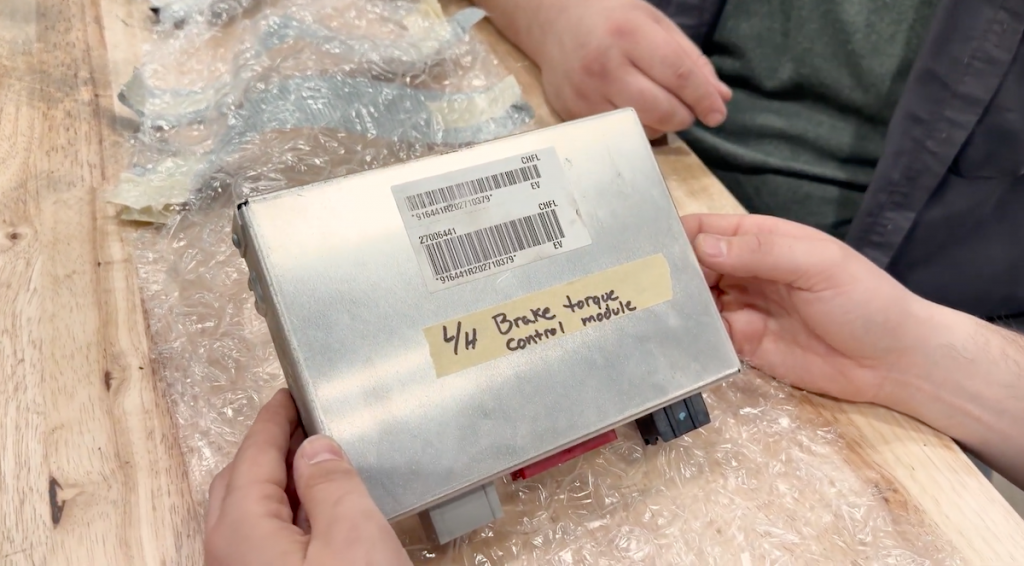 The brake torque control module. Source: The Questionable Garage
Also in the box were two junction boxes—one for each side of the car—solving even more electronics roadblocks. GM even threw in the driver door mirror switch panel for controlling the power side mirrors. It’s little stuff like that, which would’ve been impossible to find and time-consuming to re-make, that makes GM’s support so valuable here.
There Are Still Road Blocks
While some of the biggest obstacles have now been overcome, the VIN212 team still has some things to figure out. Caruso says he wants to register the EV1 in California, which, on its face, sounds like it’d be pretty tough, knowing how the state’s DMV operates. The team isn’t very worried, though.
“The titling paperwork was a little difficult with California at first, but once the local law enforcement VIN verification form was completed, it processed like a normal title,” they told me. “Registration is waiting towards completion. [We’re] hoping the car does not need to travel to California first, as the initial discussions have the unveiling more central in the United States.”
The team also has yet to share what they plan to do about the battery. Sourcing an original EV1 battery is both impossible and likely not a good idea, since the newest original packs—if you can find one—are nearing 30 years old. Either way, I’m deeply excited to see if VIN212 can be on the road by its planned completion date of November 14, 2026–exactly 30 years since the first drive of the EV1 back in 1996. Stay tuned.
Top graphic images: Billy Caruso / The Questionable Garage