BMW once introduced a futuristic electric model under the i3 name. As the only fully battery-electric vehicle from its ‘Project i’ programme—alongside the plug-in hybrid sports car i8—it left a lasting mark on the Munich-based carmaker. Outgoing CEO Oliver Zipse recently cited the lessons from Project i as a key reason why BMW now sees itself ahead of German rivals in electric mobility.
Built on a dedicated electric platform and featuring carbon-fibre construction, the i3 broke new ground. A four-metre compact model wearing the BMW badge was unprecedented at the time. Yet for many, it is the car’s polarising design that remains its most distinctive trait.
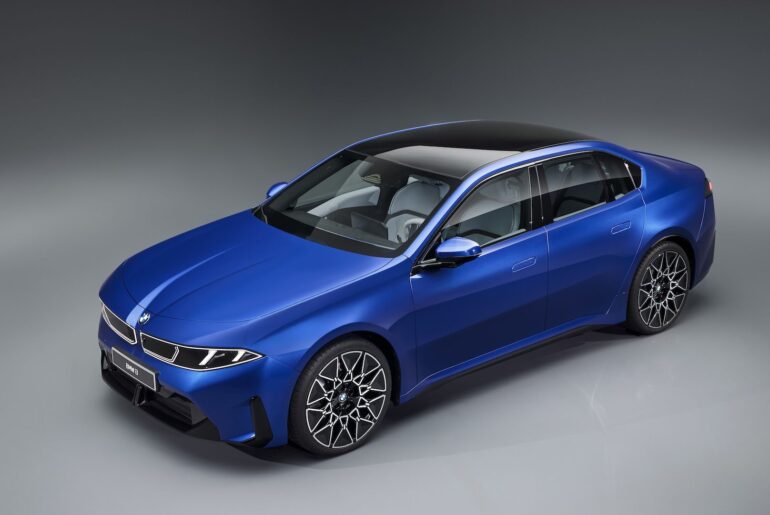
In 2026, the German manufacturer is set to revive the i3 nameplate. This time, the i3 will serve as the all-electric interpretation of the 3 Series—described by BMW itself as ‘the essence of the BMW brand.’ The new model is expected to become a design flagship once again.
Unlike its predecessor, however, the new i3 is not positioned as a technology experiment. As a core model line, expectations are significantly higher. BMW underlines the importance of the 3 Series heritage: “For five decades, this icon has stood for sporty driving pleasure, unmistakably attractive design and consistent progress. A legacy to which every generation of the BMW 3 Series is committed.”
“Every model is a reflection of its era,” said BMW CEO Oliver Zipse at the event in ‘BMW Park’ in front of journalists, stakeholders, and over 4,000 employees—surrounded by all previous generations of the 3 Series. “For five decades, we have inspired people worldwide with our 3 Series.”
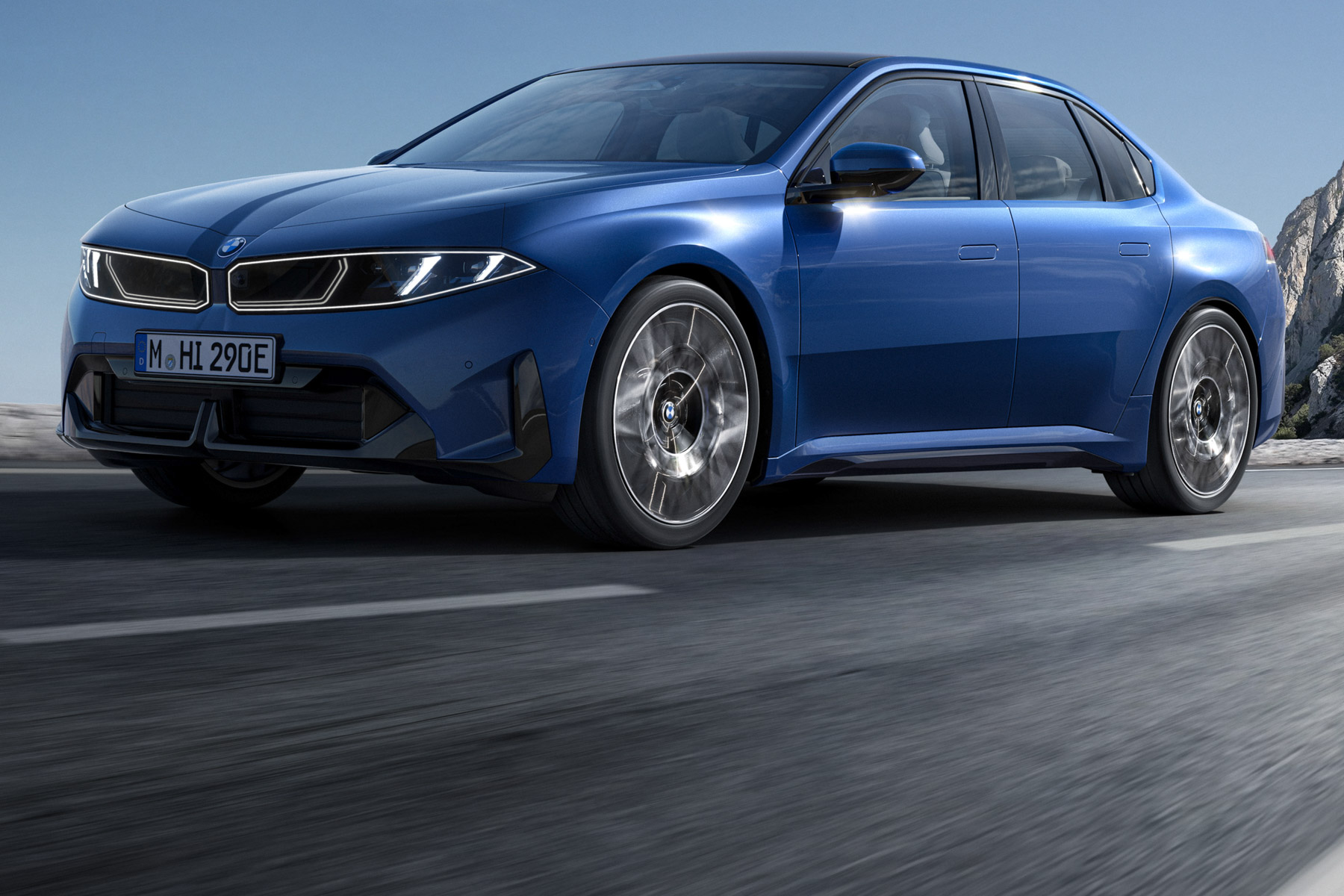
What the carmaker presented in Munich on Wednesday is entirely new, yet it feels remarkably familiar. That is because the production model’s now-revealed design remains very close to the ‘Vision Neue Klasse’ concept unveiled at the IAA in 2023 as a preview of an electric 3 Series. While the iX3, based on the later ‘Vision Neue Klasse X’ concept, was prioritised and became the first production model of the Neue Klasse to reach the market, the design of the i3 has been known in its basic outlines for some time.
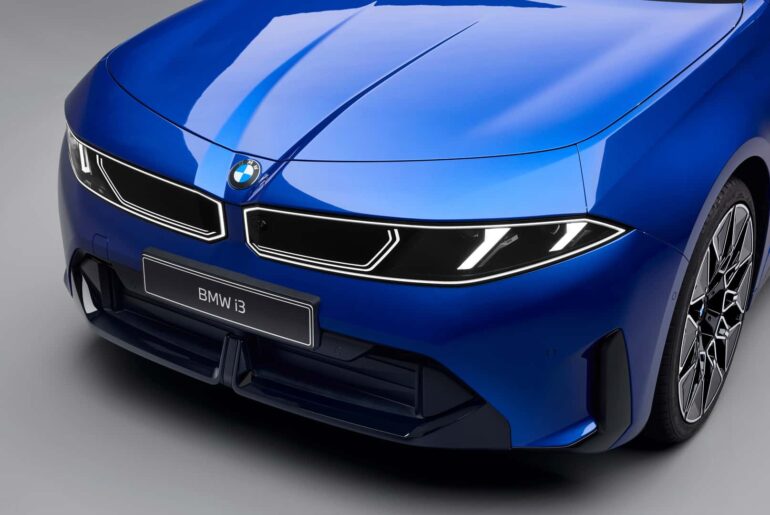
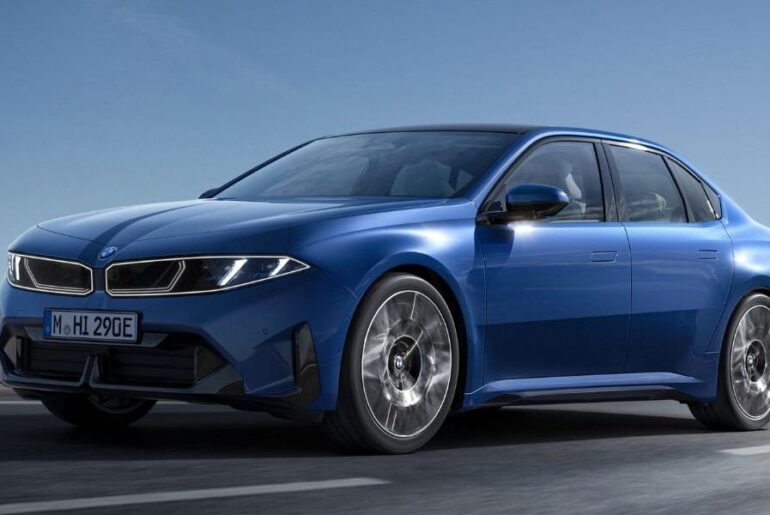
Of course, the i3 is not a 1:1 production version of the concept, where the carmaker only added door handles and conventional side mirrors. Every line has been adjusted, though mostly only slightly. The angles at the windows and roof edge appear less sharp, and the black front splitter made of recycled plastic, which was part of the concept, has been removed for the production version. An air intake is now positioned below the number plate holder. However, many of the defining design elements from the ‘Vision Neue Klasse’ made it into the production model.
For example, the headlights form an optical unit with the BMW kidney grille. “The four-eyed face is familiar, yet still new,” says the manufacturer. “The BMW radiator grille and twin headlights merge into an innovative light signature.” At the rear, the design of the horizontally arranged tail lights is also inspired by the concept, with the lights extending almost to the central BMW logo. However, the designers opted for a slightly different solution in the details. The long wheelbase, short overhangs, and sculpted wheel arches not only emphasise the sporty, wide stance but are also typical of a BMW 3 Series.
The ‘best’ 3 Series goes electric
What has not been typical of a BMW 3 Series until now is the electric drivetrain. However, the Munich-based manufacturer is changing this, emphasising in its communications that the i3 is set to redefine driving dynamics. “Maximising the unmatched capabilities of electric mobility, it offers impressively precise, effortless, and assured handling,” says BMW. This is made possible by the high-performance computer Heart of Joy, which operates ten times faster than previous systems and controls all functions related to driving behaviour and drivetrains.
“The i3 is new, but it remains what a 3 Series BMW is and what our customers expect: the ultimate driving machine,” added Zipse, visibly enjoying the applause from employees. “Regardless of the drivetrain, the 3 Series remains a statement on the road.” During the event, it was also referred to as the “best 3 Series we have ever built”—a legacy for Zipse, who will step down as CEO at the Annual General Meeting in May. And this legacy, the “best 3 Series,” is now electric.
On the drivetrain side, BMW will launch the i3 as the 50 xDrive, pairing dual-motor all-wheel drive with 345 kW of system output and up to 645 Nm of torque. To see how the drivetrain performs in the iX3, you can read our first driving review here.
The i3 uses BMW’s sixth-generation electric motors. At the rear axle, BMW installs an electrically excited synchronous motor (SSM)—a further development of the Gen5 unit, now optimised for the Neue Klasse’s 800-volt architecture.
At the front axle, BMW takes a different approach. Instead of a second SSM, the company uses an asynchronous motor (ASM). In this setup, the rotor’s magnetic field is generated via induction from the stator. These motors are typically more compact and cost-efficient, although slightly less efficient than SSM units.
However, since all-wheel-drive electric cars usually operate with just one motor in everyday use, the efficiency disadvantage of the ASM should not be significant. BMW itself describes the i3 50 xDrive as having ‘very high long-distance capability.’
The range is expected to reach up to 900 kilometres according to WLTP, while the iX3 50 xDrive achieves up to 805 kilometres. The preliminary figure of around 900 kilometres (the final value will be confirmed at the world premiere) is particularly impressive for technical reasons.
The key factor is the battery. With the Neue Klasse, BMW has not only switched to an 800-volt architecture but also moved from prismatic cells in modules to large-format cylindrical cells integrated into the vehicle using the cell-to-pack concept. For high-floor models (i.e., SUVs) like the iX3, 46120-format cells are used, which are 46 mm in diameter and 120 mm high. In low-floor models—such as saloons and estates—4695 cylindrical cells are installed, which are 20 per cent shorter at the same diameter and thus offer correspondingly less energy content.
While BMW has not yet disclosed the exact energy content of the i3’s battery, given its otherwise comparable dimensions to the iX3, it is highly likely that the 25-millimetre flatter battery pack offers around 20 percent less energy content than the iX3—approximately 86 kWh of usable energy instead of 108 kWh.
Industry experts had therefore estimated a range of around 800 kilometres. If the flatter and more aerodynamic i3 were to achieve a comparable range to the iX3 with a battery around 20 per cent smaller, that alone would already underline its efficiency—yet at 900 kilometres, it even surpasses it.
This also sends a clear signal towards Stuttgart. Mercedes does not yet offer a directly comparable model—the C-Class with EQ technology is still in development. However, the slightly smaller CLA 250+ delivers up to 792 kilometres with a net energy content of 85 kWh and a 200 kW rear-wheel drive. The CLA 350 4MATIC, with an all-wheel drive rated at ‘just’ 260 kW, reaches 771 kilometres in the WLTP test. The larger and more powerful BMW goes further with a similarly sized battery.
Despite the smaller battery, the i3 is expected to deliver comparable charging performance to the SUV model. That means that up to 400 kW of power can flow into the i3 at a sufficiently powerful fast-charging station, allowing up to 400 WLTP kilometres of range to be added in just ten minutes. With a WLTP range of 900 kilometres (or 90 kilometres per ten per cent charge), it means that starting from ten per cent charge, the battery will be more than half full after just ten minutes.
Like the iX3, the i3 will also support bidirectional charging, including functions such as Vehicle-to-Load (requiring the optional AC Charging Professional), Vehicle-to-Home, and Vehicle-to-Grid.
At the design premiere, BMW not only provided a look at the body but also at the interior. Following the world premiere of the iX3, there are few surprises here. Typical of the Neue Klasse are the striking steering wheel, the central touchscreen with angled sides, and the BMW Panoramic iDrive—a continuous display band at the lower edge of the windscreen.
Of course, assistants and connectivity are very important factors in a new 2026 model. However, at BMW, and especially for the 3 Series, the focus in Munich remains firmly on driving. ‘The i3 is great fun, especially when the road gets twisty and challenging,’ said Zipse. And it will soon offer even more practicality: although it has long been considered a certainty, Zipse confirmed the i3 Touring as an electric estate.