This story was originally published on WardsAuto. To receive daily news and insights, subscribe to our free daily WardsAuto newsletter.
Hidden deep within dense woodland and rolling hills 100 miles or so south of Stuttgart sits Mercedes-Benz’s vast Immendingen proving ground.
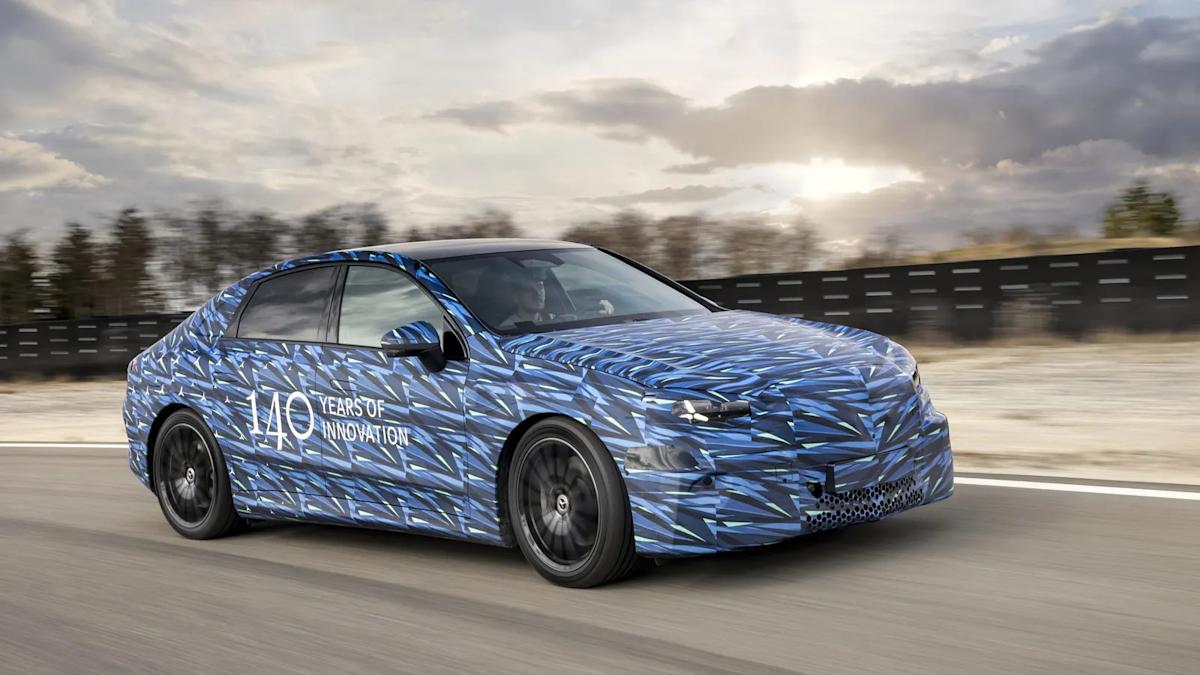
A small group of engineers and two disguised prototypes recently awaited us behind heavily secured gates, and the facility’s complex of handling tracks, durability routes and engineering workshops, where the company signs off new models before they reach production, recently provided the setting for our first close look at the upcoming electric C-Class.
Even through the strategic camouflage, their significance is clear. For more than three decades, the internal combustion engine C-Class has been one of Mercedes-Benz’s key global models in terms of sales, and the new electric version is expected to carry a similar responsibility as the German automaker expands its electric model line-up into higher-volume and more profit-oriented segments.
Tesla’s Model 3 has held a commanding sales position for years. Now BMW is preparing to introduce its new i3 sedan, the electric equivalent of its signature 3 Series, while Audi is also planning to follow with an electric A5 before the end of the decade. And Mercedes-Benz is preparing to take them on with a new generation of electric vehicle technology.
Dedicated MB:EA electric vehicle architecture
The electric C-Class, known internally under the development code W520, is based on Mercedes-Benz’s MB.EA platform, an entirely new architecture developed specifically for midsize electric vehicles and shared with the recently unveiled electric GLC SUV.
The skateboard-style platform supports an 800-volt electrical system and a new family of Mercedes-Benz-developed electric motors that will allow the new sedan to be offered with both rear-wheel drive and four-wheel drive configurations.
The development prototypes we ride in today are both initial top-of-the-range C400 4Matic Electric versions, engineers confirm. Mercedes-Benz is keeping official figures under wraps ahead of the model’s formal debut next month, but we’re told its drivetrain closely mirrors that of the GLC 400 4Matic Electric unveiled late last year and due for U.S. sale next year.
This points to output in the region of 483 hp and 596 lb.-ft. of torque delivered through two electric motors. The primary motor sits at the rear axle and features a two-speed transmission, while a second motor integrated into the front axle provides additional performance and traction when called upon.
Battery sizes vary depending on the model. Engineers say the electric C-class line-up will eventually include packs ranging from around 64 kWh to 94 kWh, with the largest capable of delivering more than 435 miles of range on the WLTP cycle. Mercedes-Benz estimates an EPA figure in the region of 380 miles.
Maximum DC fast-charging capacity will reach 330 kW, again matching the specification of the electric GLC.
Mercedes-Benz has yet to publish official specifications, but it says buyers should expect a model structure broadly similar to that of the GLC Electric lineup. For the U.S., this suggests a rear-wheel-drive C300+ using a single rear-mounted electric motor, alongside the C300 4Matic and the C400 4Matic experienced in our preview.
An even more extreme model is already under development. Mercedes-AMG engineers are working on a high-performance flagship using three axial-flux electric motors and a new round-cell battery concept.
Traditional sedan proportions
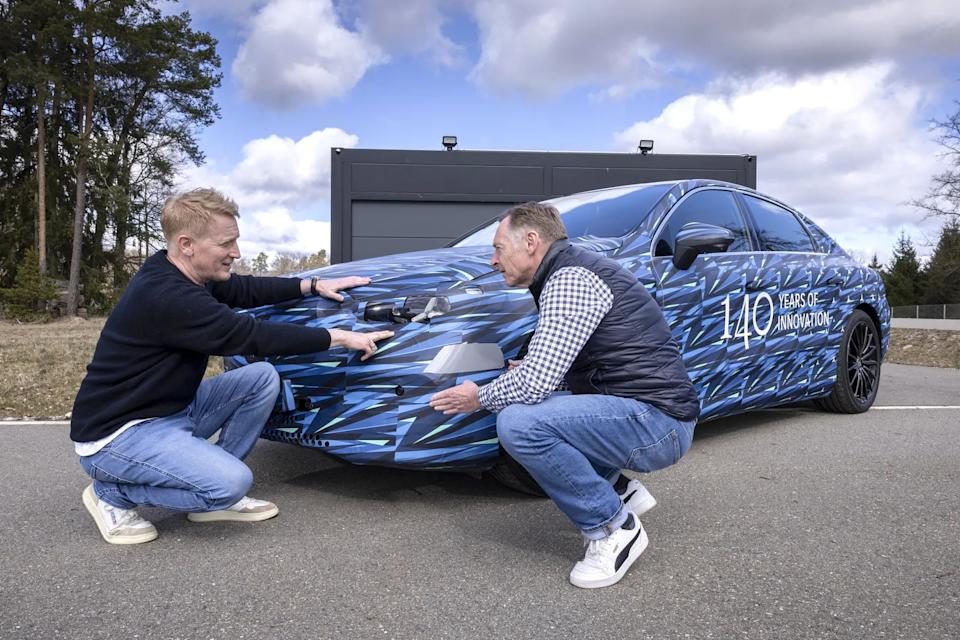
Despite the heavy camouflage, the prototypes provide clear clues about Mercedes-Benz’s evolving electric design direction. Earlier upmarket offerings such as the EQE and EQS adopted a more radical, cab-forward silhouette shaped primarily by aerodynamic efficiency.
The new C-Class Electric returns to a more conventional sedan profile, though with sufficient visual distinction from the existing internal combustion engine C-Class to set it apart immediately.
Two elements stand out. The front end incorporates Mercedes-Benz’s new illuminated “Iconic” grille, first seen on the GLC Electric, giving the car a more upright and assertive look. At the rear, however, the design marks a more noticeable shift. The rear window is set at a shallow angle, giving the electric C-Class a fastback-like appearance even though it retains a conventional trunk lid.
Mercedes-Benz says the new electric sedan rides on a longer wheelbase and wider track than the current fifth-generation internal combustion engine C-Class. The changes help improve interior packaging while accommodating the battery pack entirely within the floor. In addition to the traditional rear trunk, the car also features a front cargo compartment, increasing overall load capacity.
“Superscreen” tech and improved packaging
Mercedes-Benz was not yet ready to show the interior in full detail during our visit, with much of the cabin still partially disguised beneath development coverings. Even so, the electric C-Class will adopt the same MBUX Superscreen layout already introduced on the electric GLC.
It stretches across the dashboard in one continuous panel and combines three individual displays: a 10.3-inch digital instrument cluster, a 14-inch central infotainment display and a 14-inch passenger display.
The new EV architecture also brings better packaging. The absence of a transmission tunnel and the use of an almost flat floor, combined with the electric C-Class’s longer wheelbase, provide increased interior space compared with today’s C-Class, with the gains most noticeable in the rear, where passengers benefit from additional leg room.
Ride highlights refinement and balance
Our passenger-seat evaluation begins on Immendingen’s handling circuit alongside Dirk Kreuzberger, head of C-Class chassis development.
The smooth-surfaced track, designed to resemble sections of the Nürburgring in character, combines fast sweeping bends with abrupt elevation changes and surface transitions intended to simulate longitudinal and lateral loads while exposing weaknesses in suspension tuning.
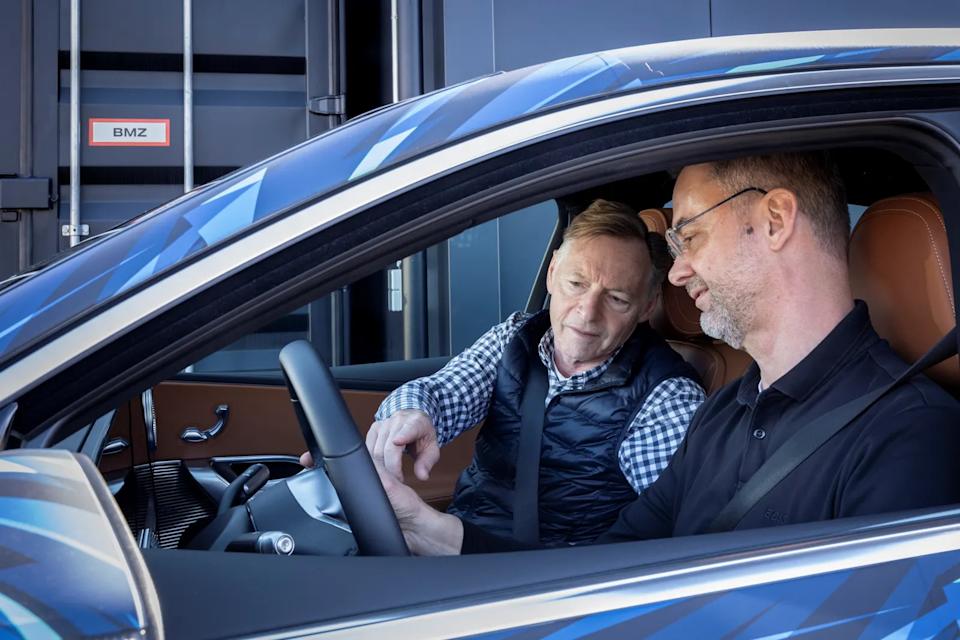
Acceleration of the C400 4Matic felt strong and effortless, with a surge of acceleration not upsetting the composed feel from the passenger seat. Body movements were tightly controlled and the front axle maintained solid grip as Kreuzberger builds speed through the circuit’s faster corners.
Rear-wheel steering can angle the rear wheels up to 4.5 degrees, helping the car rotate through tighter bends before stabilizing on exit. Engineers say the system will be offered as an option on U.S.-market models.
One section of the circuit includes a pronounced crest followed immediately by a compression severe enough to unsettle your stomach. Here the suspension gathered the body quickly after the initial movement, settling almost immediately before the next corner.
Later, another development vehicle driven by Mercedes-Benz ride engineer Ewald Dirks took us onto rougher public roads surrounding the test facility.
The road surfaces here are deliberately chosen for development work. Broken asphalt and uneven patches help engineers identify vibration or noise issues before production vehicles are finalized.
Yet the cabin remained notably quiet. Road noise was very subdued and the car isolates occupants from the harsher impacts typical of such surfaces in a way that suggest the electric C-Class will be among the most refined offerings in its class.
The chassis uses double-wishbone suspension at the front and a multi-link rear axle, broadly similar in layout to the internal combustion engine C-Class. Standard versions will use steel springs, while higher-spec models, including the prototypes we sample, will offer Airmatic air suspension.
Dirks also demonstrated the adjustable regenerative braking system, capable of recovering up to 300 kW. Drivers can adjust recuperation levels using paddles mounted behind the steering wheel.
Production begins in 2026
Production of the C-Class Electric is set to kick off at Mercedes-Benz’s Kecskemét plant in Hungary during the second quarter of 2026. North American deliveries are planned to follow early in 2027.
From this early passenger-seat experience, the message from Immendingen is clear. Mercedes-Benz is not attempting to reinvent the C-Class for the electric age so much as translate the qualities that have long defined its popular sedan — refinement, composure and everyday usability — into a contemporary electric model that, based on our brief time in these pre-production prototypes, appears well placed to challenge the segment’s established leader when it reaches the market.
Recommended Reading
Mercedes-Benz VLE EV shows that vans can be luxury limos