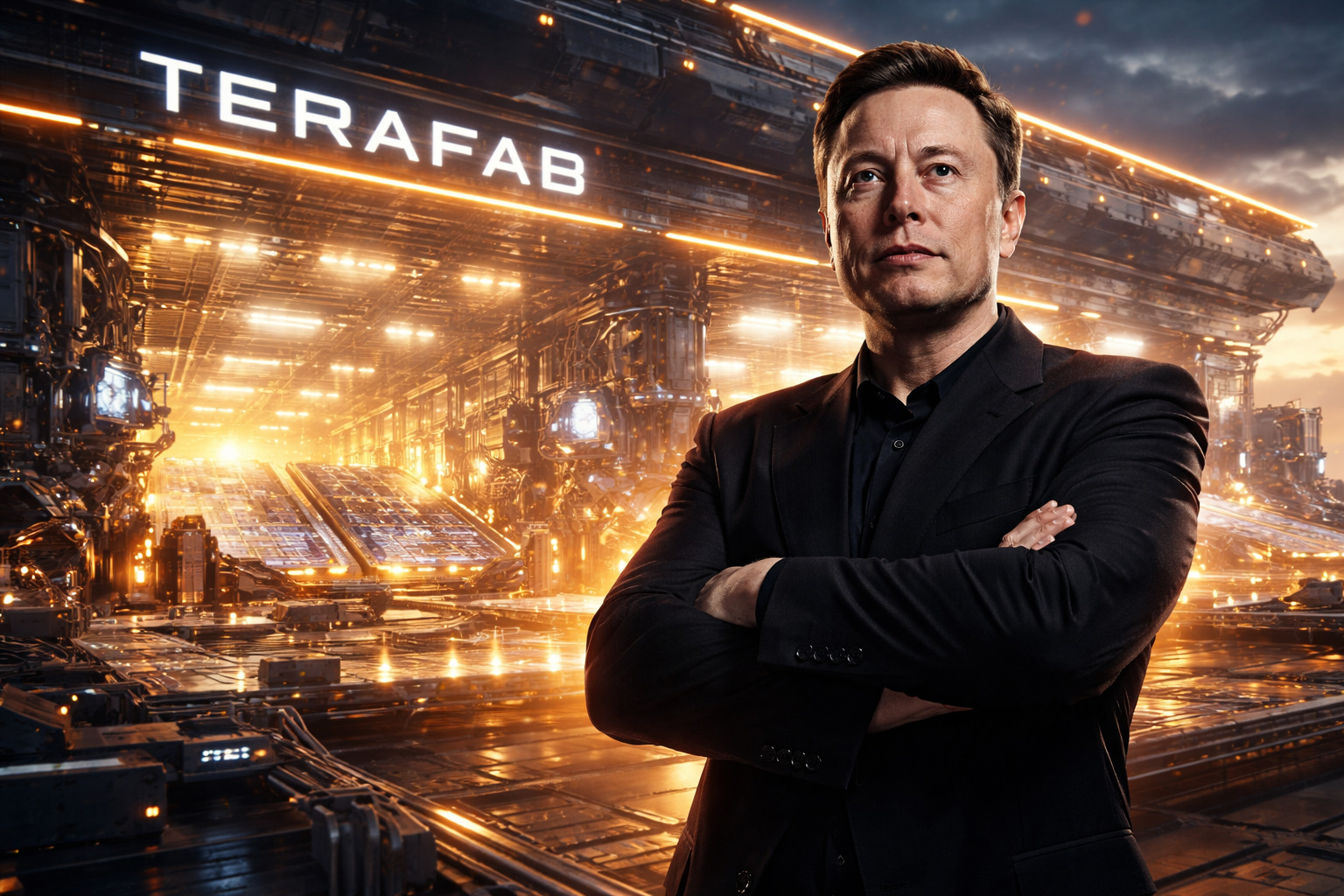
Elon Musk has once again pulled out all the stops, announcing on X that his “TeraFab Project” will launch in seven days. That’s typical Musk: maximum hype, minimum substance in the first sentence. But behind the usual hype lies a topic that actually carries weight this time: Tesla apparently no longer wants to rely on the fact that somewhere in Asia, enough capacity will become available if they just wave their cash around loudly enough.
And that brings us straight to the heart of the matter. Tesla is no longer just a car manufacturer with a display and a battery, but a corporation that needs increasingly specialized silicon solutions for FSD, Dojo, robotics, and AI inference. Anyone who wants to seriously compete in this game eventually realizes that the bottleneck isn’t the idea, but the manufacturing. Today, almost anyone with enough engineers, EDA tools, and investor money can do the design. Very few can handle production at a modern level. That’s exactly where the power lies, and that’s exactly where the dependency lies. Musk’s basic idea isn’t stupid, quite the opposite. The U.S. has a structural problem when key companies like Tesla, NVIDIA, or AMD are essentially dependent on TSMC for high-end manufacturing. As long as everything runs smoothly, it’s called efficiency. As soon as Taiwan becomes geopolitically unstable or demand explodes, it’s suddenly called risk. And in an industry like this, risk very quickly turns into an expensive form of organized helplessness.
Now to the big number that’s been flying around for weeks: 100 to 200 billion chips per year. That sounds massive, and it’s meant to. It’s the kind of number that works brilliantly in headlines because it oscillates between industrial fantasies of omnipotence and strategic sabre-rattling. But a quantity figure without context means very little at first glance. A simple controller is not an AI accelerator, a packaging module is not a full-fledged high-performance chip, and volume does not replace process depth. Anyone who simply reads “bigger than TSMC” into this is confusing scale with competence. Because that’s exactly where the uncomfortable part begins—the part fans like to gloss over. A foundry is not just another Tesla factory with more stainless steel and less paint. Modern semiconductor manufacturing is a highly sterile, chemically and process-controlled integrated system in which yield, defect density, lithography, metrology, packaging, and the supply chain mesh together like the gears in a clock that burns millions for every moment of downtime. This is no stage for spontaneous inspiration, but an industry where even the smallest errors turn entire wafer sets into hazardous waste.
Terafab Project launches in 7 days
— Elon Musk (@elonmusk) March 14, 2026
Things get particularly grim when considering Musk’s earlier remarks, suggesting that the topic of cleanrooms apparently needs to be viewed less dogmatically. This is one of those moments when vision tips over into satire. Cutting-edge technology in semiconductor manufacturing doesn’t thrive on someone “rethinking” the rules, but on taking physics, materials science, and process control dead seriously. Dust particles don’t engage in debates via tweets. Contamination can’t be negotiated away with charisma. Anyone who believes one can work at this level with revolutionary nonchalance learns very quickly that reality has no fanbase. Nevertheless, it would be too simplistic to simply dismiss the whole thing as a typical Musk-style delusion of grandeur. For there is indeed a realistic scenario in which the so-called TeraFab does not become a completely independent Tesla foundry in the traditional sense, but rather a hybrid model. In other words: Tesla contributes capital, volume commitments, perhaps packaging integration, and vertical process control, while an established partner like Intel Foundry or TSMC provides or secures the actual manufacturing technology. That would be far more plausible than the idea that Tesla will simply march into the Champions League of chip production and compete on equal footing from day one.
And that is precisely where the real strategic value could lie. Not in Musk playing the role of semiconductor messiah tomorrow, but in major customers beginning not only to secure manufacturing capacity but to structurally lock it in. Exclusive production lines, co-investments, reserved nodes, on-site packaging, tight integration with their own system architecture—that wouldn’t be science fiction, but hard-nosed industrial policy with a company logo. So in the end, it remains a double-edged sword. The idea behind it is rational, the scale is brutal, and the technical implementation would be a suicide mission if Tesla really wanted to tackle this alone. Musk is addressing a real problem, but as so often, he’s already selling the solution with fanfare before it’s even clear whether there’s a factory, a joint venture, or just the next wildly hyped announcement behind the curtain.
In other words: The dependence on foreign foundries is real. Musk’s diagnosis is accurate. Whether his solution is more than an industrially orchestrated adrenaline rush, we’ll only see next week when the buzzword actually becomes a viable concept. Until then, the TeraFab is one thing above all else: a promise with a very expensive price tag.