REGULATORY TOOLS:
The government could delay permits for manufacturers suspected of exploiting loopholes, impose tariffs or invoke eminent domain
By Fang Wei-li and Jonathan Chin / Staff reporter, with staff writer
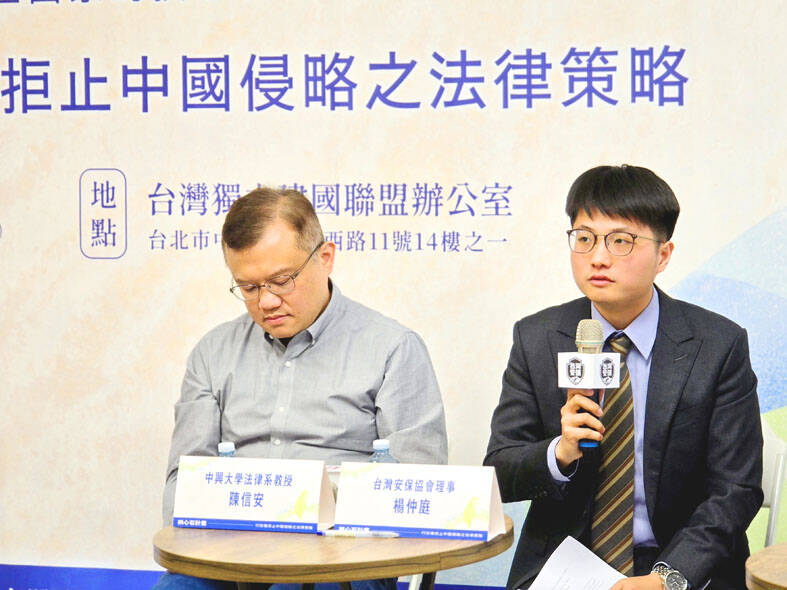
Experts at a forum in Taipei yesterday called on the government to use executive orders to counter Beijing’s bid to flood the Taiwanese market with Chinese electric vehicles (EV) by exploiting legal loopholes.
Taiwan National Security Institute board member Yang Chung-ting (楊仲庭) told the forum that China-based MG and BYD are exporting components to Taiwanese proxies who reassemble the parts into whole vehicles for sale.
The forum was jointly hosted by the institute, Better Together for NextGen Taiwan and the Youth Jurist Association of Taiwan.
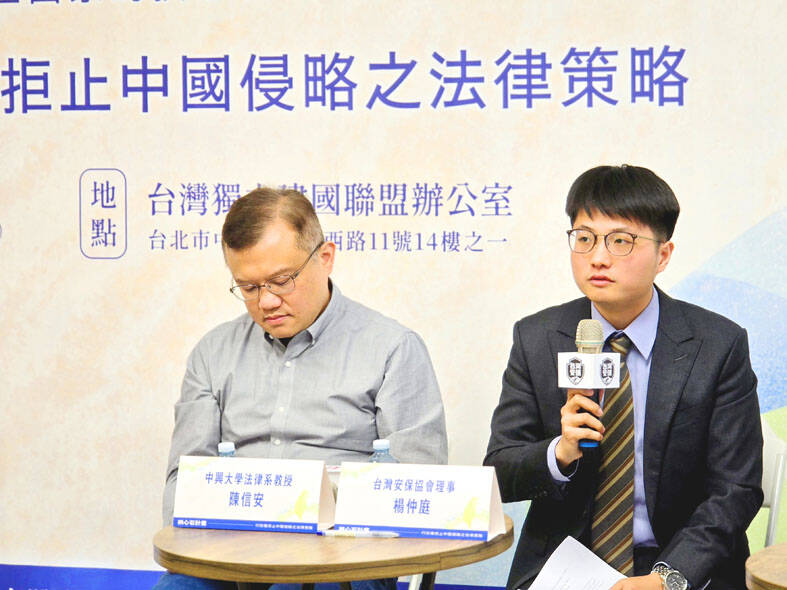
Photo: Fang Wei-li, Taipei Times
China is aggressively exporting EVs, lithium batteries and solar panels to the rest of the world as part of a strategy to seize global economic and technological leadership, Yang said.
MG and BYD’s strategy of exporting car parts to skirt measures blocking the sale of Chinese cars could be stopped by regulatory tools the government already possesses, he said.
The Ministry of Economic Affairs in its 2024 guidelines for the localization of supply chains stipulated that automakers must increase the share of Taiwan-made components in their vehicles by up to 35 percent each year, he said.
The measure mandates that carmakers must increase the share of domestically produced parts in car models already available in the commercial market, providing a powerful deterrence against attempts to obfuscate a product’s place of origin, Yang said.
The government is more than capable of foiling Chinese EV makers’ attempt to break into the Taiwanese car market by using the discretionary authority already available to it, he said.
These instruments include administrative interpretations of the law and enforcement rules that the Executive Yuan could issue to regulators without amending or passing laws through the legislature, Yang said.
The government could also demand that manufacturers suspected of being complicit in the exploitation of legal loopholes provide additional documents, and delay the issuance of certificates and permits to increase their costs, he said.
National Chung Hsin University law professor Chen Hsin-an (陳信安) said regulators should specify the issue each measure intends to address.
National security interests, economic order and protection for domestic industries are distinct legal categories that grant significantly different powers and latitude in enforcement and implementation, he said.
Invoking the appropriate category would give the government the correct regulatory tools to apply to a situation, Chen said.
Taiwan National Security Institute deputy secretary-general Ho Cheng-hui (何澄輝) called on the government to exercise its authority to impose tariffs and bans, and invoke eminent domain privileges to protect the nation’s economic integrity.