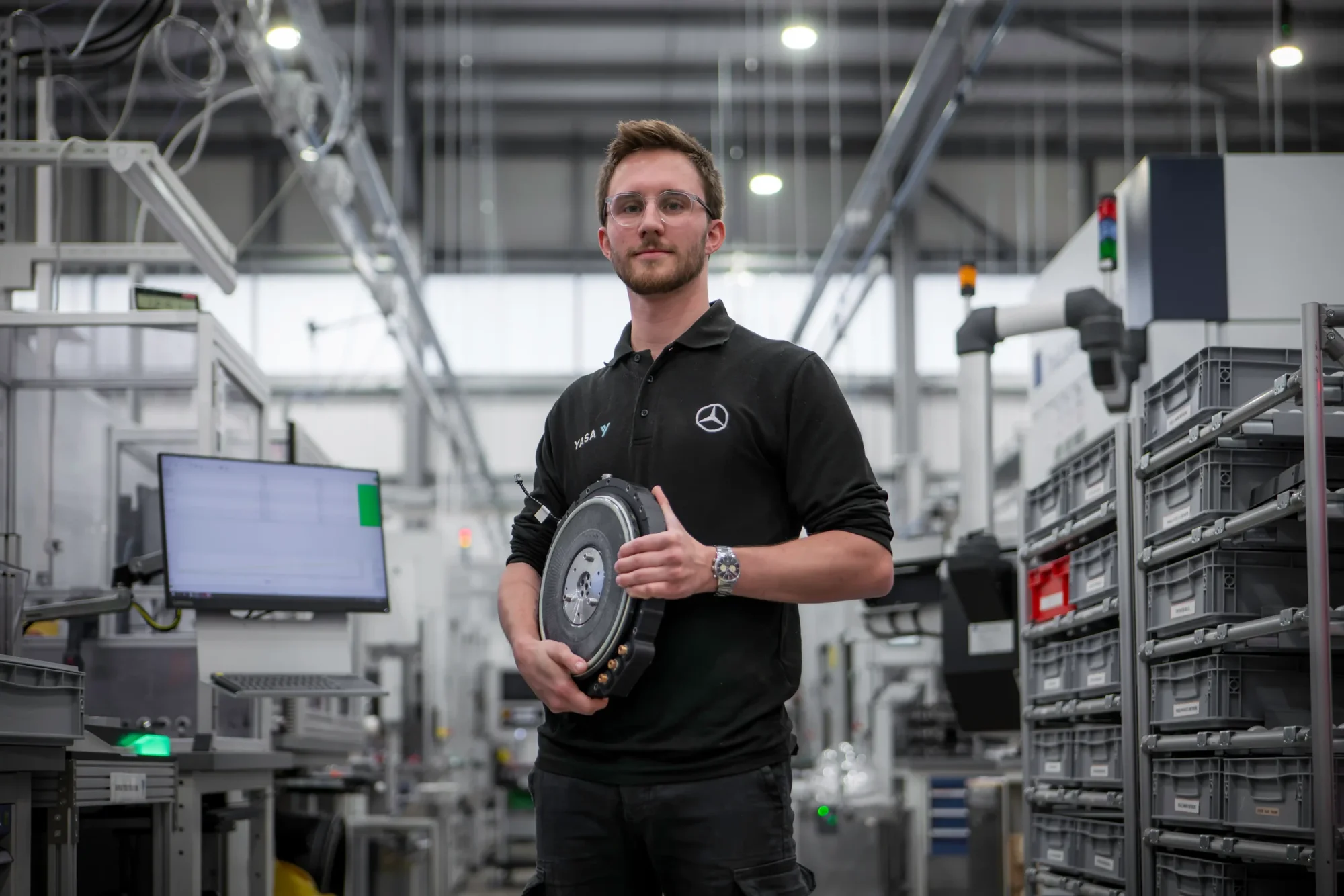
A 28-pound electric motor that puts out more than 1,000 horsepower sounds like something a screenwriter invented for a car commercial. It isn’t.
YASA, a British electric motor company owned by Mercedes-Benz and based out of an innovation center in Oxford, has done it twice now, and the second time came only a few months after the first. The company builds what are called axial flux motors, a design that stacks magnetic components differently than conventional motors, producing more power from a much smaller package. Earlier this summer, YASA set an unofficial world record for power density with a 13.1-kilogram motor producing 550 kilowatts. Then it went back to the dyno and beat itself.
The new prototype weighs 12.7 kilograms (28 lbs) and generates a peak of 750 kilowatts, which works out to just over 1,000 horsepower. That translates to a power density of 59 kilowatts per kilogram, a 40 percent jump over the already record-setting figure from just months prior.
The new prototype weighs 12.7 kilograms (28 lbs) and generates a peak of 750 kilowatts. (CREDIT: YASA) Not a rendering, not a simulation
Tim Woolmer, YASA’s founder and chief technology officer, was direct about what the company had actually built. “This isn’t a concept on a screen,” he said. “It’s running, right now, on the dynos. We’ve built an electric motor that’s significantly more power-dense than anything before it, all with scalable materials and processes.”
That distinction matters more than it might seem. The electric motor space has no shortage of announced breakthroughs that live primarily in press releases and CAD files. YASA is describing a physical object generating real data in real time, something its chief of new technology, Simon Odling, was eager to emphasize. “This is real hardware, in real life, delivering real data,” Odling said, “and it’s performing beautifully.”
The motor’s peak output is the headline figure, but sustained performance tells a more complete story. Continuous power, which is what actually drives a vehicle over time rather than just during a brief surge, lands somewhere between 350 and 400 kilowatts, or roughly 469 to 536 horsepower. That continuous power density of approximately 27.6 kilowatts per kilogram exceeds the peak figures of most competing motors outright.
For comparison, some of the other power-dense motors that generated attention in recent years, including units from H3X and Equipmake aimed at aerospace and marine applications, top out around 13 to 14 kilowatts per kilogram at peak. Donut Labs produced an automotive hub motor earlier this year that reached 15.8 kilowatts per kilogram. YASA’s new prototype is nearly four times that.
Where the competition actually stands
Before YASA’s first record this summer, the most power-dense motor covered in the specialty press was the Evolito D250, an aerospace spinoff with its own roots in YASA’s axial flux lineage, rated at 28 kilowatts per kilogram. Around the same time, British firm Helix tested its SPX177 radial flux motor, a 28-kilogram unit built for a hypercar project that hit 711 kilowatts, putting its density at about 25.4 kilowatts per kilogram.
Breakdown of an axial flux electric motor. (CREDIT: YASA)
YASA’s new number bests both of those by more than double.
Joerg Miska, YASA’s CEO, framed the gap this way: “With three times the performance density of today’s leading radial flux motors, YASA continues to redefine the boundaries of what’s possible in electric motor design.” The comparison to radial flux motors is significant because radial flux is the dominant architecture in mass-market electric vehicles today, including those from Tesla and most other mainstream manufacturers.
The three motors in a Tesla Model S Plaid combine for roughly 1,020 horsepower. YASA’s single 12.7-kilogram prototype essentially matches that on its own.
Engineered for scale, not just spectacle
One recurring point in YASA’s announcements is that the motor uses no exotic or prohibitively expensive materials. That’s a pointed contrast to some high-performance motor programs where cost and manufacturability are treated as problems for someone else to solve later. YASA describes the design as scalable, built on precision engineering, advanced thermal management, and packaging optimization rather than rare-earth windfalls or one-off fabrication techniques.
The Advanced Propulsion Centre in the UK provided support for the motor’s development, which gives it a degree of institutional backing beyond a single company’s ambitions.
Whether any of this reaches consumers anytime soon is a different question. YASA declined to offer even a rough timeline for when this prototype architecture might move toward production. Mercedes-Benz is confirmed to be using YASA axial flux motors in an upcoming electric AMG super-GT, but what goes into that car may differ substantially from what’s currently running on the test bench. The record-breaking prototype remains in a rigorous development program, and the company is continuing to release updates as testing progresses.
YASA is a British electric motor company owned by Mercedes-Benz and based out of an innovation center in Oxford. (CREDIT: YASA)
The Helix SPX177, by contrast, was built more like an F1 development exercise, with ultimate performance as the singular goal and production viability a distant consideration. YASA is explicitly not doing that, which suggests this technology has a longer arc in mind.
Practical implications of the research
For the automotive industry broadly, a scalable, high-density motor architecture that doesn’t rely on exotic materials represents genuine leverage.
Smaller, lighter motors mean more flexibility in vehicle design, including the possibility of packaging multiple motors into platforms without the weight penalties that currently come with that approach.
Performance vehicles stand to benefit most immediately, but the underlying engineering, particularly the thermal management and packaging methods that allow such power from such a small unit, could influence drivetrain design across segments over time.
If the architecture proves manufacturable at the scale YASA suggests is possible, the gap between hypercar-grade power density and production-vehicle hardware could close considerably in the coming years.
Related Stories