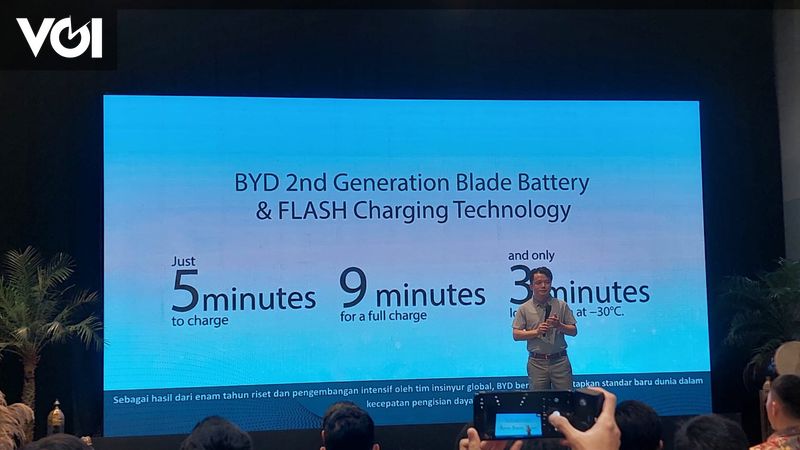
JAKARTA – BYD has introduced a new breakthrough in the field of electric vehicle technology through the Second Generation Blade Battery combined with the Flash Charging fast charging system. This innovation is designed to overcome a number of challenges that electric cars have been facing, ranging from charging time to battery performance in extreme temperature conditions.
President Director of PT BYD Motor Indonesia Eagle Zhao, explained that the development of this latest battery is also focused on improving safety aspects. According to him, the second generation Blade Battery has passed a variety of extreme endurance tests.
“The second generation Blade Battery has undergone various challenging tests, including under body impact tests. In these tests, this new battery is able to withstand impacts of up to 1,500 joules on the underside of the vehicle, or about 10 times higher than the applicable national standards,” said Eagle in Central Jakarta, Monday, March 9.
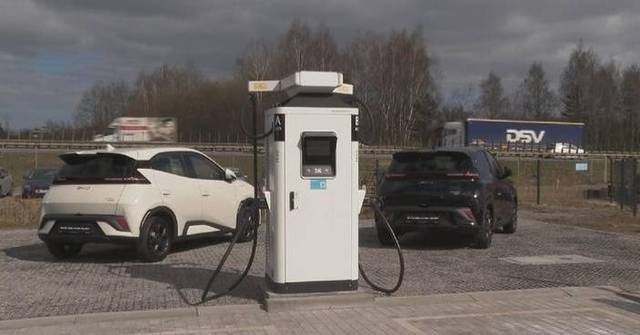
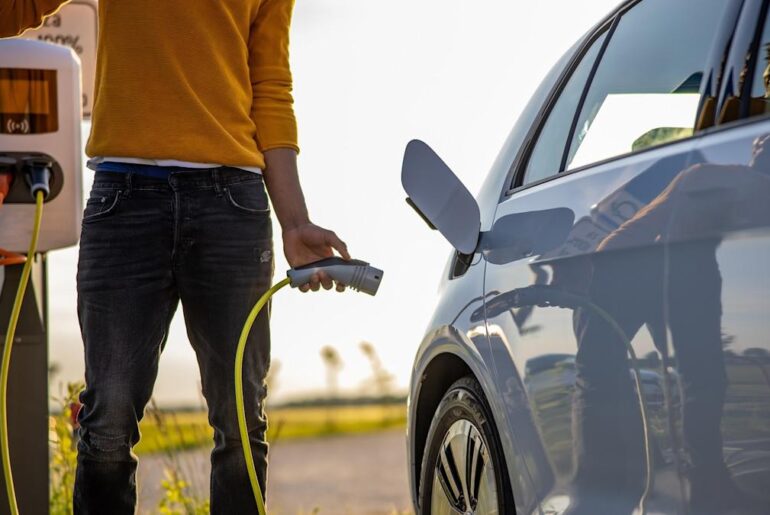
In line with the development of the battery, BYD also presents Flash Charging technology which allows the charging process to take place very quickly, just like filling fuel in a conventional car. Through this technology, electric vehicles are able to charge from 10 percent to 70 percent in just about five minutes.
Even to reach a capacity of 97 percent, the charging time required is claimed to be only about nine minutes. This speed is said to be close to the fuel filling time of conventional vehicles.
Not only fast, this charging system is also able to work well at very low temperatures. BYD said that at a temperature of minus 30 degrees Celsius, the charging process from 20 percent to 97 percent only takes an additional three minutes compared to normal temperature conditions.
The second generation Blade Battery is the result of six years of research and development by BYD. In its development, the company has tried to combine two aspects that have been difficult to achieve together, namely super fast charging and high energy density.
BYD said that this latest battery energy density has increased by about 5 percent compared to the previous generation. The increase is also supported by a heat management system consisting of a Lithium-Ion High-Speed Channel and a Full-Spectrum Intelligent Thermal Management System.
Both technologies work to keep the battery temperature stable by minimizing the heat generated during the charging process while accelerating the heat dissipation process.
With the support of the second generation Blade Battery, the Denza Z9 GT electric car using BYD’s latest lightweight body structure is claimed to be able to travel up to 1,036 kilometers on a single charge.
Meanwhile, Flash Charging technology utilizes a charger with a single connector output of up to 1,500 kW, which is said to be one of the highest in the world today. This system is also equipped with large-capacity energy storage to reduce pressure on the electricity network around the charging location.
As part of its ecosystem development, BYD targets the construction of around 20,000 Flash Charging Stations in China by the end of 2026. After that, the company also plans to expand the fast charging network to other countries.
Through the combination of the Second Generation Blade Battery and Flash Charging technology, BYD hopes to accelerate the adoption of electric vehicles while promoting the creation of a more efficient and sustainable mobility system.
The English, Chinese, Japanese, Arabic, and French versions are automatically generated by the AI. So there may still be inaccuracies in translating, please always see Indonesian as our main language.
(system supported by DigitalSiber.id)