As of March 6, 2026, Tesla Inc. (NASDAQ: TSLA) finds itself at a historical crossroads. Once the undisputed vanguard of the global electric vehicle (EV) revolution, the Austin-headquartered titan is currently navigating a complex “identity transition.” The company is shifting its strategic weight from a pure-play automotive manufacturer toward a multifaceted powerhouse of “Physical AI” and industrial energy infrastructure.
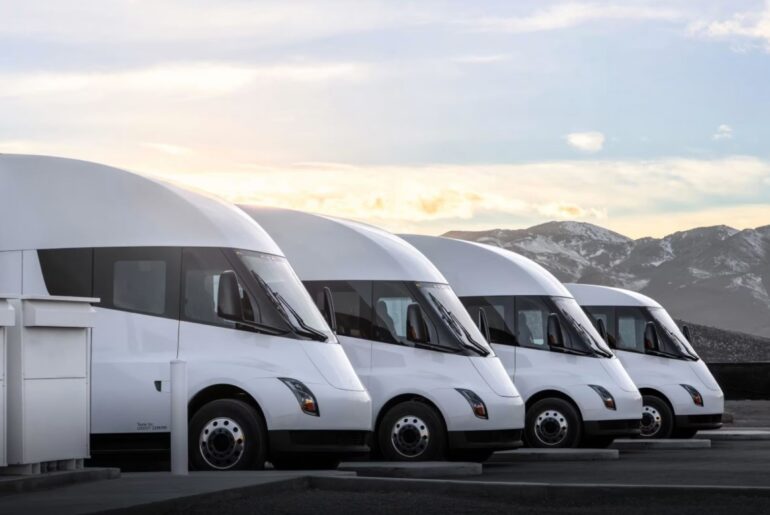
Tesla is currently in focus due to a bifurcated narrative: on one hand, the successful volume production ramp of the Tesla Semi at Giga Nevada represents a massive leap into the lucrative Class 8 trucking sector. On the other, the company faces an existential challenge in the European market, where a combination of aggressive Chinese OEMs and revitalized German legacy automakers has eroded Tesla’s once-dominant market share. This article explores whether Tesla’s pivot to AI and energy can offset the maturing—and increasingly crowded—passenger vehicle market.
Historical Background
Founded in 2003 by Martin Eberhard and Marc Tarpenning, and famously joined early on by Elon Musk, Tesla’s journey began with the high-end Roadster in 2008. The company’s “Master Plan” was clear: build a low-volume expensive car, use that money to build a medium-volume car at a lower price, and finally use that money to create an affordable high-volume car.
The successful launch of the Model S in 2012 and the Model X in 2015 proved EVs could be desirable, but it was the 2017 launch of the Model 3 that transformed Tesla into a mass-market player. Despite the infamous “production hell” of 2018, Tesla scaled global operations with Gigafactories in Shanghai, Berlin, and Texas. By 2021, Tesla reached a $1 trillion market capitalization, cementing its status as the world’s most valuable automaker. However, the 2024-2025 period—often called the “EV Winter”—forced the company to pivot away from hyper-growth in car sales toward the software and energy sectors.
Business Model
Tesla operates a vertically integrated business model that spans four primary segments:
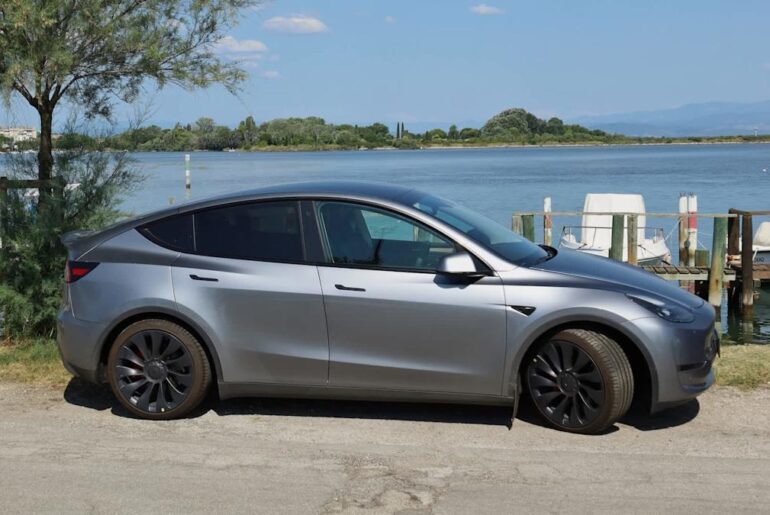
Automotive: Sale and leasing of Model 3, Model Y, Cybertruck, and the newly ramped Tesla Semi. This remains the largest revenue contributor but has seen margin compression.
Energy Generation and Storage: The fastest-growing segment, involving the sale of Powerwall (residential) and Megapack (utility-scale) batteries, along with solar products.
Services and Other: Revenue from non-warranty after-sales vehicle service, paid Supercharging, insurance, and the sale of used vehicles.
Software and AI: High-margin revenue from Full Self-Driving (FSD) subscriptions and the nascent Robotaxi network, which began pilot operations in early 2026.
Stock Performance Overview
Tesla’s stock performance has been a study in volatility.
10-Year Horizon: Investors who held through the last decade have seen astronomical returns, outperforming the S&P 500 by a wide margin as the company transitioned from a niche player to a global leader.
5-Year Horizon: Performance is more nuanced. After the 2020-2021 surge, the stock faced a massive correction in 2022 and another stagnation period in 2024-2025 as interest rates and cooling EV demand weighed on the “growth” premium.
1-Year Horizon: Entering March 2026, TSLA has shown signs of a “dead cat bounce” or a genuine recovery, depending on the analyst. The stock has rallied approximately 15% from its 2025 lows, buoyed by Energy segment growth and Semi production news, though it remains below its 2021 all-time highs.
Financial Performance
The fiscal years 2024 and 2025 were the most challenging in Tesla’s modern history.
Revenue & Deliveries: For the first time, annual deliveries saw a year-over-year decline in 2025, falling to approximately 1.636 million units. Total revenue in 2025 was $94.8 billion, down 3% from 2024.
Margins: Operating margins, which once led the industry at over 16%, compressed to 5.7% by late 2025 due to aggressive price cuts and heavy R&D spending on the Optimus robot and AI training.
Net Income: Net income saw a significant pullback, dropping to roughly $3.8 billion in 2025. However, the Energy Storage segment provided a silver lining, with deployments hitting 46.7 GWh in 2025, boasting much higher margins than the automotive business.
Leadership and Management
Elon Musk remains the central figure of Tesla, serving as CEO and the primary architect of its AI-first strategy. While his vision continues to attract retail investors, institutional “governance” concerns have intensified. Issues regarding his split attention between X (formerly Twitter), SpaceX, and xAI, as well as his massive 2024 pay package litigation, have clouded the leadership narrative.
Operationally, the management team has seen shifts. Tom Zhu, who led the Shanghai success, now oversees global production, bringing much-needed discipline to the Austin and Berlin ramps. The board remains under pressure to improve succession planning and transparency regarding the “Master Plan Part 4.”
Products, Services, and Innovations
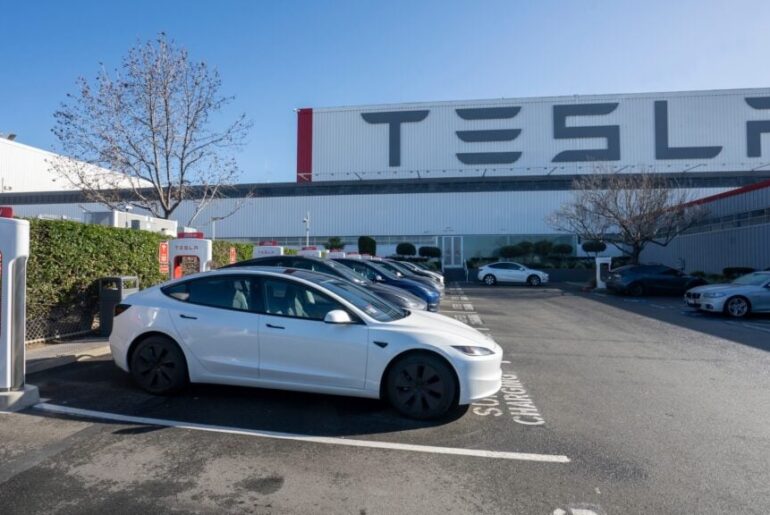
The current “Jewel in the Crown” is the Tesla Semi. In Q1 2026, the dedicated Nevada Semi-factory achieved volume production, targeting 50,000 units annually. Early adopters like DHL and PepsiCo report that the Semi’s efficiency (1.72 kWh per mile) is disrupting the logistics industry’s cost structure.
In software, FSD v13 was released in early 2026, moving closer to “unsupervised” autonomy. This software powers the Austin Robotaxi pilot, which launched in January 2026. Furthermore, the Optimus Gen-3 humanoid robot is reportedly undergoing internal testing for logistics tasks within Tesla’s own factories, signaling a future move into the robotics-as-a-service market.
Competitive Landscape
Tesla no longer enjoys a monopoly on the “cool factor” or EV technology.
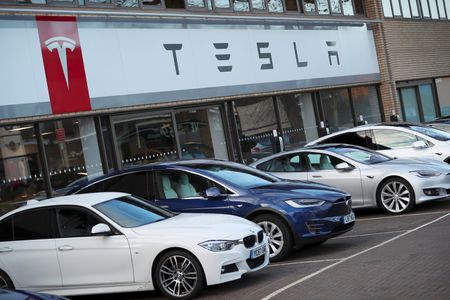
In Europe: Tesla’s market share fell to 6.1% in late 2025. Volkswagen (OTC: VWAGY) has reclaimed the top spot in EV sales, followed closely by BMW (OTC: BMWYY) and Mercedes-Benz.
The China Factor: BYD (OTC: BYDDF) has emerged as Tesla’s primary global rival. In early 2026, BYD’s registrations in Europe nearly doubled Tesla’s in certain months, fueled by their diverse, affordable lineup.
Legacy Auto: General Motors (NYSE: GM) and Ford (NYSE: F) have finally scaled their dedicated EV platforms, though they continue to struggle with profitability compared to Tesla.
Industry and Market Trends
The global EV market has shifted from “early adopter excitement” to “mass-market pragmatism.” Consumers are increasingly sensitive to price and charging infrastructure. This has led to a surge in hybrid demand, which Tesla does not offer. However, the Energy Storage sector is experiencing a secular boom as utilities rush to stabilize aging grids and integrate renewable energy, a trend Tesla is capturing with its Megapack product.
Risks and Challenges
Market Saturation: The Model 3 and Model Y are aging platforms. Without a “Model 2” (the long-rumored $25k car) in high-volume production, Tesla risks losing the bottom half of the market.
Regulatory Scrutiny: The NHTSA and European regulators continue to probe FSD safety, creating “headline risk” that could lead to costly recalls or software restrictions.
Key Man Risk: Tesla’s valuation is inextricably linked to Elon Musk. Any further perceived “distractions” or a potential departure would likely cause significant share price volatility.
Opportunities and Catalysts
The Semi Ramp: Capturing just 5% of the Class 8 truck market could add billions to the top line with higher per-unit revenue than passenger cars.
Energy Storage Acceleration: Tesla’s guidance for 100+ GWh of deployments in 2026 suggests the energy business could eventually rival the auto business in valuation.
FSD Licensing: Rumors persist of a major legacy automaker signing a deal to license Tesla’s FSD software, which would be a massive, high-margin catalyst.
Investor Sentiment and Analyst Coverage
Wall Street remains deeply divided.
The Bulls (e.g., Wedbush, ARK Invest): See Tesla as an AI and Robotics company. They maintain price targets of $600+, arguing that the Robotaxi and Optimus represent trillions in future market cap.
The Bears (e.g., JPMorgan, GLJ Research): View Tesla as a “struggling car company” with a valuation that defies reality. They point to the 300x P/E ratio and declining earnings as evidence of a massive bubble.
Institutional ownership remains high, but many hedge funds have shifted to a “neutral” stance, waiting for proof of FSD monetization.
Regulatory, Policy, and Geopolitical Factors
Tesla is caught in the middle of a geopolitical tug-of-war.
EU Tariffs: European tariffs on Chinese-made EVs have provided a slight shield for Tesla’s Giga Berlin production, but they also risk retaliatory measures from China, where Tesla has its most efficient factory.
US Incentives: The Inflation Reduction Act (IRA) continues to support Tesla’s battery manufacturing in Nevada and Texas, providing critical tax credits that bolster the company’s bottom line.
Conclusion
Tesla in 2026 is a company reinventing itself under pressure. The “easy growth” era of the Model 3 and Y has concluded, replaced by a grueling battle for market share in Europe and China. However, the successful launch of the Tesla Semi and the exponential growth of the Energy segment provide a second act that many legacy automakers cannot replicate.
For investors, Tesla remains a high-risk, high-reward play. The bull case relies entirely on the successful execution of AI and autonomous platforms, while the bear case is rooted in the reality of a maturing, competitive automotive industry. As we look toward the remainder of 2026, the success of the Austin Robotaxi pilot and the volume delivery of Semis will be the ultimate arbiters of Tesla’s premium valuation.
This content is intended for informational purposes only and is not financial advice.