
By Dnn87 – Self-photographed, CC BY 3.0, https://commons.wikimedia.org/w/index.php?curid=3215855
Global lithium demand could top 13 million tonnes by 2050 if the world moves fast on clean energy, according to Wood Mackenzie’s latest Energy Transition Outlook for Lithium. The warning is blunt: Without major new investment, lithium shortages could start as early as 2028.
“The lithium market is heading into a supply crunch much sooner than many industry players expect,” said Allan Pedersen, research director at Wood Mackenzie. “Under ambitious climate scenarios, we see deficits emerging from 2028. The industry needs to act now, as governments progress policies toward Net Zero.”
EVs are driving the surge
Wood Mackenzie modeled four energy transition pathways. By 2050, lithium demand ranges from 5.6 million tonnes of lithium carbonate equivalent (LCE) in a delayed transition to 13.2 million tonnes in a net zero scenario.
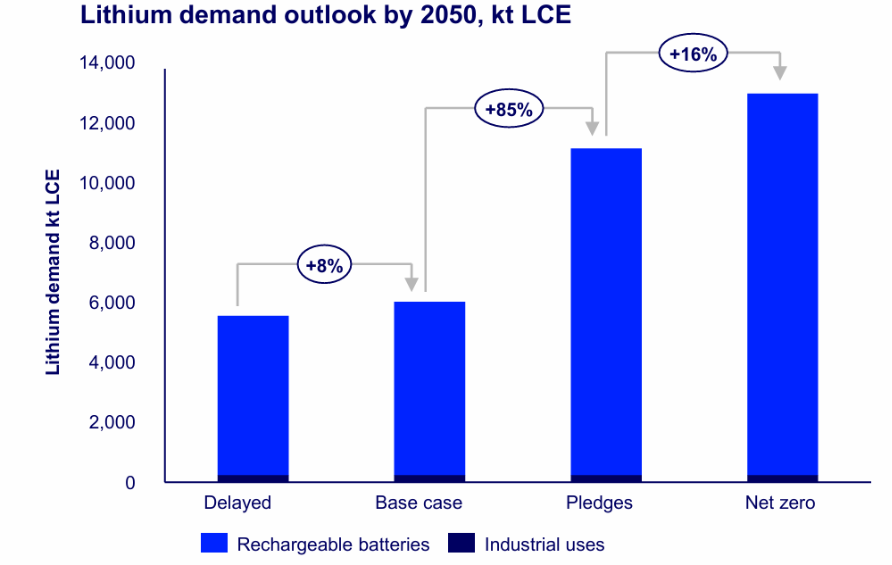 Source: Wood Mackenzie
Here’s how the supply picture changes depending on how fast the world electrifies:
Advertisement – scroll for more content
Delayed Transition: The market stays balanced until around 2037 before tipping into deficit.
Base Case: Existing projects can keep up for now, but supply starts to tighten in the mid-2030s as demand continues to rise beyond what’s currently planned.
Country Pledges: Shortages begin around 2029, with an additional 6.7 million tonnes LCE needed by 2050.
Net Zero: Deficits start in 2028 and continue through mid-century. About 8.5 million tonnes of extra supply would be required by 2050.
EVs account for 72% to 80% of lithium demand across scenarios. Under the Country Pledges pathway, EVs reach about 75% of global vehicle sales by 2040. Under a Net Zero pathway, that climbs to 95%.
By mid-century, rechargeable batteries across all uses make up 96% to 98% of total lithium demand.
But EVs aren’t the only factor pushing demand higher. There are also energy storage systems. As renewables dominate new power generation, grids need more large-scale batteries to balance supply and demand. Wood Mackenzie sees energy storage demand growing 6% to 7% annually in forward-looking scenarios.
Recycling helps – but not soon enough
Recycling will play a bigger role over time, but it won’t fix near-term lithium shortages.
Recycled supply is projected to grow 13% to 16% annually, with meaningful volumes ramping up in the 2040s as today’s EV batteries reach end-of-life. By 2050, recycling could supply between 2.3 million and 2.7 million tonnes LCE in ambitious transition scenarios.
Even with recycling ramping up, that still leaves a large gap.
Under the Country Pledges scenario, the supply shortfall reaches 6.7 million tonnes LCE by 2050. Under Net Zero, it widens to 8.5 million tonnes.
A $100–$276 billion buildout
Closing that gap will take massive capital. Wood Mackenzie estimates total investment needs ranging from about $104 billion under the Delayed Transition scenario to $276 billion under the Net Zero scenario. The Base Case requires about $114 billion, while the Country Pledges scenario comes in at roughly $236 billion.
Investment is expected to peak between 2030 and 2034 as new mining projects, refining capacity, and regional supply chains are built out.
The bottom line: No matter which transition path the world takes, lithium demand is set to outpace current supply plans. The real question isn’t whether more lithium will be needed – it’s whether the industry can move fast enough to fund and build what’s required.
Read more: The US’s first lithium from oilfield wastewater is coming this year

If you’ve ever considered going solar, make it easy by finding a trusted, reliable solar installer near you that offers competitive pricing by checking out EnergySage. It has hundreds of pre-vetted solar installers competing for your business, ensuring you get high-quality solutions and save 20-30% compared to going it alone. Plus, it’s free to use, and you won’t get sales calls until you select an installer and share your phone number with them.
Your personalized solar quotes are easy to compare online and you’ll get access to unbiased Energy Advisors to help you every step of the way. Get started here.


FTC: We use income earning auto affiliate links. More.