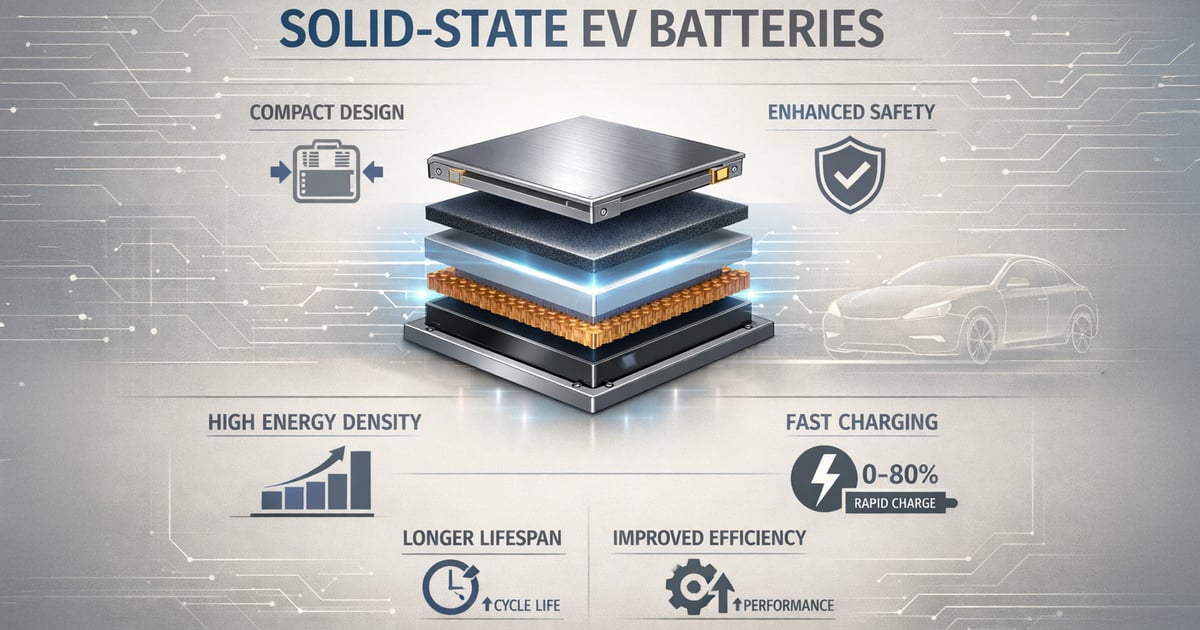
Solid-state batteries are often seen as the ‘holy grail’ battery technology for EVs. Compared to conventional lithium-ion technology, they promise to be much safer, offer better range, charge faster, and have a higher energy density. However, developing new batteries with a completely different electrolyte architecture has taken some time, and there have been some commercialisation challenges.
Liquid (or gel) electrolytes have been used in rechargeable batteries forever, so changing the status quo has taken time. For most new batteries, the battery architecture often centres on new electrode technology. Solid-state batteries buck this trend by focusing on switching from a fluid-based electrolyte to a solid material. This is a more complex process than creating batteries with conventional electrolytes, but the potential benefits of the technology are worth the development time. Despite scaling challenges over the years, solid-state batteries are becoming a commercial reality, and many automakers are developing them for their EVs.
What are solid-state batteries? Technology fundamentals explained
Solid-state batteries today are lithium-based, but sodium variants may emerge in the future, and many of the solid-state electrolytes today are sulphide- or oxide-based. Currently, there is significant interest in developing small cells for medical devices and larger battery packs for fast-charging EVs.
Solid-state batteries have a slightly different structure from lithium-ion batteries. Lithium-ion batteries possess two electrodes (an anode and a cathode), a liquid electrolyte between the electrodes and a separator, which is a membrane that separates the compartments but allows ions to flow through. By comparison, solid-state batteries have two electrodes separated by a solid electrolyte. Because there is no fluid, there is no need for a separator membrane.
Many of the liquid electrolytes used in batteries today are flammable, which is why short-circuiting, thermal runaway or piercing the battery can quickly result in fires and explosions. Liquid electrolytes can also undergo a lot of side reactions at the electrolyte-electrode interface, which degrade performance over time. On the other hand, solid electrolytes are chemically stable, which makes it less likely that side reactions (including the formation of dendrites) will occur. Removing the separator from the battery is also a significant benefit. Separator materials are sensitive to hot and cold temperatures, which limits the temperature range of the battery, but removing them means that solid-state batteries can operate in a wider temperature range.
Removing both the flammable electrolyte and the separator for a non-flammable solid material increases battery safety in multiple ways. The lack of a flammable material makes it less likely that solid-state batteries will catch fire or explode. This also means the battery can reach much higher internal temperatures without catching fire, allowing for faster charging rates—because charging at fast rates generates a lot of heat, which can cause lithium-ion batteries to catch fire, but not solid-state variants. Solid-state batteries can operate safely at temperatures up to 80 °C, whereas lithium-ion batteries struggle to remain safe (and degrade much more quickly) once the internal temperature exceeds 50°C.
Because the batteries are less likely to catch fire, they also require less casing, as they don’t need to be as heavily protected against damage as lithium-ion batteries. This enables solid-state batteries to not only be safer than their lithium-ion counterparts, but also much smaller and lighter. Solid-state batteries are less prone to degradation, so they can withstand more charge/discharge cycles, improving their longevity and extending the usable life of EV batteries before they need to be recycled and/or replaced.
For EV applications, a lighter, safer battery with a high energy density and a long usable life is ideal, which is why there is significant interest in the technology. Lithium-ion technology continues to increase its energy density and range, but developing efficient solid-state technology with higher voltages and capacities could significantly boost EV performance.
Besides purely technical considerations, there are economic considerations for using solid-state batteries. While they will take some time to commercialise and scale to be competitive with current EV battery packs, it’s thought that they could help reduce battery costs down the line. Because solid electrolytes are much more stable than liquid electrolytes, non-conventional electrode materials can be used, such as lithium metal. Having a more diverse range of electrode materials to choose from could help reduce geopolitical and supply chain risks, because much of the raw material extraction and processing for lithium-ion batteries is concentrated in specific regions of the world and is susceptible to volatile price changes. All these factors have led various automakers to invest in and develop solid-state battery technology.
Toyota solid-state Battery timeline: production plans and lifespan projections
Many of the solid-state battery developments are coming out of Japan, with Toyota among the frontrunners. Toyota has long been one of the leading automotive companies in Japan, and it currently holds the most solid-state battery patents in the world, with over 1,000. Toyota aims to have its solid-state batteries in mass production by 2027-2028, with them integrated into its vehicles by 2028.
The Toyota solid-state battery being developed has gone through several phases. Early prototypes had some trade-offs, such as shorter battery life, but Toyota has started to address them, with recent prototypes showing a 50% increase in driving range. Toyota also has plans to develop a new EV factory that will produce models from 2026. It’s believed that any new advanced solid-state batteries will power the vehicles from this factory in the coming years. It was initially announced that Toyota’s solid-state batteries would power hybrid EVs, but the focus has now shifted to battery EVs (BEVs).

Sumitomo has used proprietary powder synthesis technology to develop a “highly durable cathode material”. Image: Sumitomo Metal Mining
The first solid-state battery, planned for 2027-2028, is expected to provide a 20% increased range over Toyota’s Performance battery (a lithium-ion battery planned for 2026 with 800 km range) and is expected to deliver around 1000 km of driving range and a charging time of 10 minutes for a state of charge (SOC) from 10% to 80%. The second generation of solid-state battery is expected to deliver over 1200 km of range, but no dates have been given for when this will be produced or what the charging rate will be.
Outside the main roadmap, Toyota is continuing to file new patents for its solid-state battery technology and is working with external partners to build a more robust component supply chain. One of Toyota’s latest patents (20260024805) from 2025 centres on ensuring that solid-state batteries can be manufactured in the factory while controlling lamination and pressing methods to prevent moisture and contamination in the battery. So, Toyota is making sure the batteries are developed to a high standard before mass production begins.
On building a wider supply chain, Toyota has partnered with Idemitsu Kosan, which is building a large-scale solid electrolyte pilot plant. The solid electrolytes will be used in Toyota’s solid-state BEVs. It’s expected that the electrolyte facility will be completed in 2027 and will fit with Toyota’s timelines for mass production. Toyota has also partnered with Sumitomo Metal Mining Co., which will mass-produce cathode materials for all the solid-state batteries installed in Toyota’s BEVs.
Honda, Tesla and Hyundai’s solid-state battery strategies compared
Alongside Toyota, Honda and Hyundai are also planning to launch solid-state batteries, but Tesla is a bit more bullish about the situation.
Honda’s Solid State Battery
Honda is planning to develop its own solid-state battery, with the aim of integrating it into its EVs in the second half of the 2020s. The Honda solid-state battery is being developed within a 295,000 ft2 demonstration line in Japan, which replicates a mass-production environment and features multiple stations centred on weighing and mixing electrode materials, coating and rolling processes, and cell formation and module assembly.
Honda’s approach to manufacturing uses a roll-pressing technique adapted from lithium-ion manufacturing to increase the density of the electrolyte layers and improve interfacial contact between the electrodes and the electrolyte. Honda is also simplifying cooling structures and is relying on the heat-resistant properties of the solid materials. Honda is still in the innovation phase, as its latest patent (20260024768) centres on optimising how layers are built to prevent cracking and layer separation during cycling. Honda is also investigating various control technologies to optimise process power consumption and reduce overall manufacturing costs, making it more competitive. Once all processes are verified, Honda can move towards mass production.
By 2040, Honda hopes the batteries will be 60% smaller, 45% lighter, and 40% cheaper than its current EV batteries. While Honda is targeting solid-state batteries for EVs, it is also hoping to expand into the motorcycle and aircraft markets.
Hyundai’s solid-state battery
Hyundai is developing solid-state batteries, but is not planning to mass-produce them as quickly as Toyota or Honda. Hyundai Motor Group, which includes Kia, is not planning to launch solid-state battery EVs until at least 2030. Until these developments become a reality, Hyundai and Kia are planning to improve their existing lithium iron phosphate (LFP) and lithium nickel manganese cobalt (NMC) batteries.
That doesn’t mean that Hyundai isn’t innovating in the solid-state battery space, far from it. Hyundai recently obtained a patent that allows it to use copper in sulphide-based electrolyte batteries, with the plan to replace nickel or stainless steel in the current collectors. It’s thought that using copper could help improve adhesion within the battery, thereby enhancing durability, because the layers stick together more effectively.
There’s no Tesla solid-state battery, yet
You might think that Tesla would be one of the main companies interested in solid-state batteries, but Tesla’s Vice President of Vehicle Engineering, Lars Moravy, went on record at the X Takeover 2025 event in San Mateo, California to say that LFP cells have shown their worth in terms of energy density and capabilities. It was also noted that he said that improving the microchemistry of these batteries can make a lot of performance gains, and that they have had a lot of success in tweaking battery chemistries by changing the anode and cathode designs, as well as changing the manufacturing technology.
So, where does this leave Tesla on the solid-state battery front? Nothing concrete has been said either way about a Tesla solid-state battery; however, it’s likely that work is underway to deliver one in the future. One of the biggest clues is Tesla’s acquisition of Maxwell Technologies, who already manufacture small solid-state batteries and has dry battery electrode (DBE) technology. While DBE technology is already being used to improve Tesla’s lithium-ion batteries, it’s a method that could have a lot of benefits in solid-state battery manufacturing.
If Tesla does go down the route of solid-state batteries, they have the capital, manufacturing capabilities, innovation team and vertical integration to potentially set up robust, cost-effective solid-state battery manufacturing. Whether they go down this route is still unknown, but you feel that it will not be a matter of if, but when.
China’s solid-state EV battery manufacturing: market impact analysis
China dominates many battery markets, from lithium-ion to sodium-ion, and while China’s solid-state battery development is not yet as prolific as Japan’s, major developments are underway. If China can get on top of the market as it has done for other battery technologies, then it has the industrial landscape to potentially create a robust supply chain that will be able to supply other markets. However, this situation could create similar issues with other battery technologies, which solid-state batteries aim to avoid: a supply chain reliant on certain regions and potentially dictated by geopolitics.
The Chinese market is developing, and with it, new standards are being developed. China is preparing its first standard for solid-state EV batteries in 2026, which will clarify terminology for liquid, hybrid, semi-solid, solid-liquid, and all-solid-state EV batteries, as well as different types of electrolytes (oxide-based, sulphide-based, etc.). This will help manufacturers to accurately categorise the exact type of battery and avoid ambiguity.
In terms of actual solid-state battery development in China, Geely, a Volvo subsidiary, is developing a solid-state battery pack that will be completed in 2026. Once finished, the pack will be assembled and installed into a vehicle for validation testing. While there are currently limited details, the experimental cells have reported energy densities of around 400 Wh/kg.
Dongfeng has set its mass-production targets for 2027. It has already tested prototype vehicles and is now testing them in extreme cold weather conditions. Dongfeng plans to develop a 350 Wh/kg battery with a 1000 km driving range. While driving tests are ongoing, the individual batteries have been tested in 170 °C hotbox environments without catching fire or exploding, and at -30 °C, where they retain 72% of their capacity. Dongfeng has also completed a 0.2 GWh production line, with batteries ready for vehicle use from 2026 onwards. Dongfeng has also started research into new sulphide solid-state batteries with an anticipated energy density of 500 Wh/kg.
GAC Motor Group has been innovating a lot in the battery space and was one of the first companies in the world to introduce graphene batteries to EVs, with the Aion V benefiting. GAC have also been developing solid-state batteries and has completed its first production line. This line is currently producing 60Ah cells in small batches. Once scaled up, these batteries are expected to enable EVs with current ranges of 500 km to exceed 1000 km. GAC has plans to integrate its solid-state batteries into vehicles in 2026, with mass production planned for 2027-2030.
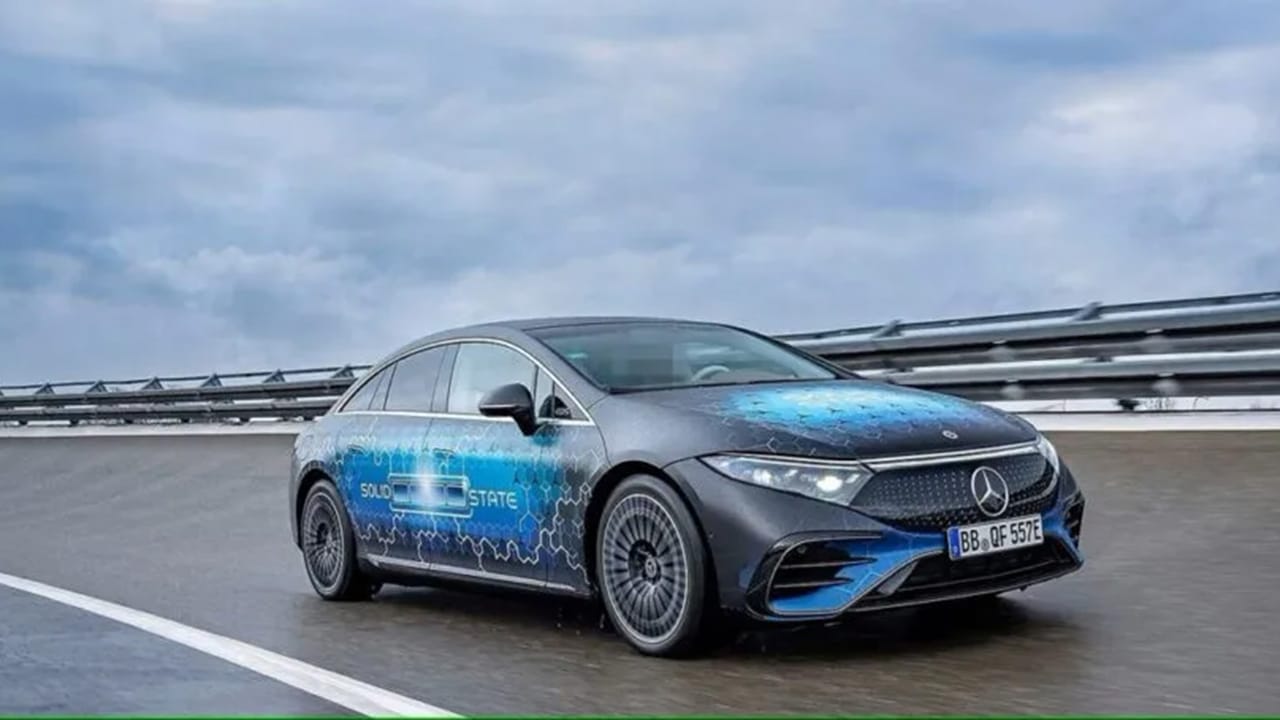
The all-solid-state Solstice battery pack, integrated into an EQS Sedan. Image: Mercedes-Benz.
Chery is another automaker that has recently produced their first batch of solid-state battery samples, with the aim of launching a solid-state assembly line with a 1.25GWh production capacity and eventually a 5GWh R&D centre with an automated production line. These first-generation batteries have an energy density of 300Wh/kg, but Chery believes that the second generation will hit 400Wh/kg, and the third generation is planned for 2027 with an energy density of 500Wh/kg.
Elsewhere in China, Qingtao Energy plans to deliver mass-produced solid-state batteries by 2027 with energy densities of at least 400Wh/kg, while BYD recently announced it is exploring the development of sulphide solid-state batteries. BYD’s batteries will likely be produced by 2027, but it’s expected to be on a small scale rather than mass production.
Overall, China is stepping up its solid-state battery game, and it could end up dominating the market in the future, as it does with almost every other major battery technology, given the already widely established battery infrastructure across multiple architectures.
Winning the solid-state EV battery race
Solid-state batteries have significant potential to improve EV charging speed and range while simultaneously making EV batteries safer, lighter and cheaper. The industry is still in a relative state of infancy compared to lithium-ion, but many major automakers are investing in the technology—both to improve it and scale it up—with many expecting to integrate solid-state battery technology into their vehicles and achieve mass production in the next few years.
Alongside the Japanese and Korean manufacturers, Germany’s Mercedes-Benz is advancing its own solid-state-powered vehicles in partnership with US-based Factorial Energy. Factorial is also partnering with US-headquartered Karma Automotive to integrate Factorial’s proprietary FEST (Factorial Electrolyte System Technology) solid-state battery technology into Karma’s next-generation vehicle platform.
In December 2025, we interviewed Richard Qiu, President of LiCAP Technologies, who discussed the company’s partnership with another Japanese brand, Nissan, to make the solid-state battery manufacturing process more cost-effective.
The Japanese market holds a lot of IP and is planning to build robust solid-state batteries, but it is being closely followed by the Chinese market, where multiple companies are now developing small batches with the aim of scaling them up in the coming years. A lot of automakers are planning for similar levels of performance in the coming years—up to 500Wh/kg energy density and 1000Km+ range—and it will be an exciting race to see who first commercialises them en masse and to see whose solid-state batteries and continued innovation outperforms others to achieve longevity in the EV market.