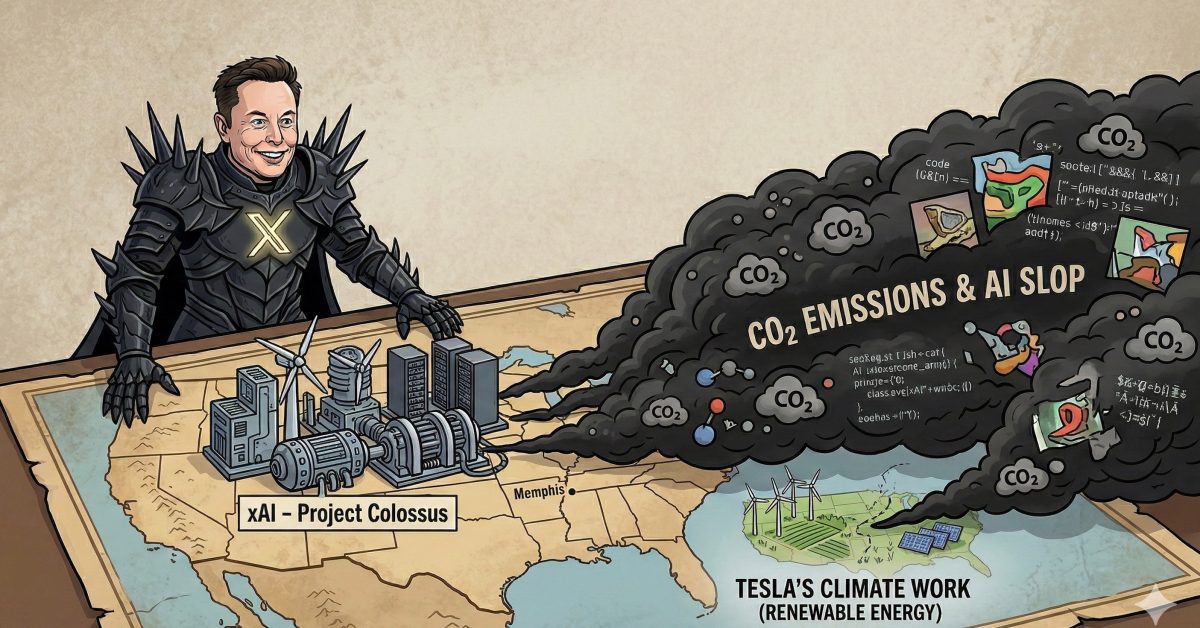
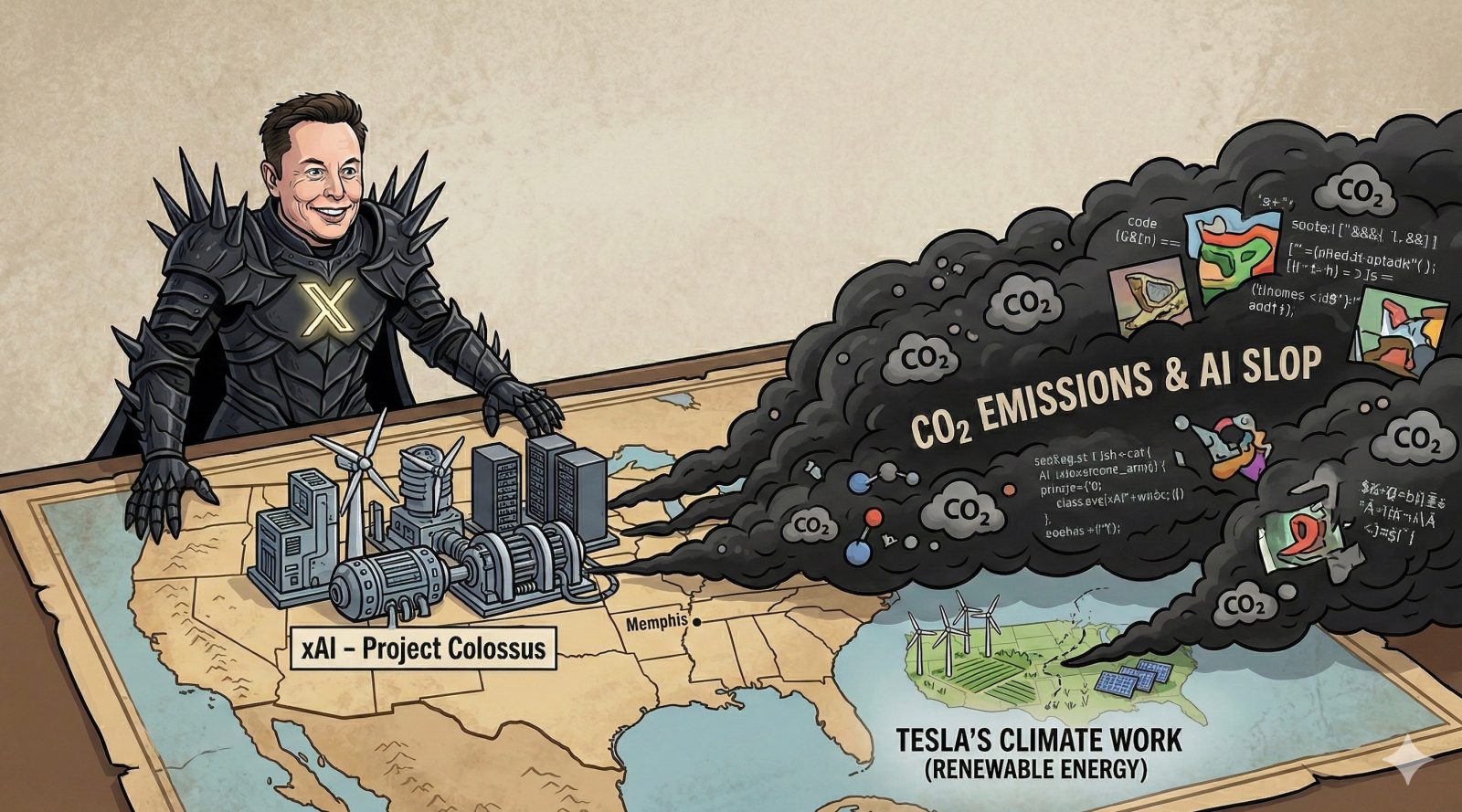
Elon Musk’s xAI is now operating 62 unpermitted methane gas turbines across two data centers in Memphis, Tennessee, and Southaven, Mississippi. According to xAI’s own permit application, the facilities could emit more than 6 million tons of greenhouse gases and over 1,300 tons of health-harming air pollutants every year.
Meanwhile, Tesla’s latest impact report brags about avoiding 32 million metric tons of CO2. Musk is single-handedly erasing a significant chunk of his own company’s climate legacy to power a middle-of-the-pack AI model.
It wasn’t that long ago that Elon Musk was calling the large-scale release of carbon dioxide into the Earth’s atmosphere the “dumbest experiment in history” and pleading with world leaders at the UN climate change conference in Paris to implement a carbon tax to curb emissions.
That Elon Musk is long gone.
Advertisement – scroll for more content
xAI’s “copy and paste” pollution strategy
It started in 2024 when xAI built its Colossus supercomputer in South Memphis. Unable to secure enough grid power, the company installed 35 portable methane gas turbines, without environmental permits or pollution controls. According to the Southern Environmental Law Center (SELC), xAI operated 33 of those turbines while holding a permit for only 15, exploiting a loophole by classifying them as “non-road engines” to dodge the Clean Air Act.
After receiving intense public pushback, xAI’s response was remarkable: company officials said they planned on “copying and pasting” the same unlawful strategy for their next facility.
And that’s exactly what they did. xAI parked 27 more unpermitted gas turbines just across the state line in Southaven, Mississippi, a diverse suburb of Memphis, to power its second data center, dubbed MACROHARDRR. Those 27 turbines generate up to 495 megawatts, the equivalent of a conventional power plant. Combined with the Memphis facility’s 422 MW, xAI is now operating nearly a gigawatt of unpermitted fossil fuel generation across the two sites.
The EPA closed the “non-road engine” loophole in January 2026, reiterating that this kind of operation requires Clean Air Act permits. Thermal drone footage from February shows xAI is still burning gas at the Mississippi facility anyway.
The emissions: 6 million tons of CO2
According to xAI’s own permit application for the Southaven site, the combined facilities could emit more than 6 million tons of greenhouse gases per year, along with over 1,300 tons of health-harming air pollutants.
At the Memphis site alone, the turbines emit between 1,200 and 2,000 tons of nitrogen oxides (NOx) per year, likely making xAI the largest industrial source of smog-forming pollution in the entire 11-county Memphis metropolitan area. The company also reported 30 tons of sulfur dioxide, 94 tons of carbon monoxide, and 11.51 tons of hazardous air pollutants annually from Colossus 1 alone. A TIME investigation found peak nitrogen dioxide levels increased by 79% near the facility compared to pre-xAI levels.
Then there’s the water. The Memphis facility consumes up to 1.5 million gallons per day for cooling, with plans to scale to 13 million gallons per day, tapping into Memphis’s vulnerable aquifer system. xAI is building an $80 million wastewater treatment plant to handle the demand.
Now compare that to Tesla
Tesla’s 2024 Impact Report claims its global fleet of EVs, solar panels, and energy storage products helped avoid 32 million metric tons of CO2 equivalent emissions, a 60% increase year-over-year. It’s worth noting that an independent study by Greenly estimated Tesla’s real avoided emissions at closer to 10.2 to 14.4 million metric tons, suggesting Tesla’s figures may be overstated by up to 49%.
Even using Tesla’s own optimistic figure, xAI’s 6 million tons of annual greenhouse gas emissions would erase roughly 19% of all the climate benefit Tesla claims to deliver globally. Using the more conservative independent estimate, xAI could be undoing 42 to 59% of Tesla’s actual climate impact.
Let that sink in. One man’s AI vanity project could be wiping out up to half the climate benefit of the entire Tesla fleet.
Those are real numbers with real consequences, and they make Tesla’s (now former) mission to accelerate sustainable energy look like a marketing slogan rather than a genuine commitment.
All of this to power a subpar AI slop machine. In the latest ARC AGI AI leaderboard, xAI’s Grok scores way below its peers from frontier labs, such as Google’s Gemini, Anthropic’s Claude, and OpenAI ChatGPT:
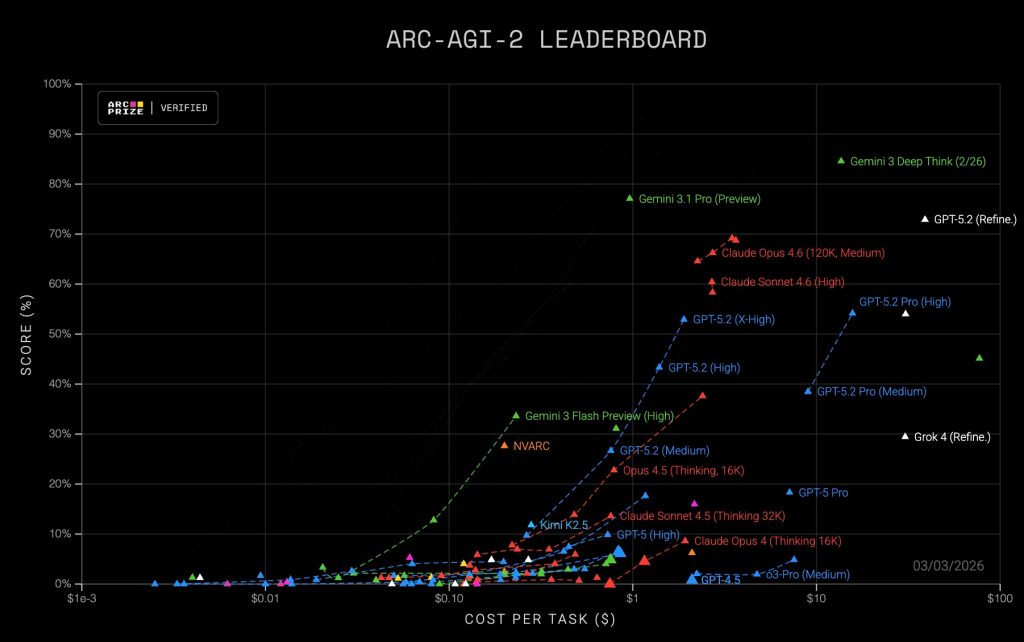
Meanwhile, it costs more to run than most of these models.
The human cost
Both xAI facilities sit in or adjacent to predominantly Black communities with existing pollution burdens. Boxtown, the Memphis neighborhood closest to Colossus, already had a cancer risk four times the national average before xAI arrived. Both Shelby County (Tennessee) and DeSoto County (Mississippi) received “F” grades from the American Lung Association for ozone pollution.
A study commissioned by SELC found the proposed permanent turbines at Colossus 2 alone could cause $30 to $44 million in annual health damages, premature deaths, new and worsening asthma, nonfatal heart attacks, hospital visits, and missed school days.
The human stories are devastating. NBC News reported that children in the Southaven area have developed respiratory problems since xAI’s turbines came online. One resident shut off her electric service and vacated her family’s 2-acre property because the noise, described as sounding like an airport runway, runs day and night. Residents report being jolted awake at 2 a.m.
On February 13, the NAACP, SELC, and Earthjustice issued a 60-day notice of intent to sue xAI under the Clean Air Act over the Mississippi turbines. Four days later, at the first and only public hearing on xAI’s Southaven permit, hundreds of residents showed up. Not a single person spoke in favor. Attendees wore shirts reading “Not all money is good money.”
Google shows how to do it differently
The contrast with how other tech companies handle AI’s energy demands makes xAI’s approach look even worse. Google invested $4.75 billion in energy and data center infrastructure with a focus on clean energy procurement. It secured a 1 GW solar deal in Texas and triggered 1.9 GW of clean energy development in Minnesota for a new data center. Microsoft and Amazon are similarly investing billions in renewables and nuclear.
Musk chose unpermitted methane turbines in poor neighborhoods, twice. The approach wasn’t just environmentally destructive. It was the laziest, cheapest option available, and he did it while running a company whose entire brand is built on the promise of clean energy.
Electrek’s Take
We’ve covered Musk’s growing conflict of interest between Tesla and xAI extensively, from Tesla investing $2 billion in xAI to xAI poaching Tesla engineers to the SpaceX bailout deal. But the environmental angle is the most damning contradiction of all.
Tesla exists because of its mission to accelerate the transition to sustainable energy. Customers bought Teslas because they believed they were making a difference. Investors valued the company at a trillion dollars in part because of that mission. And now the man at the top is personally responsible for a fossil fuel operation that could wipe out up to half of Tesla’s global climate benefit every single year.
Sixty-two unpermitted gas turbines. Six million tons of CO2. Formaldehyde and smog are pumped into communities that already can’t breathe. Children are developing respiratory problems. Families fleeing their homes. All so Grok can generate more AI slop.
The NAACP’s lawsuit is coming. The EPA has closed the loophole. And not one person in Southaven spoke in xAI’s defense.
All of that for what? To create a subpar chatbot and AI generator that is mostly used to generate AI slop on X, some of it is extremely problematic. Oh, how the mighty have fallen.


FTC: We use income earning auto affiliate links. More.