Follow us today…


The initial ownership experience of a new vehicle often sets the tone for its entire lifespan, yet for one Tesla Cybertruck owner, the first month has been a masterclass in service center roulette. What began with minor fit and finish issues quickly escalated into a multi-state service saga, leaving the owner questioning Tesla’s quality control and repair capabilities. This narrative, sadly, is not unique, reflecting a persistent pattern of inconsistency within the brand’s service network that leaves owners frustrated and often resorting to public forums for resolution.
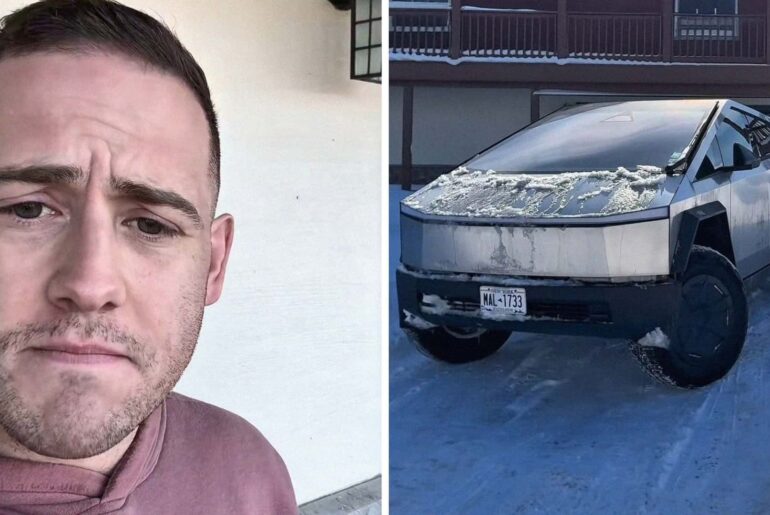
The owner, James Hofstetter from Colorado Springs area, recently detailed his escalating frustrations and eventual resolution in a social media post:
“UPDATE: Colorado Springs Tesla just stepped up and resolved the issues as someone contacted them from up above. They took the truck back this morning, fixed all the problems Denver left behind, and ordered me a new set of wheel covers. They were all scratched up. Also gave a $200 credit because they couldn’t blend the new door in, and I will have to polish the door to match. Rattle in the dash is gone. The door feels a little different, but I will give it some time to settle in a bit first.
They took me back to the service center to inspect it with a mechanic present, which showed confidence in their solution. I appreciated that.
Squeaky wheel gets the cheese. Or at least what they paid for…
Good job, COS Tesla. Thank you.
An update.. Tesla called and told me my CT was fixed and ready to pick up after 2 weeks of trying to fix the door and dash rattle problem. They had to send it off to Denver because they made it worse. Mind you, the truck has only 1000 mi and I have had it a month. I also have high-functioning autism, so I don’t miss a thing.
I went and looked at the truck and walked my a right back into that service center and threw a fit . My doors were PERFECTLY aligned when I brought the truck to them. PERFECT. My dashboard was PERFECT before I brought it in. The truck was freshly detailed and clean as new when I left it with them.
I dragged the service guy out to the truck and asked him if they even tried to mount the door correctly. It is disgustingly off. Now the doors on the other side are off too. Mind you, they were perfect prior. They scratched my wheel covers and didn’t say anything. They dented my dashboard when they took it on and off.
Colorado has a 3-day / 24-day lemon law. The local shop was the first appt. They set a separate appt for Denver. Now we are on appointment 3 with the repair rejection. I love the truck. I don’t want to give it up.
Now here are some juicy pics. They didn’t even wipe the door off after removing the protective plastic or wash the weeks of dirt off. This thing hasn’t even spent the night outside before them.”
The initial service attempt by the local Colorado Springs center, which reportedly “made it worse” before sending the Cybertruck to Denver, shows a critical deficiency in initial diagnostic and repair capabilities. For a vehicle with only 1,000 miles on the odometer, requiring a transfer to a specialist center after the initial attempt exacerbates customer frustration and suggests a lack of standardized training or tooling at the primary service level. This isn’t just an inconvenience; it’s a fundamental breakdown in the service chain that would be unacceptable from any established automaker.
Tesla Cybertruck: Service Challenges and Build Quality Concerns
The Cybertruck’s stainless steel exoskeleton, while visually striking, presents unique challenges for body panel alignment and repair, often requiring specialized tools and techniques. This material choice can complicate routine service and bodywork, leading to longer repair times and potentially higher costs.
Early production models, like many new vehicle launches, frequently exhibit “teething problems” related to fit and finish, including inconsistent panel gaps and interior component rattles. These issues are often addressed through over-the-air software updates or minor service adjustments in later production runs.
Tesla’s direct-to-consumer sales model means that all service is handled through company-owned service centers, eliminating the traditional dealer network. This centralized approach can lead to varying levels of service quality depending on individual center staffing, training, and workload.
The Cybertruck offers a range of up to 340 miles in its dual-motor configuration and boasts a 0-60 mph time of 4.1 seconds, demonstrating impressive performance metrics. These capabilities are often overshadowed by discussions surrounding its manufacturing quality and service experience.
After the Denver service center returned the truck, claiming it was “fixed,” the owner discovered a litany of new issues: severely misaligned doors, scratched wheel covers, and a dented dash top. This level of alleged negligence is not merely poor workmanship; it borders on outright disrespect for a customer’s property. Such incidents erode trust and force owners into adversarial positions, often pushing them to consider invoking consumer protection laws like Colorado’s 3-try/24-day lemon law, a recourse no new car owner should ever contemplate within their first month of ownership.
One commenter, Allen Padlock, offered a perspective that, while perhaps intended to be comforting, speaks volumes about the perceived state of Tesla’s build quality:
“To be honest, if details get people worked up, Tesla probably isn’t the best option. EVERY single one I’ve ever seen has some weird or odd detail to it. I took delivery of a Model Y Performance before, and it had a weird little spot that looked like a door ding…but it was UNDER the paint and the clear coat. It must have been there even when the door was raw metal at the factory. It’s only noticeable at the right angles and light on it, barely even tell it’s there, still, but it’s there. My old 21 model 3, the headlight housings didn’t have fully equal gapping. It wasn’t bad looking, but it wasn’t evenly gapped. It’s these kinds of things that would drive someone nuts who is obsessed with details. As Tesla would say, “it’s within spec”. To be fair, many manufacturers are suffering from misalignments. Go to a local Mercedes dealership and be prepared to be shocked. So many gaps and misaligned panels, etc. As long as it’s not TOO off and TOO bad, don’t let it sour your truck experience. It’s an awesome truck, and everything can be sorted out, as long as it drives properly, that’s the most important part.”
Padlock’s comment, suggesting that Tesla ownership might not be suitable for those who “get people worked up” over details, is a damning indictment of the brand’s quality control. The notion that a premium vehicle’s imperfections are simply “within spec” or that owners should simply accept them is a dangerous precedent. While some panel gaps are inevitable in mass production, the consistent pattern of paint defects, uneven gapping, and now, significant post-service damage, indicates a systemic issue that goes beyond minor manufacturing variances. This isn’t about being “obsessed with details”; it’s about expecting a basic level of fit and finish from a vehicle costing five figures.
Another perspective came from Anthony Restuch, who advised seeking out alternative service centers: “Not advice, but I gave my service center a couple of attempts to get something right, and I made an appointment with another service center about 40 miles away. It was worth the trip, and I now take my vehicle to the other service center. They’re both Teslas, but remember only since the early 2000s did they start building these cars so in a sense the mechanics need to learn the histories of these cars and we’re literally history in the making all my doors are misaligned and don’t look quite perfect compared to the trucks rolling out now but they all work and once these guys all have some experience and it’s in the shop, I will have them align everything the best they can but honestly right now not all the technicians know everything they need to know so I have a little patient with them and find another shop that has better informed people they’ll eventually I’ll get around there or they won’t work for the company”
Restuch’s suggestion to drive an additional 40 miles to a different service center reveals the uneven quality of Tesla’s service network. While it’s true that the automotive industry, particularly with EVs, is constantly evolving, the idea that owners must “have a little patience” while technicians “learn the histories of these cars” is a poor excuse for subpar service. Customers are paying for a finished product and competent service, not for the privilege of being beta testers for repair procedures. This approach places the burden of Tesla’s growing pains squarely on the customer, which is simply unacceptable for a company of its stature.
The Colorado Springs Tesla service center, after what the owner describes as an intervention “from up above,” rectified the issues. They fixed the dash rattle, addressed the door alignment, ordered new wheel covers, and offered a $200 credit for the door’s paint blend. This turnaround, while positive, shows a concerning dependency on escalation for satisfactory resolution. The fact that the owner felt the need to publicly air grievances to achieve a proper repair suggests a system where customer satisfaction isn’t guaranteed through standard channels but rather through persistent advocacy or external pressure.
The “squeaky wheel gets the cheese” mentality, as the owner aptly put it, should not be the operating principle for a premium automotive brand’s service department. While the final outcome was favorable for this particular owner, the journey to get there was fraught with frustration, multiple service appointments, and significant stress. This Cybertruck saga is a stark reminder that a vehicle’s quality is not just about its engineering, but equally about the integrity and competence of the service network supporting it. Until Tesla can deliver consistent quality in both manufacturing and after-sales support, these owner experiences will continue to raise legitimate questions about the brand’s long-term customer satisfaction.
Image Sources: Tesla Media Center
Noah Washington is an automotive journalist based in Atlanta, Georgia. He enjoys covering the latest news in the automotive industry and conducting reviews on the latest cars. He has been in the automotive industry since 15 years old and has been featured in prominent automotive news sites. You can reach him on X and LinkedIn for tips and to follow his automotive coverage.
Follow us today…