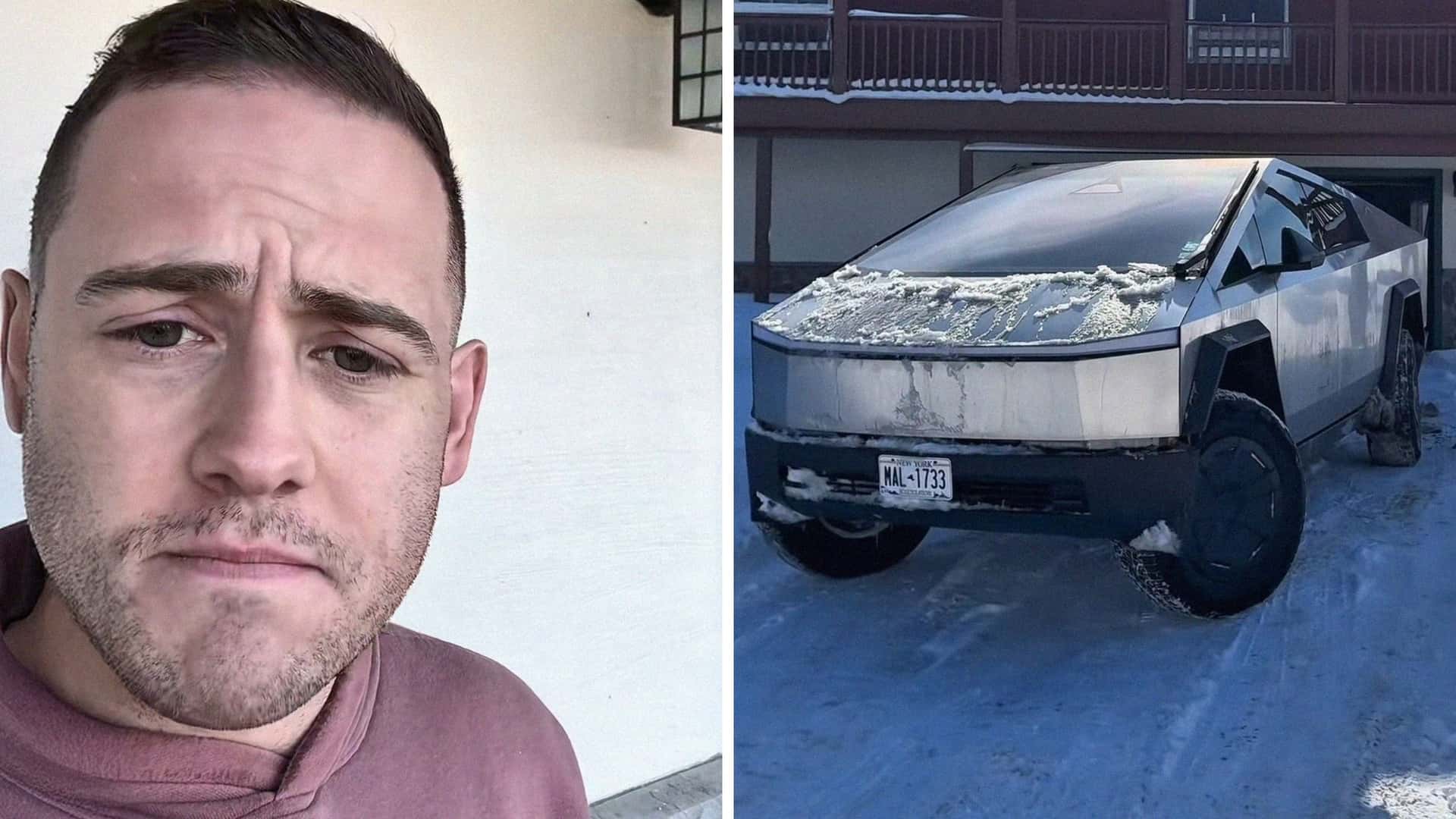
A Cybertruck owner uploaded footage of himself driving slowly through a snowstorm. And he received a warning that many folks behind the wheel of a Tesla have experienced during heavy precipitation.
Joe Fay (@jf.okay) published a video of himself taking the large, battery-powered vehicle on a snow-covered road. A notice on his car’s screen reads, “Multiple cameras blocked or blinded. Clean cameras or wait for them to regain visibility.”
The message contained obvious information, which Fay commented on as he carefully continued his commute.
“‘Multiple cameras blocked or blinded’? Yeah, the entire windshield is blocked and blinded,” the Tesla driver says as he records himself navigating the snowstorm.
Whether he’s directing his lens through the car’s driver-side window or his EV’s windshield, road visibility is severely impeded. Through the front of his car, behind the Cybertruck’s single windshield wiper, the glow of his car’s headlights bounces off the snow that’s amassed on the ground.
According to the driver, he’s utilizing the car’s large infotainment screen to determine where his car is positioned on the road.
“I can’t see anything. Thank God my Tesla can see where the road is because, well, I can’t, and I have no idea. I’m doing 12 miles an hour,” he says before his video comes to a close.
Are Tesla’s Driving Systems Useless In Snow?
In the comments section of Fay’s video, a number of TikTok users brought up different points about Tesla’s driving monitoring systems.
One person remarked that snowy conditions do a number on the vehicle’s cameras due to the abundance of slush and salt on roads, which, in turn, gathers around the EV’s numerous lenses designed to monitor the environment.
“Tesla + snow and road salt. Not the best situation … front camera constantly dirty from road salt. It tells me to clean the front camera when in FSD, they block you from spraying it,” they wrote.
Fay replied to the aforementioned user that he disagreed, as his Cybertruck is outfitted with “AWD” and has a pair of “good tires” installed on it.
Another person on the application replied that their Tesla’s cameras were obstructed by much milder weather conditions. “They’re not very good and thick, dense fog mine would not engage,” the TikTok user penned.
Others argued that Tesla should install radar/LiDAR on its vehicles to improve its road assessment capabilities. However, others argued that lidar would be effectively useless in the conditions Fay was driving in.
LiDAR Won’t Help Cars In Snowstorms
Tesla has come under scrutiny from many auto enthusiasts for not equipping its vehicles with LiDAR, sparking debate over whether the tech is beneficial for driver-assistance systems. In fact, Tesla CEO Elon Musk has gone on the record, stating in 2021 that pursuing LiDAR is a “fool’s errand” for auto manufacturers and that he isn’t confident the technology benefits road assessment or automated driving software.
However, years later, in 2024, The Verge reported that Tesla purchased $2 million worth of sensors from Orlando-based LiDAR sensor manufacturer Luminar, suggesting that despite the businessman’s opposition to the tech, Tesla may be testing its potential applications.
According to this study from the Faculty of Engineering and Applied Science at Ontario Tech University, LiDAR’s capabilities suffer significantly during snowfall. Its abstract reads, “Snowfall can degrade LiDAR performance through signal attenuation, backscattering, false detections, and sensor surface contamination.”
Furthermore, the same analysis specifically mentions that LiDAR is being utilized by a slew of auto manufacturers for “Advanced Driver Assistance Systems.” However, snowfall “ultimately reduces visibility and detection reliability,” according to the university’s breakdown.
Are Teslas Good In The Snow?
As Consumer Reports writes, while AWD systems can certainly help folks navigate snow-covered and icy roads, tires matter more. The research group’s testing found that a front-wheel-drive Toyota Camry equipped with winter tires performed just as well as an AWD Honda CR-V outfitted with dedicated snow tires. However, Consumer Reports found that AWD cars rocking all-season tires didn’t fare so well.
“We found that some of the all-wheel-drive vehicles in our fleet struggled to stay on course when equipped with all-season tires – even in the hands of our professional drivers,” the outlet penned.
Moreover, the outlet stated that if drivers live in areas that get plenty of snow, opting for an AWD car and swapping tires in cold-weather months (around Thanksgiving until Spring) will provide better traction. And if you don’t have an AWD car, winter tires still make a huge impact.
Tesla can benefit from this same logic. Regardless of whether or not the car has AWD capabilities, changing out one’s tires for ones engineered for the snow and cold weather months will do wonders for one’s commuting.
But EVs and Teslas do have some benefits that can help drivers traverse snowy roads. PimpMyEV highlighted a few perks electric vehicles can enjoy that may make wintertime commuting more bearable.
First, because their massive battery packs are so heavy, Teslas have a low center of gravity. This added heft makes them “more stable and easier to control in adverse weather conditions like snow and ice,” the outlet penned.
In 2018, Elon Musk posted on X that Tesla vehicles, even rear-wheel-drive ones, perform well on snow and ice. Echoing Consumer Reports’ assessment, he urged drivers to stay away from summer/sport tires.
Motor1 has reached out to Tesla and Fay via email for further comment. We will update this story if either party responds.
We want your opinion!
What would you like to see on Motor1.com?
– The Motor1.com Team