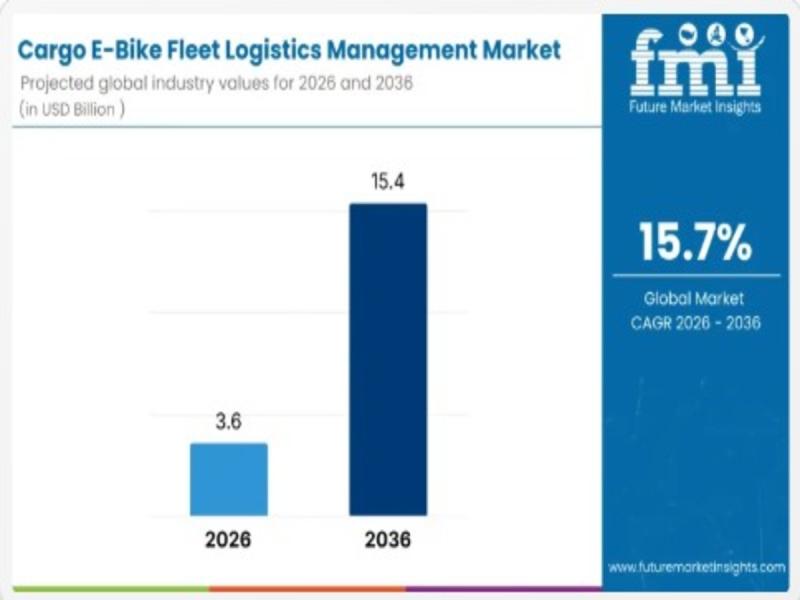
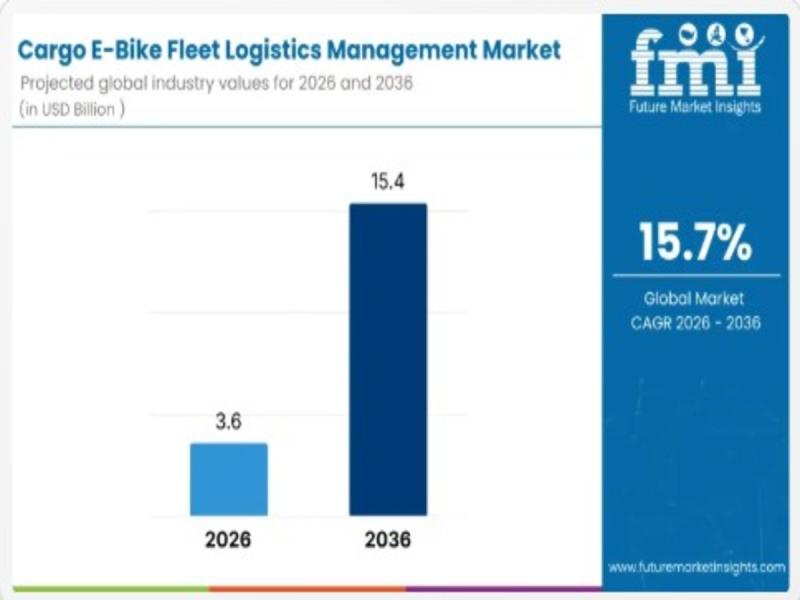
 The global Cargo E-Bike Fleet Logistics Management Market is valued at USD 3.6 billion in 2026 and is projected to reach USD 15.4 billion by 2036, expanding at a CAGR of 15.7% from 2026 to 2036. Growth is driven by the rapid transformation of urban delivery networks, increasing congestion in metropolitan corridors, and strong corporate commitments toward emission reduction.
As logistics operators modernize short-range freight systems, cargo e-bikes are transitioning from niche mobility solutions into structured fleet assets integrated with telematics, routing platforms, and battery-monitoring systems. Fleet-based deployment models are becoming central to parcel distribution, grocery fulfillment, and micro-hub logistics strategies across dense cities.
Cargo E-Bike Fleet Logistics Management Market Snapshot (2026-2036)
Market size in 2026: USD 3.6 billion
Market size in 2036: USD 15.4 billion
CAGR (2026-2036): ~15.7%
Leading bike type: Two-wheel cargo e-bikes
Top application segment: Last-mile parcel delivery
Leading ownership model: Company-owned fleets
High-growth countries: China and India
Key companies: Urban Arrow, Tern, Riese & Müller, Douze Cycles, Rad Power Bikes
Market Momentum
The market begins at USD 3.6 billion in 2026, supported by rising parcel volumes and rapid growth in same-day urban fulfillment. Between 2028 and 2030, adoption accelerates as municipalities expand low-emission zones and restrict internal combustion delivery vehicles in congested districts.
By 2032 and beyond, integration of telematics, battery diagnostics, and centralized fleet platforms strengthens operational visibility. Micro-fulfillment hubs and decentralized warehousing models further reinforce cargo e-bike utilization. By 2036, the market reaches USD 15.4 billion as fleet management systems become embedded in structured urban logistics ecosystems.
Request For Sample Report | Customize Report |purchase Full Report – https://www.futuremarketinsights.com/reports/sample/rep-gb-29804
Why the Market is Growing
The Cargo E-Bike Fleet Logistics Management Market is expanding as delivery operators seek congestion-resilient, cost-efficient transport alternatives. Cargo e-bikes support frequent stops, short trip distances, and rapid maneuvering in narrow or restricted access zones.
Operational economics also play a key role. Compared to traditional delivery vans, cargo e-bikes offer lower energy consumption, simplified maintenance, and reduced parking constraints. Fleet-management software enhances route clustering, load allocation, and battery health monitoring-maximizing daily utilization rates.
Sustainability mandates from retailers and municipalities further strengthen adoption. Low-emission delivery corridors, clean transport incentives, and urban freight decarbonization policies are pushing operators to formalize cargo e-bike fleet programs within broader logistics strategies.
Segment Spotlight
Bike Type: Two-Wheel Cargo E-Bikes Lead Demand
Two-wheel cargo e-bikes account for approximately 39.8% of global demand. Their high maneuverability, lighter weight, and efficient navigation in dense traffic corridors make them ideal for parcel-heavy routes. Three-wheel variants support improved load balance for medium-volume deliveries, while quad models serve heavier-duty applications requiring enhanced structural stability.
Ownership Model: Company-Owned Fleets Dominate
Company-owned fleets represent about 44.1% of the market. Operators prefer centralized control over branding, maintenance schedules, and utilization planning. Subscription-based models attract businesses seeking lower upfront capital commitments, while third-party managed fleets support outsourced logistics operations.
Application: Last-Mile Parcel Delivery Leads
Last-mile parcel delivery holds 46.7% of total demand. Increasing parcel density, short-range routing, and rapid stop frequency make cargo e-bikes particularly effective for urban distribution. Grocery and perishable delivery, postal services, and retail replenishment further expand application diversity.
Country Growth Outlook (2026-2036)
China leads global expansion with a projected CAGR of 17.4%, driven by dense courier networks and electrification initiatives. India follows at 16.3%, supported by rapid e-commerce growth and cost-efficient mobility adoption. The United States posts a 15.2% CAGR as sustainable last-mile systems scale across metropolitan zones. Japan (14.1%) and the UK (13.6%) maintain steady expansion through structured urban freight planning and clean-transport frameworks.
Across these regions, regulatory clarity on cargo e-bike road access, micro-mobility infrastructure expansion, and charging availability significantly influence deployment speed.
Competitive Landscape
The competitive environment features specialized cargo bike manufacturers and fleet-solution providers competing on frame durability, battery range, drivetrain efficiency, and telematics integration.
Urban Arrow maintains strong positioning through purpose-built commercial frames widely adopted in European logistics networks. Tern expands via modular cargo platforms supported by global dealer ecosystems. Riese & Müller emphasizes premium engineering suited for intensive daily commercial use. Douze Cycles focuses on articulated front-loader systems for flexible payload configurations. Rad Power Bikes competes with high-volume commercial models designed for cost-efficient fleet rollout.
Competition increasingly centers on telematics compatibility, predictive maintenance integration, spare-parts networks, and alignment with last-mile software ecosystems.
Frequently Asked Questions (FAQ)
What is the global Cargo E-Bike Fleet Logistics Management Market size?
The market is valued at approximately USD 3.6 billion in 2026 and is projected to reach USD 15.4 billion by 2036.
At what rate is the market expected to grow?
The market is forecast to expand at a CAGR of about 15.7% from 2026 to 2036.
Why are cargo e-bike fleets gaining importance in urban logistics?
They enable low-emission, congestion-resilient delivery operations while reducing operating costs and improving route efficiency in dense urban environments.
Which segment drives the highest demand?
Last-mile parcel delivery remains the largest application segment, supported by rising e-commerce volumes and micro-fulfillment expansion.
Purchase Full Report for Detailed Insights: https://www.futuremarketinsights.com/reports/cargo-e-bike-fleet-logistics-management-market
Why Choose FMI: https://www.futuremarketinsights.com/why-fmi
Explore More Related Studies Published by FMI Research:
Finance and Risk Management Consulting Services Market https://www.futuremarketinsights.com/reports/finance-and-risk-management-consulting-services-market
Smart Meeting Pod Market https://www.futuremarketinsights.com/reports/smart-meeting-pod-market
Outsourced Digital Workplace Service Market https://www.futuremarketinsights.com/reports/outsourced-digital-workplace-service-market
Contact Us:
Future Market Insights Inc.
Christiana Corporate, 200 Continental Drive,
Suite 401, Newark, Delaware – 19713, USA
T: +1-347-918-3531
For Sales Enquiries: sales@futuremarketinsights.com
Website: https://www.futuremarketinsights.com
About Future Market Insights (FMI)
Fture Market Insights, Inc. (FMI) is an ESOMAR-certified, ISO 9001:2015 market research and consulting organization, trusted by Fortune 500 clients and global enterprises. With operations in the U.S., UK, India, and Dubai, FMI provides data-backed insights and strategic intelligence across 30+ industries and 1200 markets worldwide.
This release was published on openPR.