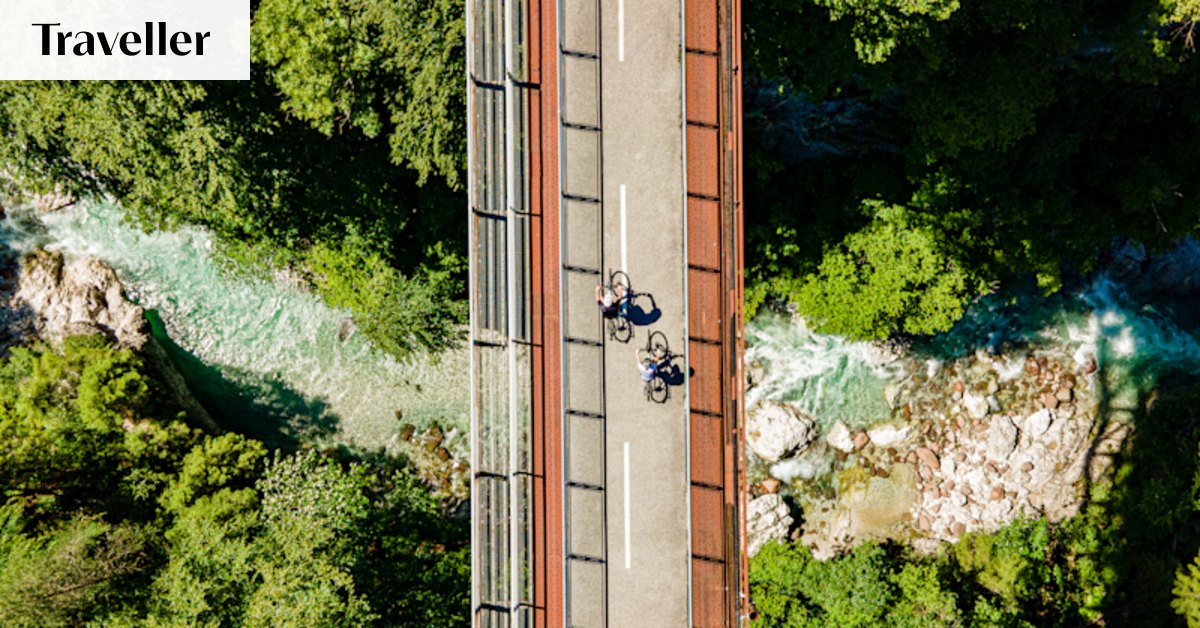
We leave the baroque city of Salzburg in morning mist. It’s a chill autumnal start to our long-anticipated journey across the alps to the Adriatic Sea, an epic 415-kilometre e-bike ride from the Austrian city of Mozart to the Italian seaside town of Grado.
I love a journey with the solemnity and purpose of a pilgrimage, but the Alpe Adria trail is not that kind of thing. It’s no Camino. No Via Francigena.
The cycle path has been popularised by hedonistic holidaymakers, mainly landlocked Austrians, heading to the Italian coast for fish restaurants, pre-lunch spritzes and oceanfront promenades. Worshippers of the gods Helios and Bacchus, these pilgrims earn no status credits in heaven.
What the Alpe Adria offers instead are the satisfying challenge of long-distance bicycle touring and the earthly delights of stunning vistas: a procession of stirring landscapes through river-threaded valleys and thrilling traverses of not one but two mighty European mountain ranges: the Austrian Alps and northern Italy’s Julian Alps.
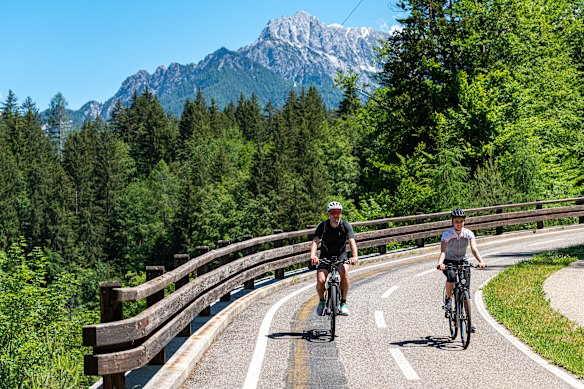 Cyclists of all persuasions and on all types of bikes pass through sublime alpine country along the Italian section of the Alpe Adria route.
Medieval market towns are scattered along the route. And at the end of every long stretch in the saddle is the promise of tafelspitz (the national dish of tender boiled beef) and torte in Austria and, on the Italian side, heart-starting espressos and sunset aperitivi.
Sign up for the Traveller Deals newsletter
Get exclusive travel deals delivered straight to your inbox. Sign up now.
Launched in 2012, the popular two-nation Alpe Adria connects existing bike paths with redeveloped long-abandoned railway infrastructure. It’s said about 80 per cent of the route is dedicated bike path, 10 per cent is off-road (much of it gravel), and the rest on bitumen roads shared with traffic. That sounds about right.
SPEED DATING: Salzburg, Hallein and Golling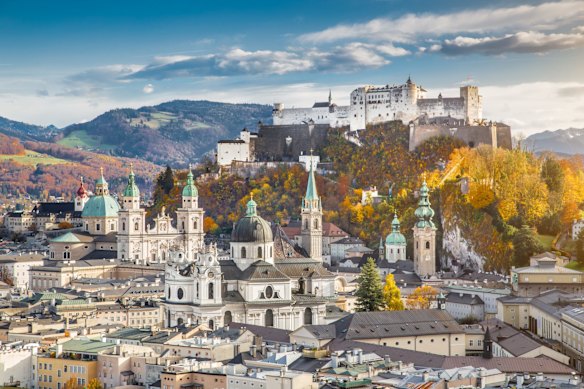 Hohensalzburg Fortress looms over the Austrian city of Salzburg, the starting point for an epic 415 kilometre e-bike ride.iStock
It’s a mercifully short and straightforward exit from our hotel in Salzburg’s handsome old town to its popular riverside bike path. The city is bisected by the swift-flowing Salzach River, and for the first 15 kilometres we follow it south-east through green-gold autumnal forest.
There’s time to notice the big things – birch groves, the for-now distant peaks – and the little ones: the first autumn leaf-fall, wildflowers nodding in meadows, skittish squirrels playing hide-the-acorn.
After the sleepy town of Hallein the path rises and twists through rolling farmland of manicured perfection, dotted with neat white farmhouses and silent churches capped by onion domes and slender spires.
In scenes straight from a Bruegel canvas, we pass farmers harvesting ripe red apples in backyard orchards, knocking the fruit from high limbs with rakes. Towering in the distance is a palisade of bare iron-grey limestone crags brooding beneath low clouds.
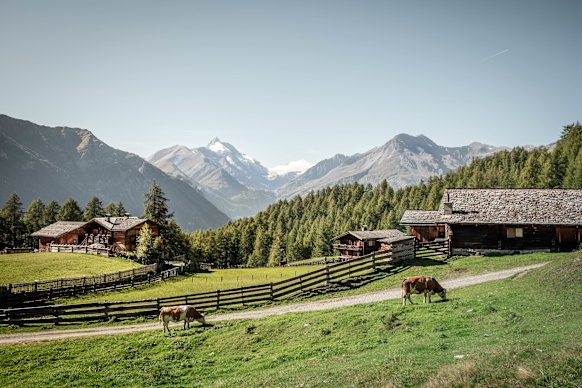 A larch-studded meadow in the picturesque Austrian alpine region of Grossglockner.
After good late-summer rain the pastures are glowing green. I catch the tonk-tonk of goat bells and the lowing of contented dairy cows. Passing a horse stud we disturb a herd of blonde-maned and tan-flanked Haflingers, sure-footed equine supermodels bred in the uplands.
Until now, my e-bike and I have been getting to know each other, and it’s been a little awkward. Modes from eco to turbo need calibrating to eight gears and various terrains. But on this undulating stretch I rediscover the sweet childish pleasure of hurtling downhill. The wheels go whizz. The wind whistles through my helmet. Gone is the awkward introduction – we’re speed dating.
On the approach to the 13th century market town of Golling, the flags on the bridge are rippling and straining. Rain clouds with heads like Chinese dragons pour out of the mountain passes. The heavens open over Golling’s stolid grey castle.
Overnight the rain eases, and we wake to the pealing of church bells and a volley of disconcerting explosions. It’s the customary way to herald a birthday in the town, explains Helmut, our tanned and towering host in lederhosen, and we get chatting about the Alpe Adria.
“It used to be just fitness freaks on road bikes,” he says, “but these days we’ve got 80-year-olds on e-bikes.”
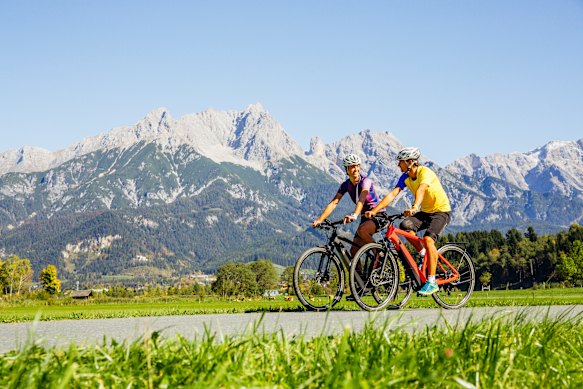 The route is full of European cyclists, some riding regular bikes and others some atop e-bikes.
There’s no doubt that the e-bike – plus the convenience of having luggage sent ahead each day and a route-plotting app – has opened the trail to cyclists of varying ages and skill levels.
Every day we see parties of European cyclists aged 70-plus, some on regular bikes, some atop e-bikes, all having the time of their lives.
In hindsight, with our reasonable fitness, we could have managed regular bikes on the Alpe Adria, but adding battery power offers peace of mind and means (theoretically at least) more stamina and time to explore diversions along the way.
For sure, souped-up e-bikes – or “fat bikes” to detractors – can add another urban hazard for cyclists, motorists and pedestrians, but for long-distance touring it’s difficult to find a downside.
INTO THE ALPS: Lueg Pass, Werfen and St Johann im Pongau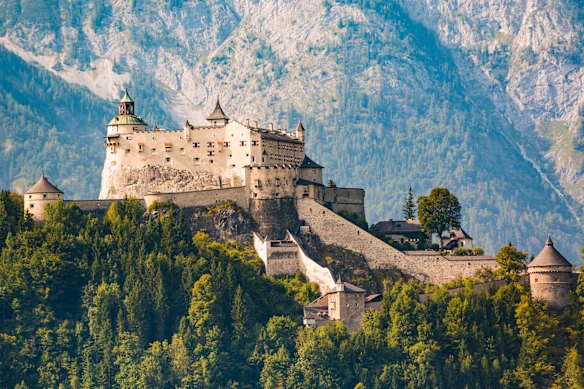 Hohenwerfen Castle overlooks the market town of Werfen.iStock
From Golling we take the bike path in bright morning sunshine uphill to the rather forbidding Lueg Pass. Here cyclists are funnelled to a busy main road for some 15 kilometres.
The severe limestone crags looming above are such a magnetic sight it takes effort not to peer at the summit while peddling, an ill-advised manoeuvre on a road shared with heavy vehicles.
Unless you’re comfortable cycling alongside trucks, it’s worth considering taking the train between Golling and Werfen. (For train enthusiasts, there’s another short train ride the following day through an eight-kilometre mountain tunnel.)
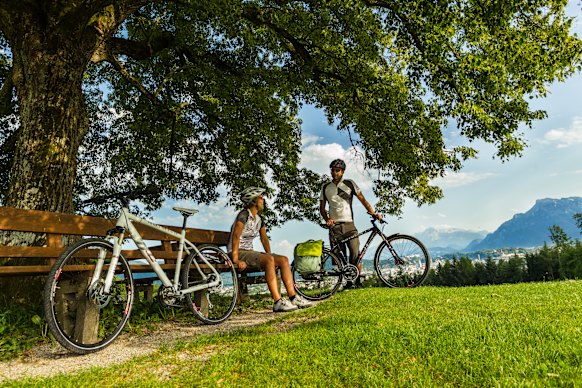 Cyclists pause for a well-earned rest along a shaded section of the Alpe Adria in Austria.
Thankfully, a rest stop lies ahead. We pull over to view the mountains beyond the pass and, further down the valley, the ornately gothic silhouette of Hohenwerfen Castle perched romantically on its knuckle of rock.
By the time we reach the riverside town of St Johann im Pongau, we’ve been in the company of the Tennen Mountains most of the day. Against a purple twilight they resolve into a clearly defined alpine massif, a cluster of pale shards, fissured and veined and riddled with ice caves, thrusting skyward with the vigour of geological youth.
THE SCENT OF ITALY: Obervellach, Drau Valley and Villach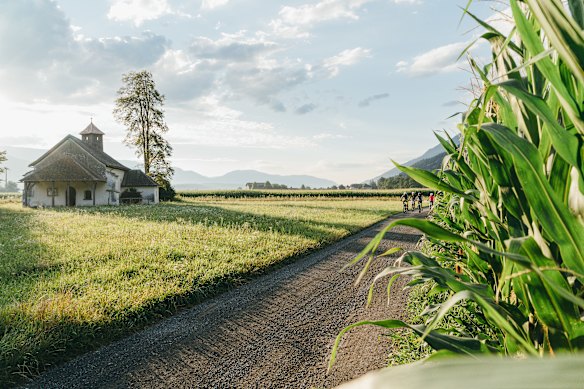 Chapel of St Maria Magdalena a highlight for cyclists on the Alpe Adria Cycle Path.Sam Strauss/Austrian Tourism Board
By next evening we’re beyond the Hohe Tauern Alps and deep in the southern Austrian province of Carinthia, installed in a lovely mid-19th-century hotel in the chocolate-box town of Obervellach.
It’s a quaint country inn, much like a French auberge, with dinner laid on. Our host schools us in the ravioli-like local specialties and shares his grappa distilled from pine cones.
From the main street, which fills with waves of touring cyclists, the alps pile up behind us, peaks like the sculpted heads of Titans. About an hour’s flight by crow, north by north-west rises Mount Glockner at nearly 3800 metres – 1000 shy of Mont Blanc but a good 1500 metres above our own Kosciuszko.
By this point of the journey a curious tension has taken hold. The deeper we press into Carinthia the more powerful the spell of these idiosyncratic Austrian valleys. But with each kilometre pedalled we slip further toward Italy.
National boundaries mean little in this neck of the alps. Austrians hereabouts take pride in their affinity with the Italian regions of Alto Adige and Friuli just across the border. Mountain folk, they share the same unbearably beautiful first snows, the long winter nights, the dazzling colours of the alpine spring.
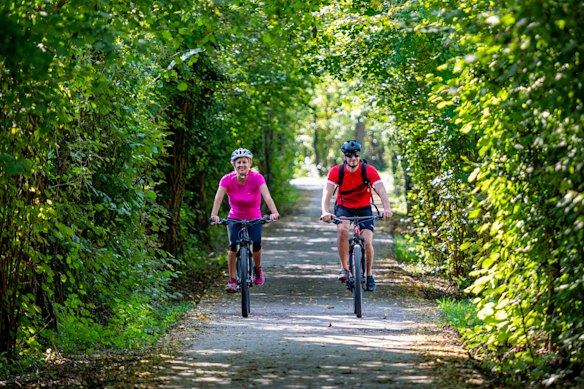 A pair of cyclists is cheerfully enveloped by a lush forested section of Alpe Adria in Italy.
The next two days gift us a gentle cycle through the peaceful Drau Valley. For the first few days of this journey we were travelling against the current of the Salzach, but the Drau is flowing swiftly from the mountains to the Black Sea and for the first time I’m aware of travelling downstream, as if swept along by the current.
The colour of milky jade, the river fattens as we approach the provincial city of Villach. The corn is ripening, the trout are biting and weekend anglers are tying flies and fiddling with their lines as we cycle by. “Catch don’t kill” reads a sign, in English.
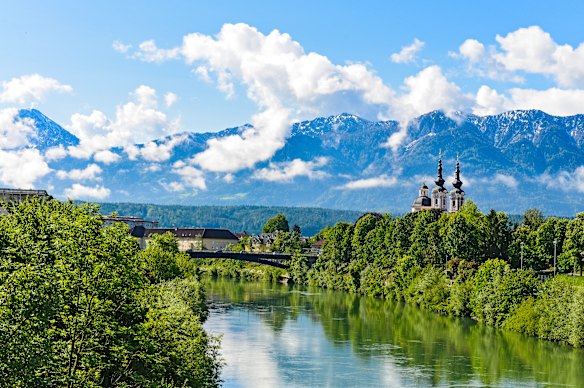 The city of Villach is framed by ethereal mountains and places of worship alongside the Drau River.iStock
I remember Villach from a winter’s journey many years ago, north to Vienna from Venice, stamping my feet in the sharp air. Today, bathed in autumn sunshine, Villach’s old heart has an elegant Mittel European tone and with its riverside bars and water fountains, a sybaritic southern personality.
WHEN THE GOING GETS EASIER: Tarvisio and Venzone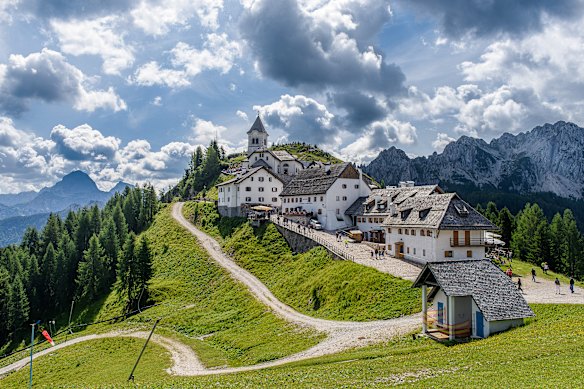 The sanctuary of Monte Lussari is located near Tarvisio in Italy’s Friuli Venezia Giulia region. iStock
We line up at the train station next morning with 20 or so cyclists, or Alpe-Adriasts as I’ve taken to calling them, loading bikes into a dedicated carriage bound for Tarvisio, a mountain town straddling three borders: Austria, Slovenia and Italy.
Today’s 60-kilometre stretch of the Alpe Adria south from the Italian border turns out to be the most spectacular of all: a leisurely mostly downhill cycle along repurposed railway lines through an alpine wonderland of passes, crags and waterfalls.
We sweep over old railway bridges and pass through dark cold tunnels – I lose count at 15 – with the cones of our bike lights to show us the way. At a handful of old train stations converted into wayside cafes, we pause for coffee and panini.
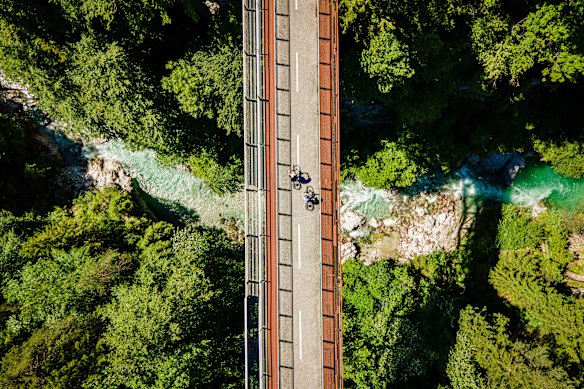 Cyclists pass over a bridge in the mountainous countryside near Tarvisio where the borders of three nations converge.
Along the way we have the Julian Alps for company. Jof di Montasio, at 2752 metres, thrusts pridefully through swathes of cloud, a sort of baby Matterhorn.
By now those of us on the long haul from Salzburg have been joined by Italian cyclists – they’re the ones without bike helmets, taking selfies and early afternoon spritzes.
Dinner is in Venzone, a pretty 13th century walled town and a sober reminder of the powerful capricious forces that make and remake this mountain landscape.
In 1976, Venzone was brought to its knees by an earthquake, killing 47 residents. Painstakingly, during the next 15 years the survivors rebuilt their town with the fallen stones along old medieval lines.
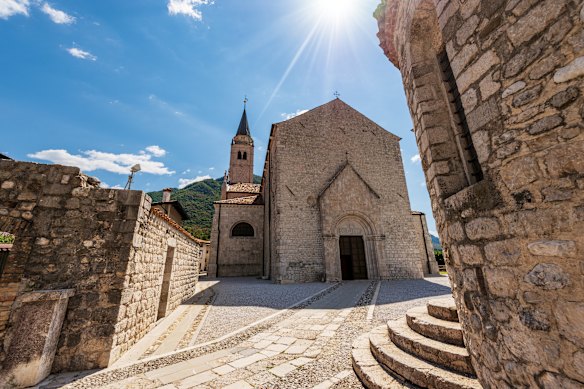 The medieval cathedral of Venzone was destroyed by a 1976 earthquake and rebuilt between 1988 and 1995.
iStock
At a jolly restaurant opposite the restored Gothic church of St Andrew, I order cjarsons, a kind of oversized Friulian ravioli stuffed with raisins, chives, parsley and nuts and topped with shreds of smoked ricotta. Friulano red or white wine comes by the carafe. It’s excellent, and costs about the same as bottled water at home.
On our last day in mountain country we leave the handsome city of Udine and its fine late-Renaissance town square, Piazza Liberta, before the morning traffic has peaked. After half an hour of bumbling with the route app – frequent shifts of direction in town traffic are never fun – we’re in open fields making a dash for the coast beneath a dry autumn sky.
THE LAST LEG, ON OUR LAST LEGS: Palmanova, Aquileia and Grado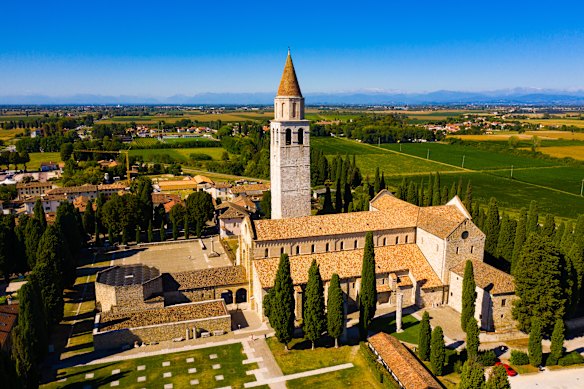 The medieval Basilica di Santa Maria Assunta in the small Italian town of Aquileia.iStock
Now we’re in flat, fertile country, corn fields and vineyards cross-hatched with springs and rivulets streaming down from the mountains, broadening into canals wide enough for small boats. The finish line at Grado lies ahead – we can almost smell the Adriatic – but there are two exceptional UNESCO World Heritage treats to detain us along the way.
The first is Palmanova, a fortified star-shaped late-Renaissance town, like a wheel or mandala, lying in the flat plain. It’s a place I’ve longed to see, but it’s unlikely I ever would have glimpsed Palmanova if not for the Alpe Adria. We stop for coffee in the bright sunshine.
Our next stop is the ruins of the old Roman capital of Aquileia. A great power in this part of the world for at least a millennium, Aquileia is a vivid witness to the shifting tectonic plates of civilisation.
On one side of the bike path stands a procession of broken classical columns, the remains of the old Roman forum, attended by archaeologists working away beneath black parasols.
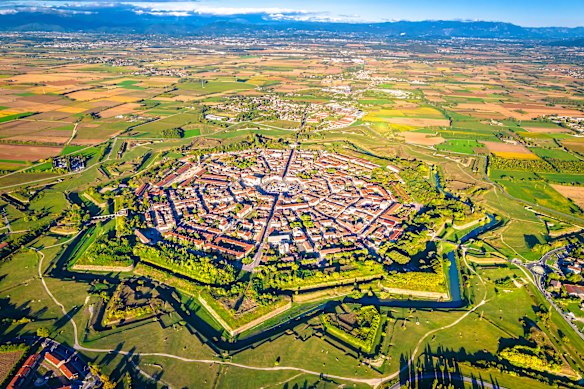 Italy’s fortfied late-Renaissance town of Palmanova is UNESCO World Heritage-listed.iStock
A little further on, part of the same complex, is a Christian basilica with a beautiful fourth century floor mosaic depicting abundant marine life. Time has buckled the mosaic, giving it an undulating surface. It’s as if the sea has washed inland, and we’re on an antique glass bottom boat staring at the ocean floor.
“Now for the final assault,” says my partner on this journey – and in life – as we press on, fortified with more coffee and crostata. We push into a briny sea breeze and the going gets harder just when we crave a reprieve.
Suddenly, we break from land into a blue world of sea and sky. The last stretch of the Alpe Adria is a five-kilometre causeway crossing a vast lagoon. From this distance, Grado is a splay of modern Noosa-like apartments, fishing boats, and a few towers and cupolas as mementos of the city’s origins. Sixth-century exiles from troubles on the mainland fled cities like Aquileia and took to the lagoon. Grado was colonised by these “boat people” before Venice was even dreamt of.
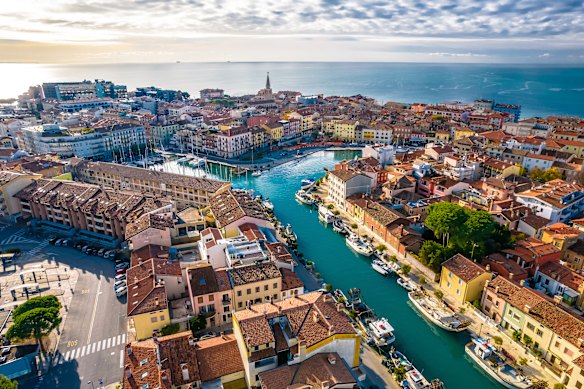 The town of Grado, located in the Friuli-Venezia Giulia region of Italy, is the end point of an epic ride.iStock
After six hours in the saddle, I’m tired and ragged, but I put on the afterburners and sweep across the bridge. The Greek poet CP Cavafy’s famous poem Ithaka urges the traveller to be patient: “… don’t hurry the journey at all. Better it lasts for years.”
Cavafy prized the path over the destination. To hell with that. I’ve pedalled 414 kilometres across the Alps, and I’ve one click to go. Hannibal did it with elephants. I’ve done it with an e-bike. But I’ve done it nevertheless.
Related Article
I reach the end of the causeway and turn to face the magnificent Julian Alps spread across the western horizon. Right behind me, sprinting as if breasting a finishing tape, is my companion. She brakes hard, plants both feet on the asphalt, and takes a deep breath. Her sunburnt cheeks are filmed with sweat, and she wears an expression of exhaustion and elation.
How does it feel? I ask, and she smiles.
“My butt aches.”
THE DETAILS
TOUR
Departures on UTracks’ self-guided Alpe Adria route are daily between April 25 to October 4. The 10-day trip costs between $3290 and $3840 a person, depending on season, including breakfast, accommodation (twin share), bike hire and insurance, luggage transfer, digital navigation app, briefing and emergency hotline. Choose a 21-speed bicycle with handlebar bag, pannier and repair kit; a 27-speed superior bike; or an e-bike (supplement applies). See utracks.com
FLY
Qatar Airways flies from six Australian capital cities, including Melbourne and Sydney, to the Austrian capital of Vienna and to Venice, Italy. From Vienna take a two-and-a-half-hour train ride to Salzburg and the start of the Alpe Adria cycle route. From the final cycle destination of Grado, take a three-hour bus and train ride to Venice. See qatarairways.com
MORE
austria.info; italia.it/en
FIVE LESSONS OF AN E-BIKER VIRGIN
Lesson one I was an e-bike virgin before this tour and early on almost ploughed into a parked Audi. The lesson? An e-bike will certainly reduce the physical effort, but never let your attention waver.
Lesson two Due to the battery and motor, e-bikes weigh about 25 kilograms and are heavy, so always be sure to change the gears on your model from econo to low well before any incline.
Related Article
Lesson three Following on from lesson two, the weight of these e-bikes makes for a thrill when descending sharply downhill. But care is needed. Bring your own helmet, padded shorts, cycling gloves and a gel-cushion seat cover.
Lesson four Though much of the Alpe Adria is along dedicated cycle paths, roads through small and large towns are shared with traffic. Along this route, in particular, there are good rail options.
Lesson five Rehearse the route ahead before heading out each day, as route apps are good but not infallible. The only time I came off my bike – fortunately at a low speed – was when my phone’s brightness setting faltered and I was studying the screen, not the path.
The writer travelled as a guest of UTracks.