
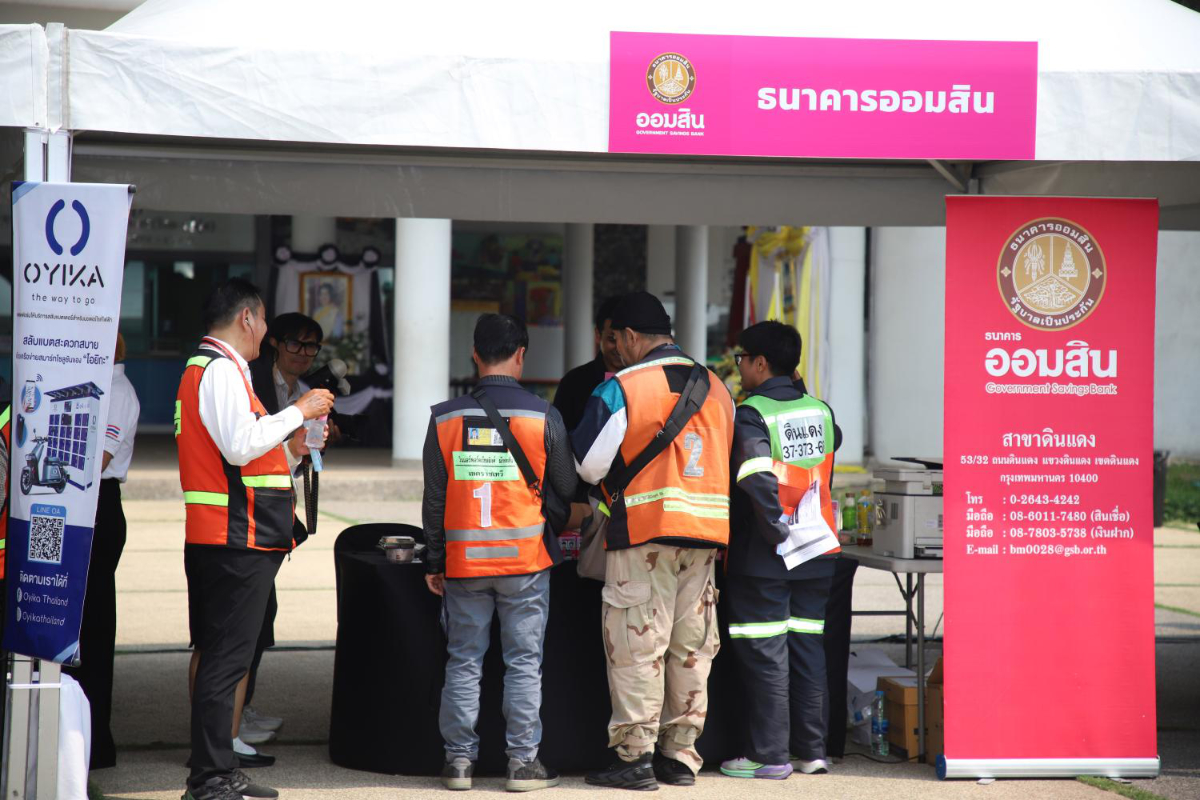
If you’re a Bangkok native or have been to Thailand’s capital city before, chances are you have used the service of P’Win, the Thai term coined for motorcycle taxi drivers, for zooming around the city at what feels like light speed.
Bangkok’s motorcycle taxi network has long served as the capital’s urban transportation system, weaving through tight alleyways and congested streets where larger vehicles cannot pass. More than 89,000 riders operate from over 5,300 designated stations across the city, forming the “capillary system” of Bangkok’s busiest infrastructure.
Now, city officials are looking to transform the power fuelling this pathway.
The Bangkok Metropolitan Administration, in collaboration with the German Society for International Co-operation (GIZ), has officially launched the “EV for Motorcycle Taxi Riders” initiative — a programme aimed at accelerating the transition from fuel-powered motorcycles to electric vehicles.
Branded as a “Win-Win-Win” initiative for the city, riders and the environment, this project seeks to lower operating costs, reduce pollution and modernise Bangkok’s transport ecosystem. “Together we win,” organisers emphasised.
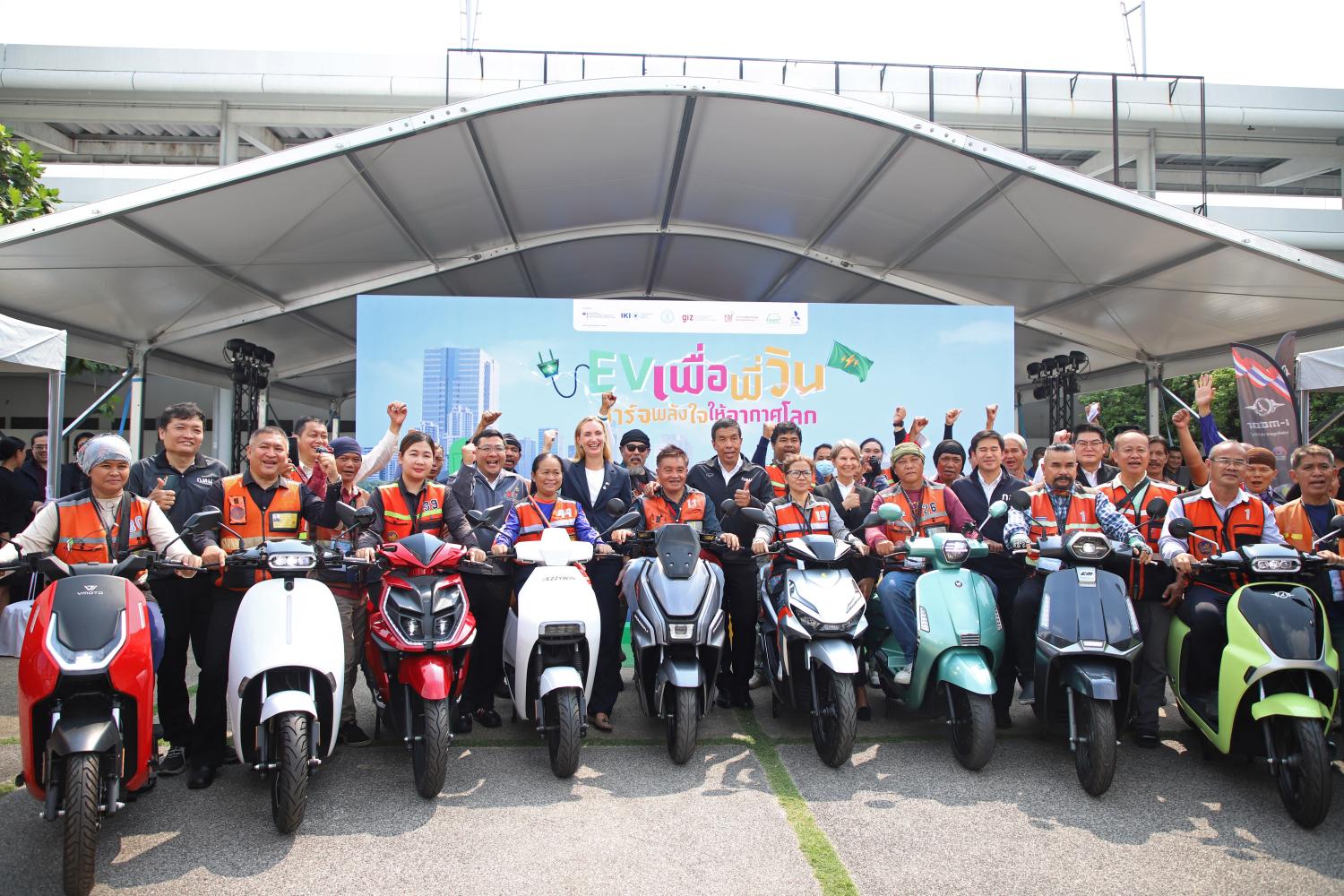
Bangkok governor Chadchart Sittipunt together with motorcycle riders at the launch event.
The initial test phase will involve more than 200 motorcycle taxi riders and BMA street sweepers in Bangkok’s Din Daeng and Phaya Thai districts. Participants will receive guidance on costs, maintenance, charging systems, and practical usage considerations.
From this group, 30 participants will be selected for a free, one-month pilot programme to collect real-world performance data.
Bangkok Governor Chadchart Sittipunt stressed that promoting EV awareness is critical to the transition’s success.
“The shift is necessary,” he told reporters. “But it will not succeed unless users understand it first.” He encouraged drivers to research thoroughly before purchasing EVs, emphasising that public confidence will grow once efficiency becomes visible.
Insa Illgen, of GIZ Thailand, described the initiative as a cornerstone for Bangkok’s electric mobility future.
“Motorcycles are the backbone of Bangkok’s transportation,” she said, adding that neither the BMA nor GIZ can address emerging mobility needs alone. “This is a marathon, not a sprint.”
She emphasised that access to financing will play a decisive role in drivers’ adoption decisions.
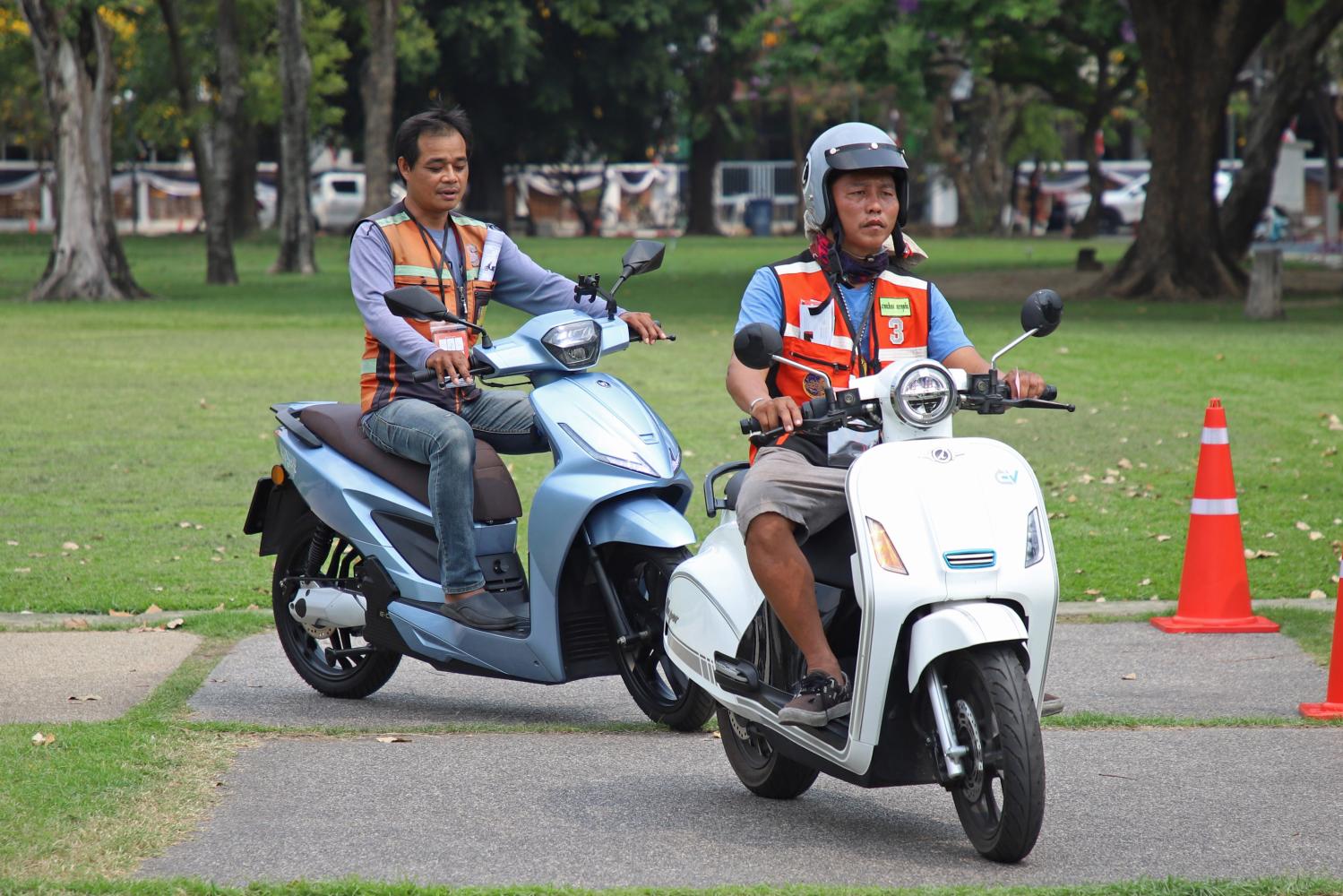
Varuth Hirunyatheb
Riders who have tested the vehicles reported a mix of enthusiasm and hesitation.
A driver from Ladprao 101 station said that while fuel-powered motorcycles currently present few issues beyond occasional tyre wear, learning about EV benefits changed his perspective. A female rider praised the quiet operation and smooth ride, noting that customers appreciated the comfort.
Most importantly, many riders pointed to significant fuel cost savings as the strongest incentive.
Other drivers said electric motorcycles require an adjustment period. One rider described the experience as more enjoyable than fuel, but noted the lack of clear user manuals for first-time EV users.
According to a study, electric motorcycles could reduce riders’ operating costs by up to seven times. Annual expenses could drop to approximately 7,200 baht per year. Additionally, switching to EVs could reduce PM2.5 emissions by an estimated 16 tonnes annually.
Despite the advantages, financing remains the most significant obstacle. For many drivers whose income margins are already tight, upfront purchase costs and battery replacement concerns weigh heavily in decision-making.
Chadchart highlighted the need for private-sector investment to support long-term expansion as financing has been one of the highlighted issues motorcycle taxi drivers are facing when switching from fuel to electric.
The majority of motorcycle taxi drivers travel between 100km and 150km per day, making fuel costs a substantial portion of their daily costs. Currently, 75% of drivers report that their income is equal to or less than their expenses.
Nearly half of riders surveyed said they are not yet ready to transition to electric motorcycles. Charging infrastructure preferences also differ: 67% prefer home charging, while 33% would rather use battery-swapping stations.
Janjira Ruengchan, a win driver, added to the conversation that maintenance is generally simpler for electric motorcycles, as they eliminate the need for engine oil changes. However, concerns remain about battery longevity and repair costs. She worries that if major components fail, replacement costs could be higher than fuel-powered motorcycles.
Speed is another concern, as some EV models do not match the top speeds of conventional fuel-powered motorcycles.
As Bangkok begins its transition towards electrified motorcycle taxis, officials acknowledge that widespread adoption will take time. But with education, financing solutions, and infrastructure support, the city hopes its iconic wins can lead the way towards a cleaner, more sustainable future.
“Amid global warming and worsening air pollution, every switch to an electric vehicle is a step towards cleaner air and a healthier future,” says Chalerm Changthongmadan, president of the Motorcycle Taxi Riders Association of Thailand.