Support CleanTechnica’s work through a Substack subscription or on Stripe.
Or support our Kickstarter campaign!
It’s been the case since the early days of electric vehicle (EV) adoption, but what’s good to see is this has not changed as more of the “mass market” has begun adopting EVs — electric car owners love their EVs and would buy an EV again. This is not surprising not only because surveys have shown similar results for years, but also because EVs simply offer huge advantages over non-electric cars that people consistently love.
The news this week confirming this yet again comes from JD Power. The JD Power 2026 U.S. Electric Vehicle Experience (EVX) Ownership Study was published on February 18 and the biggest take-home statistic was that 96% of EV owners said they’d consider purchasing or leasing an EV (a fully electric vehicle, aka BEV) for their next vehicle. Notably, this is actually the highest result for this question that the annual study has received since it began doing this survey in 2021.
The study surveys thousands of EV owners within their first year of ownership. It examines 10 key factors of ownership:
accuracy of stated battery range
availability of public charging stations
battery range
cost of ownership
driving enjoyment
ease of charging at home
interior and exterior styling
safety and technology features
service experience
vehicle quality and reliability.
It’s nice to see that JD Power, not known as the bastion of progressive thought or cleantech enthusiasm, is saying the same things we’ve been saying recently about EVs and continued EV adoption after the end of US federal subsidies. “EV market share has declined sharply following the discontinuation of the federal tax credit program in September 2025, but that dip belies steadily growing customer satisfaction among owners of new EVs,” said Brent Gruber, executive director of the EV practice at JD Power. “Improvements in battery technology, charging infrastructure and overall vehicle performance have driven customer satisfaction to its highest level ever. What’s more, the vast majority of current EV owners say they will consider purchasing another EV for their next vehicle, regardless of whether they benefited from the now-expired federal tax credit.” Indeed, once you enjoy the benefits of an electric vehicle and get used to how convenient they are, why go back to gas? I can’t imagine wanting to do so.
One big thing that is boosting satisfaction is growing public EV charging infrastructure. From the NEVI program Democrats launched to Tesla opening up its Supercharger network to other brands, public EV charging has improved significantly, and EV owners have noticed. “The availability of public charging is by far the most improved index factor in both premium and mass market BEV segments. Satisfaction among premium BEV owners is 652 (on a 1,000-point scale) and 511 among mass market owners, up 101 and 115 points, respectively, year over year. The continued growth of publicly available chargers and opening of the Tesla Supercharger network have notably improved satisfaction among mass market BEV owners during the past several years. Furthermore, satisfaction among Tesla owners is rebounding as they adapt to the expanded access of the charging network,” JD Power writes.
Another notable improvement was the quality of the vehicles, especially premium BEVs. “While total problems experienced by owners improves among both premium and mass market BEVs, the premium segment sees an improvement of 15.9 problems per 100 vehicles (PP100) year over year to 75.0 PP100, marking the best quality performance for the segment in the current iteration of the study. This is driven by improvements in squeaks/rattles inside the vehicle, as well as fewer problems with driver assistance and excessive noises from outside the vehicle. By comparison, total problems among mass market BEVs is 92.2 PP100.”
Comparing BEVs to PHEVs, BEV owners are significantly happier with their vehicles. “Premium BEVs score 114 points higher than premium PHEVs in this area, while mass market BEVs outperform their PHEV counterparts by 117 points.”
The most satisfied owners were Tesla owners. Here were the top premium BEV models and their scores:
Tesla Model 3 — 804
Tesla Model Y — 797
BMW i4 — 795
BMW iX — 794
And here were the top mass-market BEV models and their scores:
Ford Mustang Mach-E — 760
Hyundai IONIQ 6 — 748
Kia EV9 — 745
Hyundai IONIQ 5 & Kia EV6 — 743
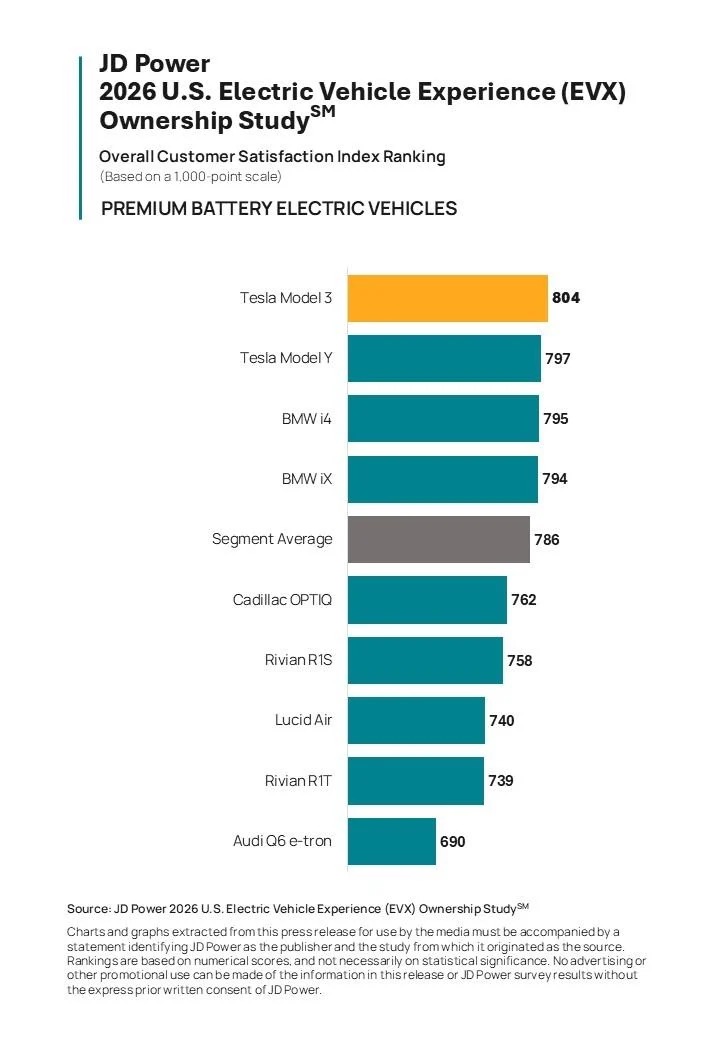
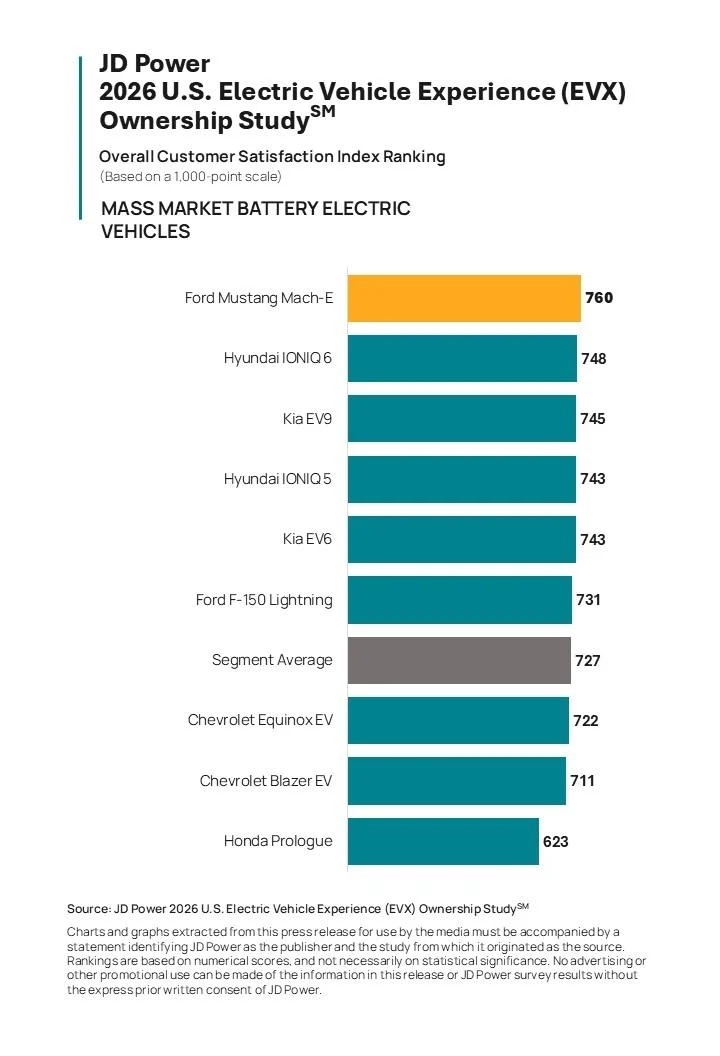
Overall, the average premium EV score was up significantly from 756 last year to 786 this year, and the average for mass-market EVs was up slightly from 725 last year to 727 this year.
Notably, the study is conducted in collaboration with PlugShare, a company that knows a great deal about EVs and EV owner data collection.
Support CleanTechnica via Kickstarter
Sign up for CleanTechnica’s Weekly Substack for Zach and Scott’s in-depth analyses and high level summaries, sign up for our daily newsletter, and follow us on Google News!
Advertisement
Have a tip for CleanTechnica? Want to advertise? Want to suggest a guest for our CleanTech Talk podcast? Contact us here.
Sign up for our daily newsletter for 15 new cleantech stories a day. Or sign up for our weekly one on top stories of the week if daily is too frequent.
CleanTechnica uses affiliate links. See our policy here.
CleanTechnica’s Comment Policy