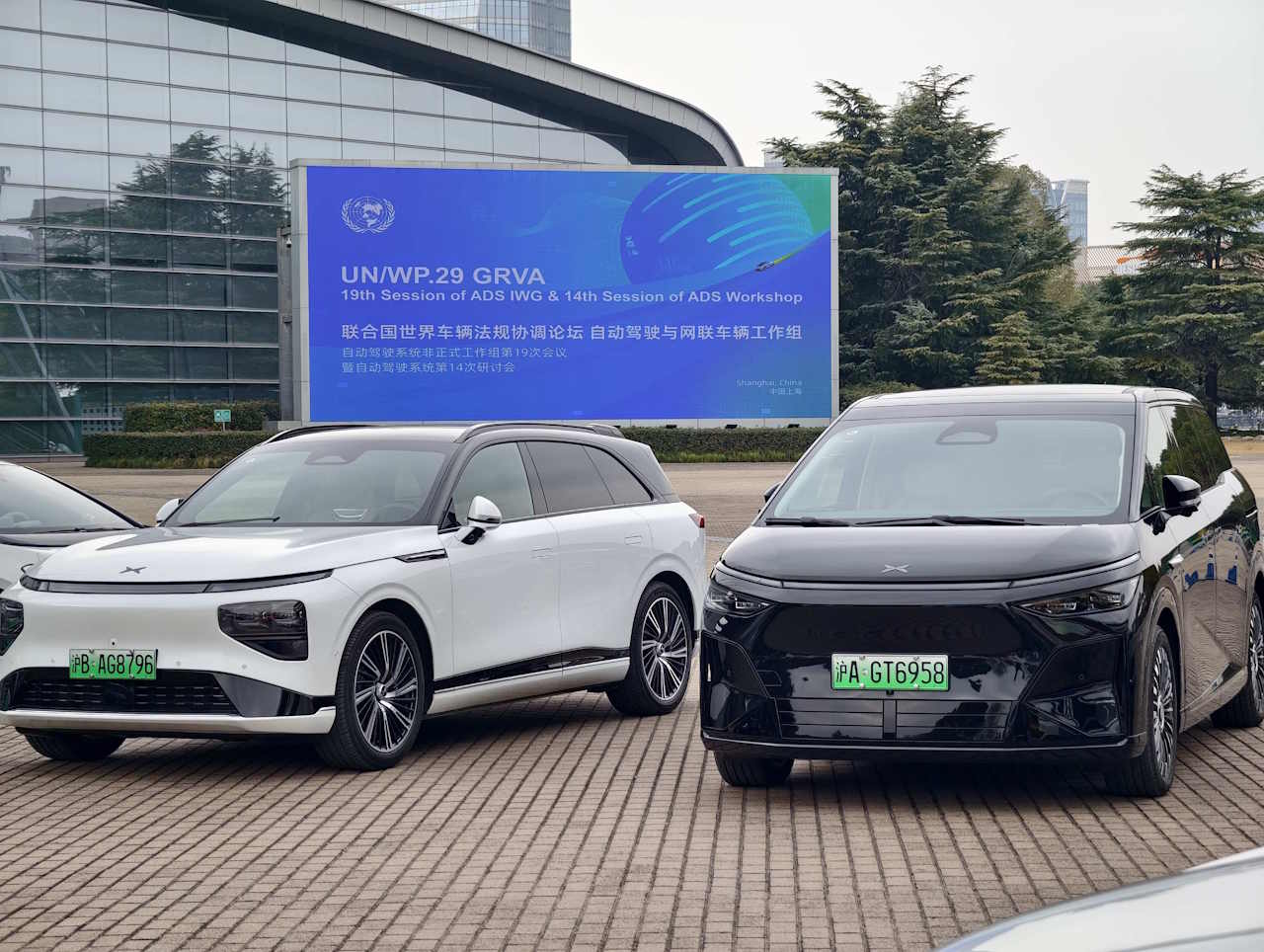
Chinese electric vehicle (EV) manufacturer Xpeng last week showcased its AI-driven Advanced Driver Assistance Systems (ADAS) to global delegates during in live road demonstrations as part of a United Nations informal working group on ADAS.
Xpeng demonstrated its AI-driven ADAS technology to global delegates in Shanghai last week attending the United Nations Economic Commission for Europe (UNECE) World Forum for Harmonization of Vehicle Regulations (WP.29) Informal Working Group on Automated Driving Systems (IWG ADS).
The combination of a UN gathering focused on artificial intelligence (AI) technology means that any reporting on this event is going to be littered with acronyms, starting with the IWG ADS, which exists to gather government and industry representatives to share their technical expertise on automated driving systems.
Xpeng has been involved the Taskforce on Advanced Driver Assistance Systems (TF ADAS) discussions on Driver Control Assistance Systems (DCAS) since 2023 but only began joining IWG ADS meetings in 2025.
At this latest session held in Shanghai, Xpeng was the only emerging Chinese automaker to participate throughout the session, and the only one to provide live demonstrations to attending delegates, rather than limit their engagement to more technical presentations.
According to Xpeng, officials from some of the world’s largest automotive markets including Canada, the European Union (EU), Japan, United Kingdom, and the United States jumped into an Xpeng EV to experience its XNGP in-house developed ADAS in real-world urban and highway scenarios.
“The session provided global delegates with firsthand exposure to how large-scale, data-driven AI systems perform in the variability and unpredictability of real traffic environments,” said in a press release.
“During the demonstrations, participants observed the XNGP driving system’s real-time perception, decision-making and control capabilities, as well as its integrated safety framework — including driver status monitoring, human-machine interaction logic and safety design.
“Across complex urban and highway scenarios, these capabilities translated into a smooth driving experience.”
Xpeng also used the IWG session to share insights about its upcoming VLA 2.0 (Vision-Language-Action) architecture, a next-generation AI foundation for intelligent driving that streamlines how visual input translates into vehicle actions, delivering faster response times, reduced information loss, and more human-like driving performance.
Built on this new technology, Xpeng is aiming to advance its Robotaxi roadmap in China, starting with trial operations planned for some time later this year.

Joshua S. Hill is a Melbourne-based journalist who has been writing about climate change, clean technology, and electric vehicles for over 15 years. He has been reporting on electric vehicles and clean technologies for Renew Economy and The Driven since 2012. His preferred mode of transport is his feet.