
Dublin, Feb. 18, 2026 (GLOBE NEWSWIRE) — The “Electric Two Wheeler Market by Vehicle, Voltage Type, Motor Type, Battery, Motor Power, Technology, Vehicle Class, Usage, Region – Global Forecast to 2032” report has been added to ResearchAndMarkets.com’s offering.
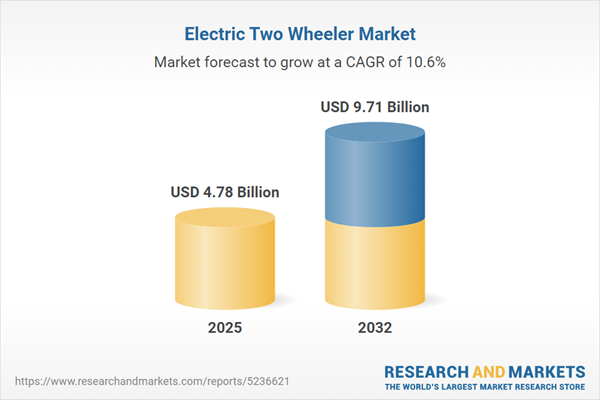
The electric two wheeler market is projected to grow from USD 4.78 billion in 2025 to USD 9.71 billion by 2032 at a CAGR of 10.6%
The electric two wheeler market is dominated by major players, including Ola Electric (India), Bajaj Auto Ltd. (India), TVS Motor Company (India), Ather Energy (India), and Yadea Technology Group Co., Ltd. (China).
These companies have adopted a mix of organic and inorganic growth strategies, such as product launches, strategic partnerships, joint ventures, mergers & acquisitions, and expansion of production facilities, to strengthen their international footprint and capture a larger market share. Through these strategies, they have expanded across regions by offering a diverse portfolio of electric two-wheelers tailored to local market needs, featuring advanced battery technologies, connected mobility solutions, and competitive pricing to attract a wider customer base.
In India and Southeast Asia, localized battery pack assembly and cell-to-pack (CTP) designs are being adopted to improve the cost-per-kWh efficiency of mass-market scooters. Shared mobility and delivery operators are providing real-time usage data to OEMs, influencing next-generation vehicle designs focused on durability, thermal endurance, and ease of maintenance.
Electric motorcycles are now being engineered for sustained power delivery rather than short bursts, reflecting a shift toward continuous performance optimization. As a result, competitive differentiation is moving from mechanical hardware to intelligent systems, including ride modes, traction control algorithms, and energy management software.
Hub motors are expected to dominate the electric two wheeler market during the forecast period.
Hub motors are expected to dominate the electric two wheeler market due to their simple construction and low maintenance requirements. Integrated directly into the wheel hub, they eliminate chains, belts, and gearboxes, reducing mechanical complexity, weight, and service costs. Their compact design enables lighter and more ergonomic vehicles to be an essential advantage for urban commuters and delivery fleets. Hub motors also provide efficient regenerative braking and improved energy utilization, enhancing range and overall ride efficiency.
With battery prices declining and energy density improving, hub motor-based vehicles are becoming more cost-effective to produce and easier to scale for mass markets. The growing importance of shared mobility and fleet operations further supports hub motor adoption, as reliability and low upkeep outweigh the need for peak performance. Aligning with the global shift toward urban electrification, hub motor architecture offers OEMs an optimal balance of cost, simplicity, and scalability. In August 2025, Ola Electric (India) introduced an in-house hub motor utilizing ferrite (rare-earth-free) magnets, thereby reducing its dependence on imported rare-earth materials and strengthening local manufacturing capabilities.
The commercial usage segment is expected to grow at the fastest rate in the electric two wheeler market during the forecast period.
The commercial usage of electric scooters and motorcycles, including delivery fleets, ride-share services, and last-mile logistics, is expected to grow at the fastest rate in the electric two wheeler market as operators focus on lowering lifecycle costs, improving operational efficiency, and ensuring rapid fleet turnover.
Electric two-wheelers deliver substantial savings in fuel and maintenance compared to internal combustion models, making them ideal for high-utilization fleets. With the rapid growth of e-commerce and food delivery, many companies are transitioning their entire fleets to electric models to meet sustainability goals and comply with stricter urban emission norms.
These commercial operations also benefit from predictable routes and usage patterns, enabling easier deployment and financing of electric vehicles at scale. In response, OEMs are developing rugged, cargo-capable electric scooters and motorcycles, supported by battery swapping and dedicated charging networks tailored for fleet operations.
For instance, in May 2025, Komaki launched the CAT 2.0 Eco, an electric scooter designed for last-mile delivery and utility applications. It features a lithium-ion battery offering a range of 110-120 km per charge and is powered by a BLDC motor capable of reaching a top speed of 55 km/h. Once commercial adoption reaches scale, the resulting cost efficiencies and infrastructure development are likely to extend into the consumer market, driving broader industry growth.
The Asia Pacific electric two wheeler market is mainly driven by India.
India’s vast two-wheeler market, driven by strong replacement demand and rapid urbanization, presents a highly favorable environment for electrification in the scooter & motorcycle sector in the Asia Pacific region. Government initiatives such as the FAME II scheme, state-level subsidies, and the national target of achieving 30% EV penetration by 2030 have significantly lowered upfront costs and accelerated adoption. The steady decline in lithium-ion battery prices is further enhancing the cost competitiveness of electric two-wheelers compared to ICE models.
Leading domestic OEMs and startups, including Ola Electric, Ather Energy, and Hero MotoCorp, are actively expanding their electric portfolios while strengthening local manufacturing, distribution, and service networks. India’s dense urban traffic, short daily commutes, and high fuel prices make electric two-wheelers particularly attractive from a total cost-of-ownership perspective.
The shift toward electrification is also supported by the country’s environmental and energy-security goals, aligning market forces, policy direction, and consumer demand. Reflecting this momentum, electric two-wheeler sales in India reached approximately 1.15 million units in FY24. Infrastructure development is keeping pace, with players such as Ather Energy planning to double their retail presence to 700 outlets nationwide by March 2026.
Key Attributes:
Report AttributeDetailsNo. of Pages379Forecast Period2025 – 2032Estimated Market Value (USD) in 2025$4.78 BillionForecasted Market Value (USD) by 2032$9.71 BillionCompound Annual Growth Rate10.6%Regions CoveredGlobal
Case Study Analysis
Genze Partnered with Leewayhertz for Integration of Electric Scooter with Mobile AppHero Electric Partnered with Ebikego to Transform Last-Mile DeliveriesZypp Electric to Use Hero Electric Bikes to Electrify 100% Last-Mile Delivery by 2025
Market Dynamics
Drivers
Fleet Electrification for Urban and Commercial MobilityAdvancements in Battery SystemsCollaborations Between OEMs, Electric Two Wheeler Manufacturers, and Fleet Operators
Restraints
Charging Infrastructure Gaps in Many Emerging Economies and Range Performance IssuesBattery Heating Problems and Long Charging Times
Opportunities
Lightweight Design and Shared Vehicle Architecture InnovationTransition to Modular and Swappable Energy PlatformsSoftware Ecosystem Development and Digital Value Chain Expansion
Challenges
Reliability of Thermal and Power Electronics in Urban Operating ConditionsLack of Standardization in Battery Communication and Swapping Protocols
Impact of Generative AI on Electric Two Wheeler Market
Product Design and Development OptimizationIntelligent Manufacturing and Supply Chain EfficiencyPersonalization and User Experience EnhancementAdvanced Battery Management and Energy Optimization
Acoustic Vehicle Alerting System (Avas) in Electric 2-Wheelers
Regulatory Framework and MandatesAvas Integration in Electric Two WheelersComponent Architecture and Design TrendsTypical SetupDesign TrendsFuture Advancements in Sound Signature and Smart AvasDynamic Sound ProfilesPsychoacoustic Tuning
Emerging Business Models in Electric Two Wheeler Market
Subscription-based and Leasing ModelsBattery Swapping and Energy-As-A-Service (EaaS)Shared Mobility and Fleet ElectrificationBattery-As-A-Service (BaaS)Digital Service Monetization
Key Emerging Technologies
Integrated Powertrain Modules
OEM Analysis
Production Capacity of Key OEMsTechnological DevelopmentsHondaYamahaBMW MotorradPiaggio Group (Vespa/Piaggio)Ather EnergyOla ElectricNiu (China/Global)
Companies Featured
Ola ElectricBajaj Auto Ltd.Tvs Motor CompanyAther EnergyYadea Technology Group Co. Ltd.Hero ElectricGogoroVmoto LimitedNiu InternationalJiangsu Xinri E-Vehicle Co. Ltd.Ideanomics, Inc.Askoll Eva S.P.A.Ultraviolette AutomotiveRevolt Intellicorp Private Limited (Revolt Motors)Z Electric VehicleCakeLightning MotorcyclesJohammer E-Mobility GmbHPiaggio GroupKtm AGHarley DavidsonBMW GroupAima Technology Group Co. Ltd.Honda Motor Co. Ltd.Greaves Electric Mobility Private Limited (Ampere Vehicles)Dongguan Tailing Electric Vehicle Co. Ltd.CezetaTerra Motors CorporationNexzu Mobility Ltd. (Avan Motors India)Emflux MotorsMahindra & Mahindra Ltd.Damon Motors Inc.Viar Motor IndonesiaSelisGesitsUnited E-MotorSmoot ElektrikPt Volta Indonesia Semesta (Volta)AlvaNusa MotorsBf Goodrich
For more information about this report visit https://www.researchandmarkets.com/r/xbgfol
About ResearchAndMarkets.com
ResearchAndMarkets.com is the world’s leading source for international market research reports and market data. We provide you with the latest data on international and regional markets, key industries, the top companies, new products and the latest trends.
