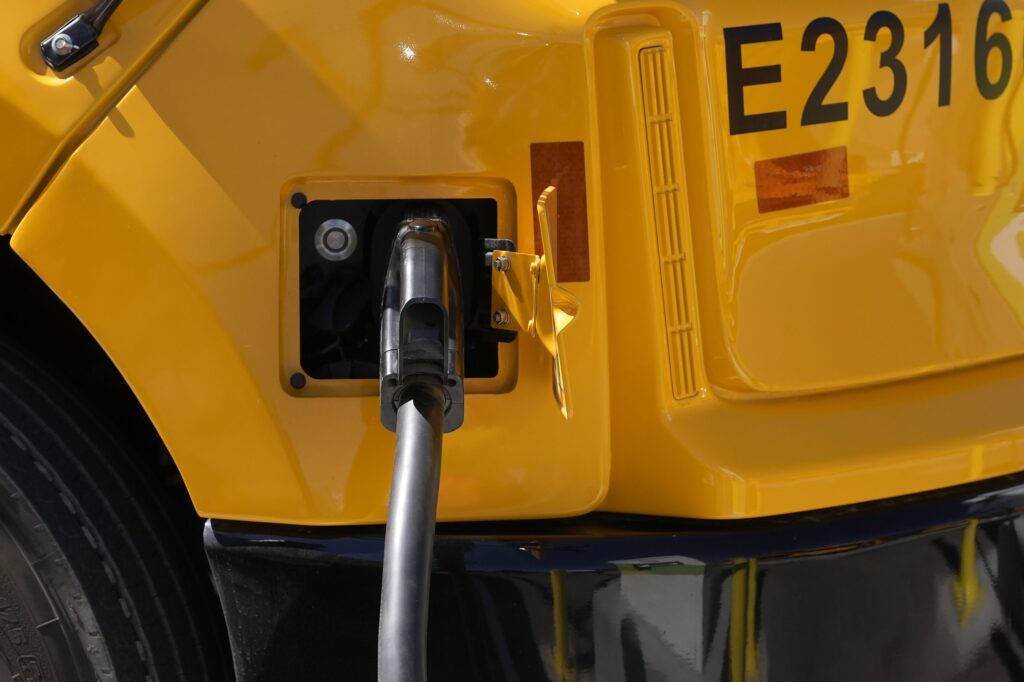
The bus drop off area at Red Lake Elementary has been a bit quieter — and a bit less pungent — since late 2024, when two electric school buses began running routes there.
Red Lake Public School District officials expect three more electric buses later this year, at which point electrons will power more than 20% of the buses operated in this sprawling rural district on the Red Lake Indian Reservation in northern Minnesota, where passenger EVs are few and far between. A grant from the U.S. Environmental Protection Agency funded the first two buses and a new, complimentary curriculum focused on clean technologies.
Across Minnesota, the number of electric school buses shuttling kids to class is on track to rise sharply in 2026 as districts tapping into federal and state incentives see orders fulfilled.
Red Lake district superintendent Tim Lutz and business manager Willie Larson said students have so far shown more regard for the electric buses than they do for the diesel variety. Kids being kids, Lutz said it’s notable that the seats remain free of doodles nearly two years in. Larson credited the classroom tie-ins and the fact that the buses — which lack pollutant-emitting tailpipes — are plainly easier on human health and the environment.
“We’ve tried to tie (the buses) into the tribal mission and values of protecting our lakes and woodlands,” Larson said.
Use of electric school buses on the rise
Red Lake’s experience now has echoes in every corner of the state. Though it remains far behind leading states like California, New York and Illinois, Minnesota has seen “slow, on-and-off growth of electric school buses” since Lakeville Public School District got the Midwest’s first electric school bus in 2017, said Susan Mudd, who tracks the clean school bus landscape for the Environmental Policy and Law Center.
Minnesota had 19 electric school buses on the road in February, according to the World Resources Institute, which tracks adoption through its Electric School Buses Initiative. Those buses carry about 700 students.
Minnesota schools have ordered or been awarded another 129 electric school buses, with at least 21 districts in some stage of procurement or operation, WRI says. They’re tapping grants from the U.S. EPA, the Minnesota Department of Commerce and the Minnesota Pollution Control Agency to reduce the up-front cost of the buses, whose sticker prices can exceed $300,000. The MPCA grant is funded by billions in settlement dollars paid by German automaking giant Volkswagen to settle claims it manipulated diesel vehicle emissions systems — a pot of money that also funds public passenger EV charging infrastructure.
At least some of these “committed” buses will be ready for students by the start of the 2026-2027 school year.
Related: MPCA unveils pilot program to fund six electric school buses in Minnesota
Moorhead Area Public Schools hopes to take delivery of its first three electric buses this fall, said Sean Schneider, the district’s transportation director. They’re funded in part through a $13 million state grant program that covers at least 80% of the buses’ up-front costs and 65% of the cost of vehicle charging infrastructure.
Thomas Built Buses, the manufacturer, says the vehicles headed to Moorhead can run up to 150 miles on a single charge in ideal weather conditions. That’s roughly double the length of the average U.S. school bus route, according to the National Renewable Energy Laboratory (now National Laboratory of the Rockies).
Schneider, of course, knows that weather conditions are often not “ideal” in the wind-swept Red River Valley. To avoid unpleasant surprises due to cold weather range loss — which the Red Lake officials have observed at around 30% on the chilliest days — Schneider said Moorhead is easing the buses into service on shorter routes that will see them run about 50 miles daily. At that distance, they should be able to complete morning and afternoon runs without topping off in between, even in winter.
“We’re going to start with the routes I would say we’d be very confident with, and then stretch our legs from there,” he said.
Schneider is also confident that Moorhead’s new buses will cost less to operate. At current electricity prices, he said the electric buses’ fuel costs will come in one-half to two-thirds lower than diesel.
And because electric buses have far fewer moving parts than internal-combustion buses, they — at least in theory — require less maintenance and fewer repairs as they age. Lower operations and maintenance costs were more than enough to offset higher up-front costs in a 2023 Environmental Defense Fund analysis that estimated the 12-year cost of ownership for an electric bus at nearly 40% below that of a diesel bus.
Moorhead and Red Lake aren’t the only Greater Minnesota school districts to take a flier on electric school buses. More than half the districts with operating or committed electric school buses are outside the Twin Cities metro, according to WRI. Several share the same rural character as Red Lake: Ogilvie in east-central Minnesota, Laporte in north-central Minnesota and Vermilion County in far northern Minnesota.
But just as consumers’ sometimes-overblown concerns about cold weather performance, public charging infrastructure and fire risk have hindered passenger EV adoption in Minnesota, some school boards and district officials have been slow to warm to the technology. Lutz and Larson diplomatically characterized their counterparts in other rural districts as both curious and skeptical about their buses. Larson said his message is that electric buses really aren’t much different from buses that run on liquid fuels — and that, for now, they’re available for a song thanks to heavy state subsidies.
“Why wouldn’t you want a free school bus?” he said, rhetorically.
Lexie Lyng, electric vehicle program coordinator for the Minnesota Pollution Control Agency, said she expects school leaders’ skepticism to wane as they see more of their peers taking the plunge.
MPCA recently reached out to districts in Minnesota counties with elevated air pollution to gauge their interest in electric school buses. Its takeaway from that effort was that “a lot of folks are interested (and) kind of waiting to see more hit the road,” Lyng said.
Anna Crouch, an electric vehicle program director with the Minnesota Department of Commerce, said her agency works to educate prospective electric school bus users on the health, environmental and the onboard safety benefits of much quieter cabins. Easier monitoring of student behavior — and communication when students act out — means “a big quality of life improvement for bus drivers themselves,” Crouch said.
Rural districts’ concerns about range are reasonable in some cases but “overblown” in others, Crouch added. It’s likely that most if not all Minnesota districts can electrify at least one route with current technology, she said.
“We want to make sure that there’s accurate, helpful info out there about electric school buses,” Crouch said.
Additionally, Commerce designed its grant program not to require “scrappage,” Crouch said, meaning districts can procure electric school buses without replacing an equal number of diesel buses. If they need to take an electric bus out of service for repairs or any other reason, they can fall back on the old vehicles.
New technology brings growing pains
Still, any new technology — let alone the most significant change in vehicle propulsion in more than a century — brings some growing pains.
For help, several Minnesota districts have tapped outside contractors for help with the electric transition. Red Lake, Moorhead and Edina work with Highland Electric Fleets, a Massachusetts-based company that helps districts choose buses, navigate grant applications and line up other forms of financing, build out charging infrastructure, and keep buses running and in good repair once they arrive.
Larson said Red Lake pays about $15,000 per bus, per year for its maintenance agreement, which includes out-of-warranty battery replacement. That would cost the district around $80,000 per bus if it had to pay out of pocket.
“We sort of view it as insurance,” he said.
Joshua Williams, senior Midwest regional manager for Highland Fleets, said Highland’s agreements with school districts generally include a “charging management service” that guarantees the buses are ready for their routes each morning. The relationships are designed to last for the entirety of the buses’ operating lives, typically 10 to 15 years, with zero up-front cost for participating districts. Instead, they pay $20,000 to $50,000 annually per bus for Highland’s full service suite, beginning when the bus is delivered.
Elsewhere in the United States, fleet management companies like Highland and First Student also put electric school buses to work stabilizing the electric grid when they’re not in use. According to WRI, at least 26 electric utilities in 19 states have “vehicle-to-grid” programs that help them manage local power flows. Williams said that for each of the past few summers, some Highland-managed buses in New England have earned $8,000 to $12,000 apiece.
Though no Minnesota utility yet has a commercial vehicle-to-grid school bus program, the Environmental Policy and Law Center’s Mudd encouraged Xcel Energy and others to consider implementing them. Districts could use the income to offset up-front bus costs as the Trump administration dials back support for electric vehicles, she said.
Vehicle-to-grid program or not, Red Lake’s “turnkey” arrangement with Highland makes life much easier for the district’s mechanics, drivers and office staff, Lutz said.
“We can’t speak highly enough of Highland… they have just been a wonderful partner,” Larson said. “The hardest part now is just waiting for the buses to be delivered.”
Related