Introduction: A Market in the Middle of a Mobility Revolution
The automotive industry in North America is undergoing one of the most significant transformations in its history. As governments, businesses, and consumers push toward cleaner and more sustainable transportation, electrification has moved from a niche concept to a mainstream priority. Within this transition, plug-in hybrid electric vehicles (PHEVs) are emerging as a practical bridge between traditional internal combustion engines and fully electric vehicles.
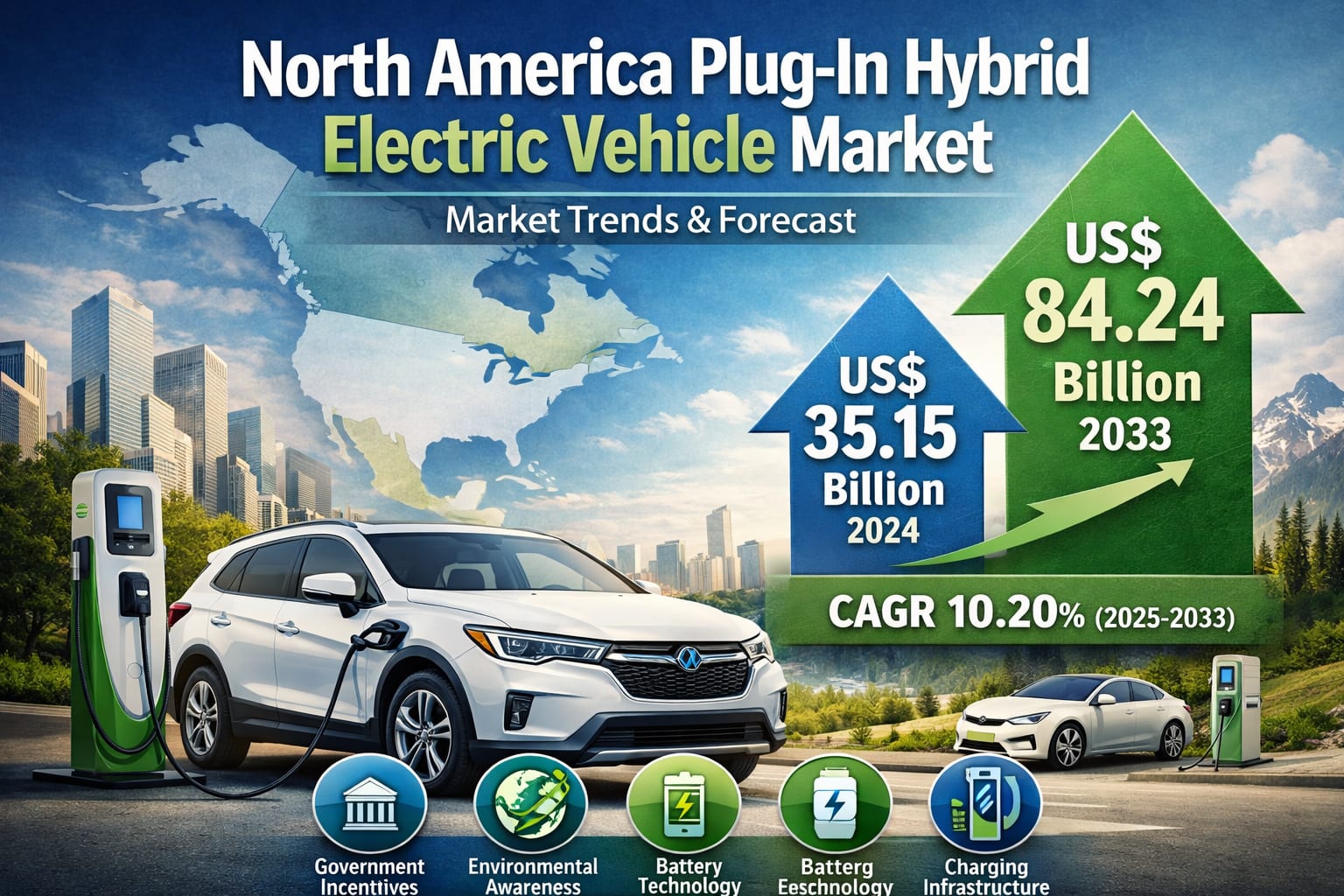
According to Renub Research, the North America Plug-in Hybrid Electric Vehicle Market is expected to grow from US$ 35.15 billion in 2024 to US$ 84.24 billion by 2033, registering a strong compound annual growth rate (CAGR) of 10.20% from 2025 to 2033. This impressive growth reflects a combination of policy support, rising environmental awareness, rapid technological progress, and expanding charging infrastructure across the region.
Understanding Plug-in Hybrid Electric Vehicles
A plug-in hybrid electric vehicle is a hybrid car equipped with a battery pack that can be charged both internally—through regenerative braking and the internal combustion engine—and externally via a charging cable connected to an electric power source. While PHEV technology is also being used in commercial vehicles, buses, and specialized applications, passenger cars currently account for the majority of market demand.
One of the defining advantages of PHEVs is their operational flexibility. When driven within their electric-only range and regularly charged, these vehicles can operate largely on electricity, significantly reducing fuel consumption and emissions. When the battery is depleted, the vehicle seamlessly switches to hybrid mode, using gasoline and regenerative braking to continue the journey without range anxiety.
Fuel efficiency in PHEVs depends heavily on driving habits and charging frequency. If a vehicle is never plugged in, its performance resembles that of a conventional hybrid. However, when charged regularly and used for shorter daily commutes, it can operate primarily as an electric vehicle, delivering substantial fuel savings and environmental benefits.
Market Overview: Why North America Is Embracing PHEVs
North America is becoming a key growth hub for plug-in hybrid electric vehicles due to a convergence of favorable factors. Governments across the United States, Canada, and Mexico are tightening emission regulations, encouraging low-emission vehicle adoption, and investing in charging infrastructure. At the same time, consumers are becoming more environmentally conscious and increasingly willing to consider alternatives to traditional gasoline-powered cars.
Technological progress has also played a major role. Improvements in battery efficiency, power management systems, and vehicle integration have made modern PHEVs more reliable, more efficient, and more appealing than earlier generations. Combined with a growing variety of models across different price points and vehicle categories, this has helped push PHEVs further into the mainstream automotive market.
Despite being more expensive upfront than comparable conventional or standard hybrid vehicles, PHEVs benefit from fuel savings over time, along with various tax credits, rebates, and incentives that help offset initial costs. For many buyers, this makes the total cost of ownership increasingly competitive, especially as fuel prices remain volatile and environmental regulations become stricter.
Key Growth Drivers Shaping the Market
1. Government Incentives and Policy Support
One of the strongest forces behind the expansion of the North America PHEV market is government support. Federal, state, and provincial authorities across the region have introduced a wide range of incentives, including tax credits, purchase rebates, reduced registration fees, and other financial benefits. These measures significantly lower the effective purchase price of PHEVs, making them accessible to a broader range of consumers.
Beyond direct financial incentives, policy frameworks also play a critical role. Stricter emission standards, long-term decarbonization targets, and investments in charging infrastructure all create a favorable environment for electrified vehicles. These policies not only encourage consumers to switch to cleaner vehicles but also push automakers to expand their PHEV portfolios and accelerate innovation.
2. Rising Environmental Awareness and Sustainability Goals
Environmental consciousness is no longer a fringe concern—it is now a central factor influencing consumer decisions. As awareness of climate change, air pollution, and resource depletion grows, more buyers are actively seeking ways to reduce their carbon footprint. PHEVs offer a practical compromise: they significantly cut emissions compared to conventional vehicles while still providing the convenience and range security of a gasoline engine.
For many households, PHEVs represent a manageable first step toward electrification. They allow drivers to experience electric driving for daily commutes while avoiding the anxiety associated with long-distance travel in fully electric vehicles. This balance aligns well with both personal sustainability goals and broader government and corporate environmental commitments.
3. Automaker Investments and Expanding Model Availability
Major automotive manufacturers are investing heavily in plug-in hybrid technology as part of their broader electrification strategies. Instead of limiting PHEVs to a single niche, companies are now offering them across multiple segments, including sedans, SUVs, and even larger family-oriented vehicles.
This expanding range of models ensures that PHEVs appeal to diverse customer groups—from urban commuters looking for efficiency to families needing space and versatility. Automakers are also targeting different price categories, from more affordable options to premium and luxury models, further broadening the market’s reach. As choice increases, so does consumer confidence and adoption.
Challenges Facing the PHEV Market
Limited Electric-Only Driving Range
One of the main limitations of PHEVs is their relatively short electric-only range compared to fully electric vehicles. While this is sufficient for many daily commutes, it may not meet the needs of drivers with longer travel requirements. As a result, some owners may rely more on gasoline than initially intended, reducing the overall environmental benefits.
This limitation can also contribute to range anxiety, especially in regions where charging infrastructure is still developing. For some potential buyers, this remains a psychological barrier, even though PHEVs are designed specifically to eliminate the risk of being stranded.
Growing Competition from Fully Electric Vehicles
Fully electric vehicles (EVs) are advancing rapidly, with longer ranges, faster charging times, and an expanding charging network. For environmentally focused consumers, EVs offer the ultimate solution: zero tailpipe emissions and complete independence from gasoline.
As EV technology continues to improve and become more affordable, some buyers may choose to skip the “transition phase” of PHEVs and move directly to full electric models. This competitive pressure forces the PHEV segment to clearly communicate its unique value proposition as a flexible, practical, and transitional solution in the broader electrification journey.
Country-Level Insights
United States Plug-in Hybrid Electric Vehicle Market
The United States represents the largest and most influential market for PHEVs in North America. Growing environmental awareness, combined with federal and state-level incentives, continues to drive adoption. Consumers are increasingly attracted to the idea of reducing fuel consumption without sacrificing driving convenience.
While challenges such as competition from fully electric vehicles remain, ongoing investments in charging infrastructure and continuous technological improvements are expected to support steady growth. For many American consumers, PHEVs strike a compelling balance between sustainability, practicality, and cost efficiency.
Canada Plug-in Hybrid Electric Vehicle Market
Canada’s PHEV market is benefiting from strong policy support and high levels of environmental awareness. Provincial incentive programs, particularly in regions such as British Columbia and Quebec, have made PHEVs more affordable and attractive to a wide range of buyers. These are further supported by federal initiatives aimed at promoting zero-emission and low-emission vehicles.
Canada’s commitment to reducing greenhouse gas emissions and promoting clean transportation continues to create a favorable environment for PHEV adoption. As regulations tighten and consumer awareness grows, the Canadian market is expected to remain a strong contributor to regional growth.
Mexico Plug-in Hybrid Electric Vehicle Market
Mexico is emerging as an important growth market for PHEVs, driven by increasing environmental awareness, supportive government measures, and the introduction of new models by both domestic and international manufacturers. Urban centers, in particular, are seeing rising interest due to incentives such as tax benefits, reduced registration fees, and exemptions from certain driving restrictions.
The gradual expansion of charging infrastructure and the broader push toward sustainable transportation are expected to further strengthen the PHEV market in Mexico over the coming years.
Market Segmentation Overview
By Vehicle Class:
Low Priced
Mid-Priced
Luxury
By Car Type:
SUV
MPV & Vans
Midsize & Large Cars
Small & Compact Cars
By Country:
United States
Canada
Mexico
Rest of North America
This segmentation highlights how PHEVs are no longer confined to a single category or consumer group. From affordable compact cars to premium luxury models and versatile SUVs, the market is becoming increasingly diverse and inclusive.
Competitive Landscape and Key Players
The North America PHEV market features a mix of established automotive giants and innovative global players. Key companies covered in the market include:
Nissan North America, Inc.
Tesla
Ford Motor Company
BMW Group
General Motor Company
Toyota Motor North America, Inc.
BYD Company Ltd.
Mercedes-Benz USA
These companies are competing across multiple dimensions, including technology, design, performance, pricing, and brand trust. Their strategies typically focus on expanding model lineups, improving battery efficiency, enhancing driving experience, and aligning with regulatory requirements. Continuous innovation and strategic investments are expected to remain central to maintaining competitiveness in this rapidly evolving market.
The Road Ahead: What the Future Looks Like
Looking forward, the North America Plug-in Hybrid Electric Vehicle market is well-positioned for sustained growth. With the market projected to more than double in value from 2024 to 2033, PHEVs will continue to play a crucial role in the region’s transition toward cleaner mobility.
While fully electric vehicles will undoubtedly gain a larger share of the spotlight, PHEVs are likely to remain highly relevant—especially for consumers who want a balanced, flexible, and low-risk entry into electrified driving. As technology improves, infrastructure expands, and policies continue to favor low-emission transportation, the appeal of PHEVs is expected to remain strong.
Final Thoughts
The North America Plug-in Hybrid Electric Vehicle market stands at a fascinating crossroads between tradition and transformation. With a projected rise from US$ 35.15 billion in 2024 to US$ 84.24 billion by 2033, and a CAGR of 10.20%, the numbers clearly show that PHEVs are not just a temporary trend—they are a significant pillar of the region’s clean transportation future.
By offering a practical blend of electric efficiency and gasoline-powered flexibility, PHEVs are helping millions of drivers take meaningful steps toward sustainability without sacrificing convenience. In many ways, they represent the perfect bridge between where the automotive world has been and where it is going next.