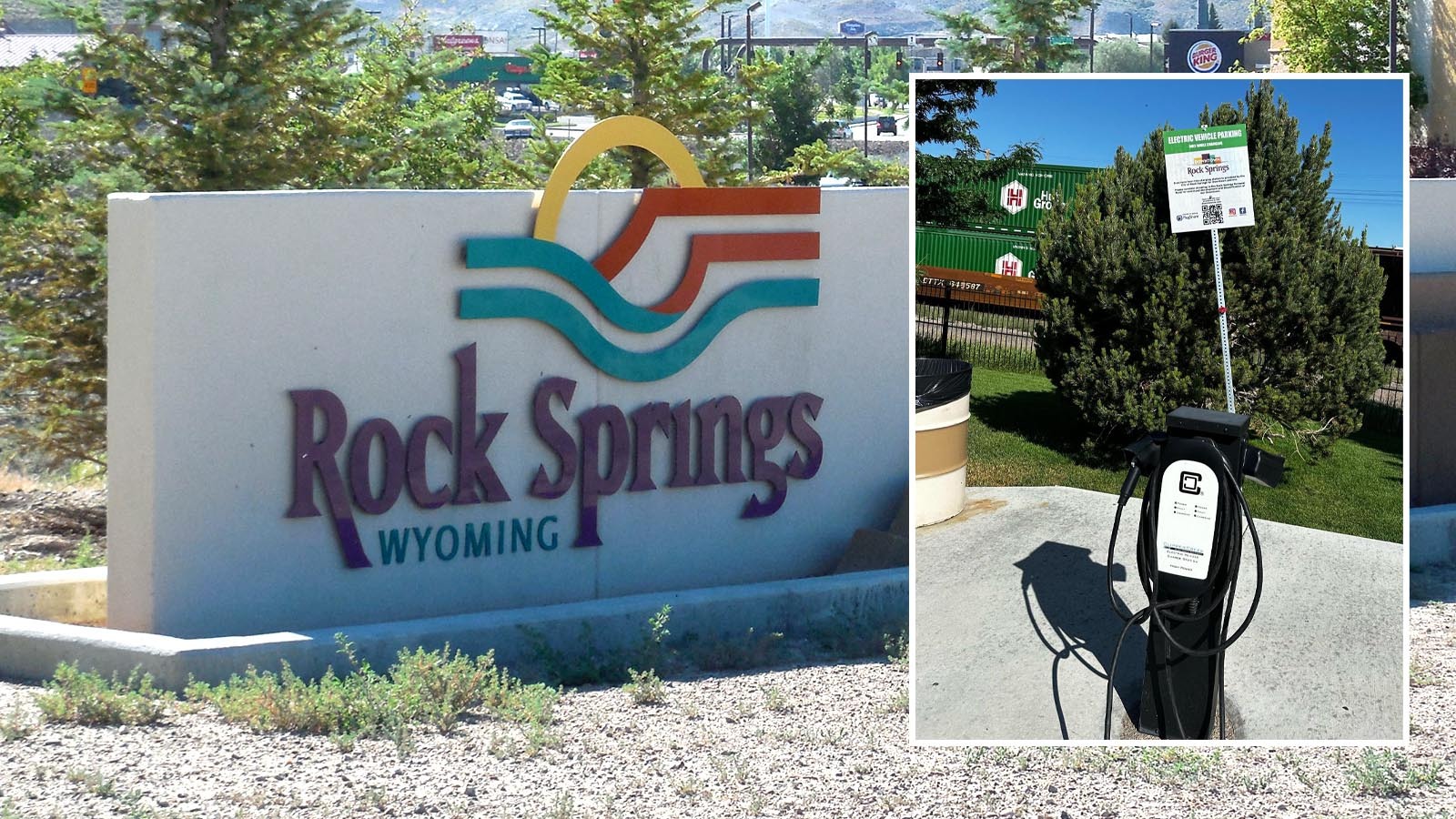
CHEYENNE — A free electric vehicle charger that Rock Springs installed downtown as a perk for visitors was removed after the Wyoming Department of Transportation told the city it would have to pay taxes on electricity it was giving away at no cost to those traveling through.
The charger’s disappearance, disclosed in a memo to the Rock Springs City Council, is exactly the kind of consequence that EV advocates warned about when WYDOT began enforcing a fuel tax on charging stations last year.
Now a Jackson legislator has proposed a bill that would exempt stations like Rock Springs’ from the tax altogether.
House Bill 145 has been referred to the House Transportation Committee for discussion.
Matt McBurnett, the city’s director of administrative services, told Cowboy State Daily that WYDOT contacted Rock Springs and informed the city it would have to pay taxes and obtain a license for the free charging station.
“The mayor basically made the decision,” McBurnett said, explaining that the station wasn’t set up to track how much electricity it dispensed. “It was done for economic development for the downtown area several years ago. So we just made the decision to take it out.”
The charger, which sat outside the Bunning Freight Station near the city’s Urban Renewal Agency offices, has been physically removed — not just turned off.
The idea behind the charger was simple: EV drivers planning a trip might stop and spend money in downtown Rock Springs while they waited for their vehicle to charge.
“That’s correct,” McBurnett confirmed.
In his memo presented to the City Council at its Feb. 4 meeting, McBurnett spelled out the problem.
“Under WYDOT’s interpretation, we would be required to pay tax on the electricity we provide at no cost to the public,” the memo read. “Because our charging unit does not have the capability to track or quantify the amount of electricity given away per vehicle, we have no mechanism to calculate or remit such a tax.”
The memo added: “This decision is solely the result of WYDOT’s interpretation of the applicable statutes. If anyone has concerns about this requirement or its impact on public charging availability, we encourage them to contact their local state legislator.”
The council received the memo as part of its consent agenda, which it approved unanimously.
Predicted Problem
The charger removal is precisely what Rep. Mike Yin, D-Jackson, and other EV advocates predicted when Cowboy State Daily first reported on Wyoming’s new EV charging tax in October.
“What will likely happen is some of those charging stations, rather than pay a tax, these folks are probably just going to remove their station,” Yin said at the time.
Alicia Cox, executive director of Yellowstone-Teton Clean Cities, said WYDOT began sending letters to all charging station owners and operators across the state last summer, notifying them they would need to register each station for $25 and track and pay a tax on electricity sold or dispensed monthly.
“What’s happening now because of this program is that you have Level 2 station owners, like Rock Springs or a hotel, that now have to monthly track how much electricity they sold or gave away through their station, and then multiply that by the amount and then send in a check,” Cox told Cowboy State Daily. “So it’s just a lot of work for not a lot of money.”
Cox said some Level 2 station owners are looking at an hour or two every month of administrative work to figure out the reporting and are deciding it’s simply not worth it.
“They think they’re going to be out of compliance,” she said. “If they don’t have a way to track the electricity, so they just shut it down anyway so they don’t have to deal with it.”
Rock Springs isn’t alone. Cox said Riverton-based Wild West EV also had to take some stations down temporarily while he figured out how to manage tracking and reporting under the new requirements.
Triple Taxed
Cox said the deeper problem is that Wyoming EV owners are effectively paying three taxes compared to the single fuel tax that gasoline vehicle owners pay — the alternative fuel tax at charging stations, sales tax on the electricity, and Wyoming’s $200 annual EV registration fee.
“They’re all kind of capturing money for the same thing,” Cox said.
That’s the core issue Yin’s bill aims to fix. A working draft of the legislation, titled “Removing triple taxation for resident EV drivers,” would limit the alternative fuel tax on electricity to DC fast-charging stations only, exempting the Level 2 chargers like the one Rock Springs removed.
The draft bill would also set a new per-kilowatt-hour tax rate of 3.5 cents instead of using the current gasoline gallon equivalency formula, exempt electricity sold at charging stations from sales tax, reduce the annual registration fee for plug-in hybrid vehicles from $200 to $100, and create a refund mechanism allowing Wyoming-registered EV owners to recoup up to $200 per year in charging taxes paid at DC fast-charging stations.
Cox said the approach makes sense because DC fast-charging station operators are already set up to track and report electricity sales, and those stations are where out-of-state travelers — who don’t pay Wyoming’s EV registration fee — do their charging.
“Significantly less residents will charge at Level 3 stations because they’ll do so at home,” Cox said. “And are already paying the registration fee.”
Quiet Response
“WYDOT respects local entities making local decisions, and we have no further comment,” said Jordan Young, WYDOT’s deputy public affairs officer.
Cox said she met with WYDOT about two weeks ago and came away with the understanding that the agency isn’t trying to make life harder for Level 2 station owners.
“They didn’t introduce this program to make it more difficult to own and operate a Level 2 charging station. They’re just following what they have to, to be legal with that 2015 bill that passed,” Cox said. “And there’s been several bills that have been introduced over the years to put more clarity, and they haven’t made it through.”
Cox said WYDOT even indicated it would accept estimates and averages from station owners who lack precise tracking mechanisms, rather than forcing them to shut down.
Slow Growth
Cox said she doesn’t expect a wave of Level 2 stations to be shut down the way Rock Springs pulled its charger, but she does believe the current rules will slow new installations.
“People will be a little bit more cautious or think through it more, realizing that they’re not just offering an amenity,” Cox said. “They are now offering like a fueling station, and that just might not end up being worth it to them financially and administratively.”
Wyoming has 1,231 registered electric vehicles statewide and about 135 charging stations subject to the tax requirements, according to WYDOT data.
The state isn’t alone when it comes to dealing with this issue.
“I’ll just add the Montana perspective: Montana’s law excludes chargers under 25kw thus avoiding these issues entirely,” noted Jesse Therien, Montana project manager for Yellowstone-Teton Clean Cities.
“I was a business owner around the time this Montana Bill was being discussed in 2023 (which initially included Level 2 chargers) and spoke to the burden of sending in a monthly check of $0.85; I think that’s what we would have owed at that time. It just didn’t make sense or cents!” Therien told Cowboy State Daily.
David Madison can be reached at david@cowboystatedaily.com.