AI chip for SDVs; hypercar; automotive edge chip; Waymo’s new GenAI model; neuromorphic detects motion 4X faster; sodium-ion battery; Ferrari-all electric; carmakers’ recalibrations on EVs; batteries that don’t break in the cold; radar that sees around corners.

Quick links: Automotive chips, Autonomous, EVs, Batteries, Policy, Research.
Automotive chips
Mythic and Honda will jointly develop an automotive-grade AI SoC for Honda’s SDVs that leverages Mythic’s energy-efficient analog compute-in-memory technology.
ST released a new MCU with AI acceleration for the automotive edge, integrating an embedded neural network accelerator.
Infineon’s CoolSiC MOSFETs were selected for Toyota’s new bZ4X model, an all-electric SUV.
Vishay rolled out new AEC-Q200 qualified thick film chip resistors for automotive and other applications.
Research
JD Powers’ latest U.S. Vehicle Dependability study finds that 63% of software updates were performed OTA and resulted in 14% increase in problems over the past 12 months. Mobile phone integration in cars is the top issue for the third consecutive year, and PHEVs remain the worst of any powertrain type in the study.
Ultra-fast motion perception, enabled by neuromorphic HW with 2D synaptic transistors, was developed by an international team led by Beihang University along with BIT, KAUST, and Cambridge researchers. The system “encodes brightness changes and accumulates them in analog, non-volatile states, generating compact regions of interest,” all at a speed four times faster than humans. Applications include vehicle operations, robotics, and UAVs.
The University of Pennsylvania developed a radar system that can “see around corners,” using radio waves and ML paired with physics-based modeling. The technology can be paired with sensors to provide another safety tool at blind intersections.
More automotive technology research:
Autonomous
Waymo introduced its new GenAI model, Waymo World Model, featuring photorealistic, multimodal simulations for autonomous driving built on Google DeepMind’s Genie 3 technology. The model generates high-fidelity, multi-sensor outputs with both camera and lidar data.
Fig.1: World Model can adjust for time-of -day conditions. Source: Waymo
In collaboration with Toyota, Pony.ai plans to roll out 1000 bZ4X robotaxis this year, equipped with its latest autonomous driving system.
EVs
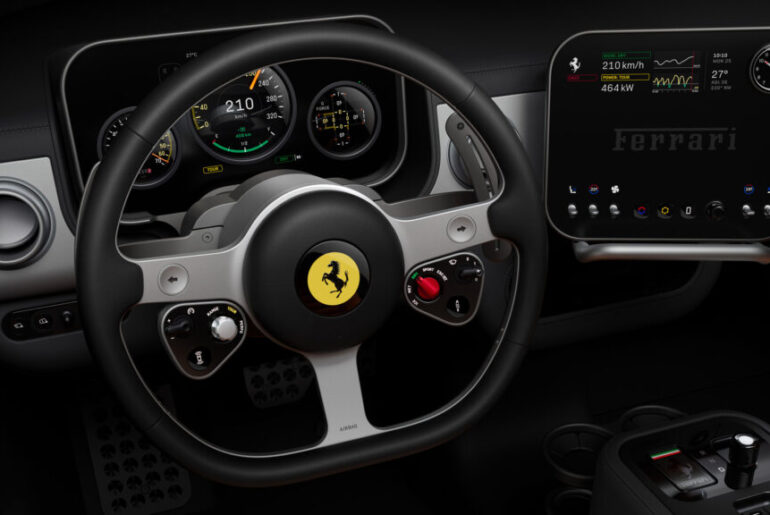
Ferrari plans to roll out its first all-electric car, the Ferrari Luce, in May at an expected price of $.5M. The vehicle can accelerate from 0 to 100 km/h in 2.5 seconds, with a 300+ mile battery range.
And if that isn’t fast enough for you, check out UK-based McMurtry Automotive‘s electric single-seater Spéirling Pure hypercar, which will go from 0 to 60 mph in just 1.55 seconds. That’s slightly less than 2Gs, which can make it hard to move your arms and legs. McMurty plans to commercialize the £995,000 vehicle, which includes a downforce-on-demand fan system and a 100 kWh lithium ion battery system with 745kW peak output.

Fig. 2: Spéirling Pure hypercar. Source: McMurtry Automotive
Honda joined other carmakers in warning of slowing demand for EVs and tariff pressures. Ford said EV losses will remain for three more years. Recently, Stellantis took a €22 billion writedown, mostly to reduce its EV investments.
But it’s not all bad news for the EV market, as 22% of US vehicles sold in 2025 were hybrid, battery electric, or plug-in hybrid vehicles, up from 20% in 2024. The increase was largely due to hybrid vehicle sales.
S&P Global expected BEV sales to climb 19% this year, according to its new report, “Five projections for the 2026 automotive industry outlook.” Collectively, all types of EVs are expected to account for 30% of global vehicle sales.
Policy
The March 17 deadline for automakers to certify that their automatic driving systems (ADS) and vehicle connectivity systems do not contain any code from China or Russia is causing a scramble among carmakers to audit their multi-layered supply chains.
US federally funded EV chargers must now be made out of 100% domestic parts, versus the prior requirement of 55%.
ACEA and Mercedes-Benz penned a letter to EU leaders urging measures to prevent de-industrialization, ensure pragmatic decarbonisation, and reverse the decline in vehicle production in Europe. Also, Europe’s automotive association CLEPA appealed to EU leaders, warning of an “industrial exodus” and pushing for “made in Europe” rules for components in European vehicles.
Batteries
China’s Nankai University and others released a new ultra-high specific energy lithium-rich manganese solid-liquid battery system, claiming energy density exceeding 500 Wh/kg, a range of over 1,000 kilometers (621 miles) on a single charge, and fast charging capabilities.
CATL and CHANGAN are now mass-producing a sodium-ion battery vehicle, with a range exceeding 400km/248 miles, with over 90% capacity retention at –40 °C and steady power delivery at temps as low as –50 °C.
New battery research:
More Reading