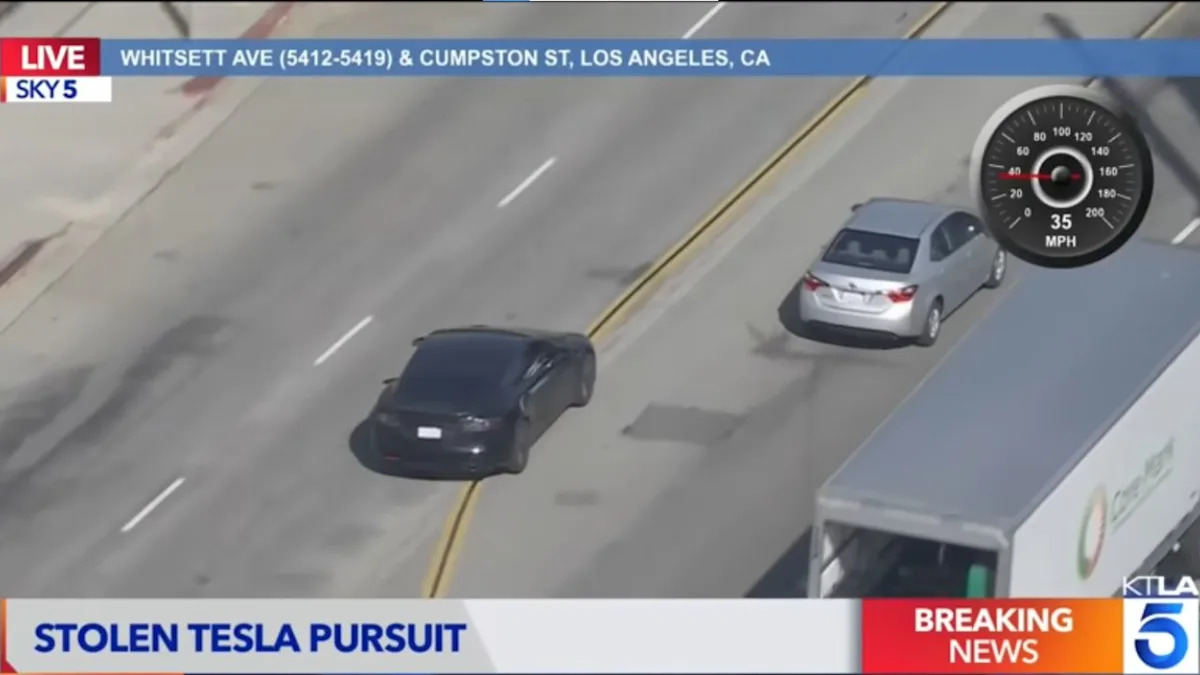
It started as a routine afternoon in the San Fernando Valley but quickly turned into must-see television, as a black Tesla transformed North Hollywood into a real-time action movie set, complete with a Sky5 helicopter, frantic radio chatter, and a driver who appeared determined to test every rule of the road at once.
“To get to some breaking news here this is the San Fernando Valley,” the broadcast began, with the unmistakable urgency that signals things are about to go sideways.
From above, Sky5 HD locked onto a black Tesla wanted for grand theft and already deep into a pursuit with the LAPD.
The location bounced rapidly across the map. Burbank. North Hollywood. The 170 freeway. And then back again, like a pinball with regenerative braking.
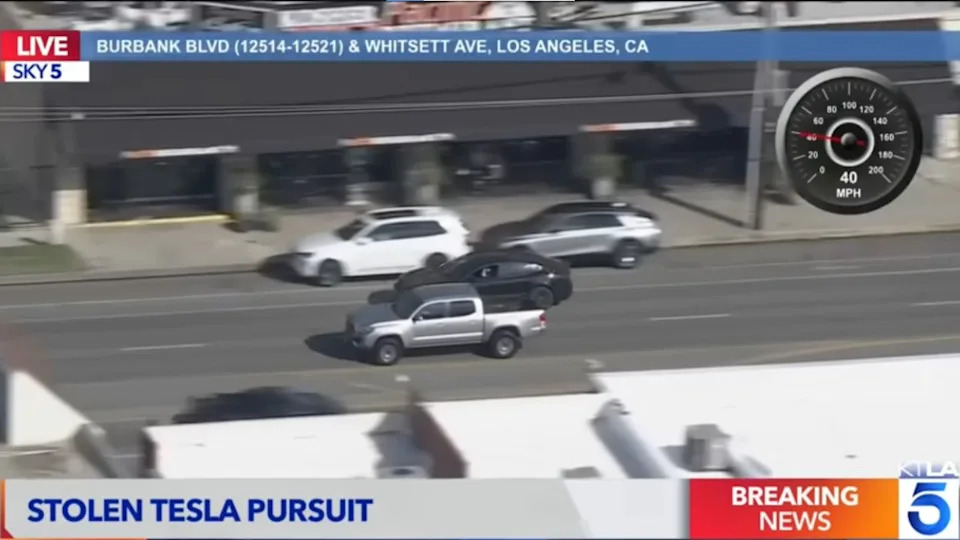
Image Credit: KTLA5/YouTube.
The driver exited the 170 freeway briefly before darting back into North Hollywood streets, heading westbound on Burbank Boulevard. Viewers were warned almost immediately that this was not your average chase.
The Tesla was “oftentimes driving on the wrong side of the road,” weaving through residential neighborhoods with what appeared to be just one person inside. At one terrifying moment, the car “just barely missing, a cyclist there in the crosswalk,” prompting an audible shift in tone from exciting to alarming.
A Suspect Who Wouldn’t Slow Down
Police units backed off slightly, creating distance while a helicopter took over overhead surveillance. “They’re just not directly behind his black Tesla,” the reporter explained, as the car continued at high speed through city streets.
The Tesla driver even rolled down the window at one point, casually talking to people on a sidewalk, a surreal pause in the chaos.
Seconds later, the calm vanished. “Right after that we saw really accelerate through that neighborhood,” the broadcaster said, as the Tesla bolted away once again.
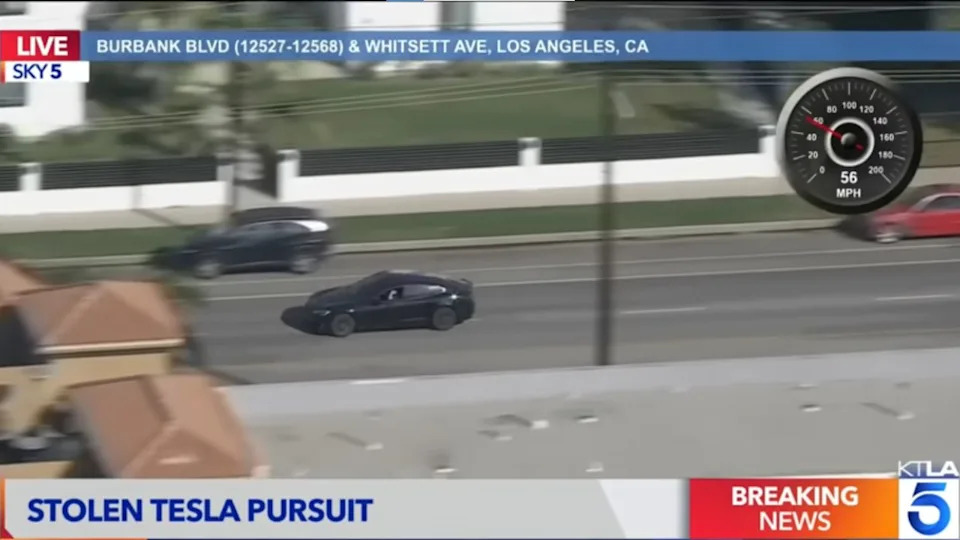
Image Credit: KTLA5/YouTube.
Radio chatter crackled with indecision as officers weighed public safety against the need to apprehend the suspect. “All right, our camp cancel the pursuit… okay…. so, LAPD canceling,” came the update, followed by clarification that the helicopter would continue tracking from above.
Despite the lack of patrol cars directly behind him, the Tesla driver did not slow down. In fact, things got worse. The car was clocked at “nearly 90 miles an hour on these surface streets in the city of North Hollywood,” even without active pursuit.
The aerial footage showed the Tesla riding the center divider, cutting around traffic, and again nearly striking pedestrians. “We saw nearly missed people in the crosswalk,” the reporter emphasized, underscoring why the ground chase had been pulled back.
The driver seemed to be looping the same area repeatedly, “really just kind of going in circles back and forth,” eventually drifting back toward the 170 freeway where the pursuit had first begun.
Did LAPD Make the Right Call?
Did the LAPD handle this right?
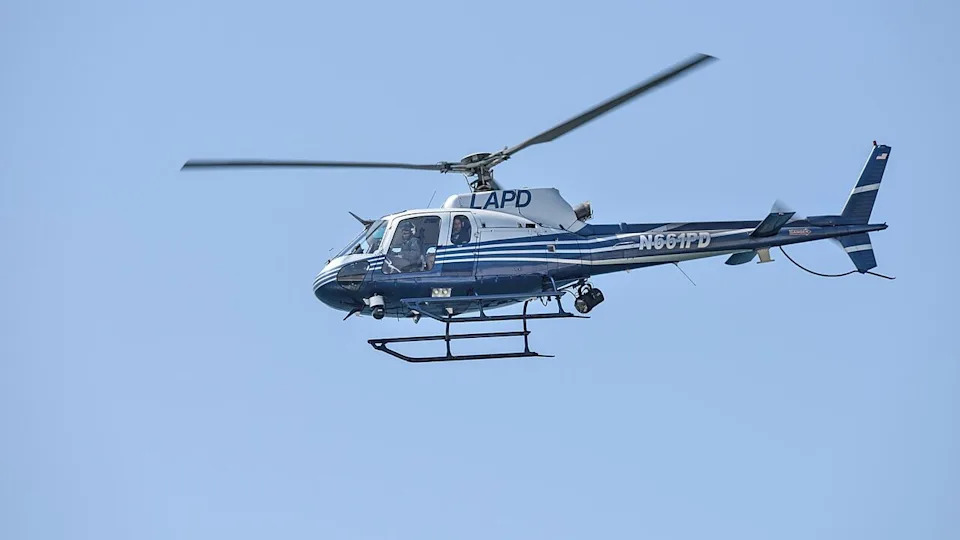
Image Credit: Cayambe – Own work, CC BY-SA 4.0, Wikimedia.
One critique often raised is whether the initial ground pursuit escalated the suspect’s behavior. There is research suggesting that some drivers slow down when they believe they have “lost” the police.
In this case, though, the driver continued at extreme speeds even after units disengaged. That weakens the argument that the chase itself was the sole trigger for the reckless driving.
Another question is whether a no-pursuit policy for nonviolent felonies would have been safer. Some cities have adopted stricter limits, relying on license plate readers, GPS tagging darts, or later apprehension.
LAPD does have access to tracking technology in some situations, but it is not universally deployed. And with a stolen vehicle and an unidentified suspect, letting him vanish into LA traffic carries its own consequences.
From what we can surmise here, officers did follow a key best practice: they terminated the close ground chase when speeds and risk levels climbed.
They relied on air support. They coordinated rather than crowding the suspect. And when the vehicle slowed under the overpass, they moved in decisively and ended it quickly on foot.
The uncomfortable reality is that there is no perfectly safe option once someone decides to drive like that through a dense city. In a place like Los Angeles, with constant traffic, mixed-use neighborhoods, and millions of daily drivers, every pursuit becomes a rolling risk calculation.
In this case, the fact that it ended with no reported injuries suggests the balance, while tense, may have been about as controlled as it could be under the circumstances.
The Takedown: Swift, Clean, and Under the Overpass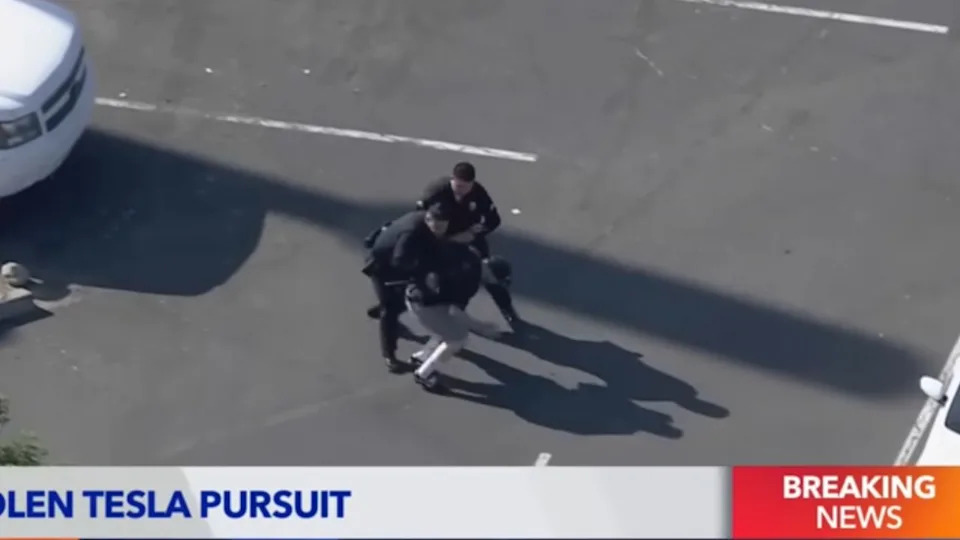
Image Credit: KTLA5/YouTube.
Then came the moment every viewer waits for. As the Tesla slowed slightly under an overpass, brake lights flickered. “Hopefully no,” the reporter muttered, watching closely. Seconds later, a squad car appeared. The timing was perfect. Officers moved in decisively.
“Well at least it is caught up to it there now,” the broadcast announced. The driver bailed out and ran, but only for a heartbeat.
“There he goes down on all fours… is now being taken into custody,” the reporter said, relief unmistakable. The closing words summed up what everyone watching was thinking.
“Thank goodness that car was moving in a way that was so dangerous and putting so many people at risk.” With the suspect in custody and no reported injuries, North Hollywood could finally exhale.
Inside LAPD’s Pursuit Playbook
Car chase policy in Los Angeles has changed a lot over the years, mostly because of exactly what viewers saw in this North Hollywood pursuit: high speeds on crowded surface streets, pedestrians in crosswalks, and a suspect who seems more reckless the less pressure he feels.
The LAPD’s current pursuit policy is built around a simple but hard truth. The danger created by the chase itself cannot outweigh the danger posed by the suspect.
Officers are allowed to pursue when the suspect is wanted for a violent felony or poses an immediate threat to public safety.
For property crimes like grand theft, supervisors have to constantly weigh risk versus necessity. That is why you heard that back-and-forth on the scanner about canceling the pursuit “for safety reasons.”
In Los Angeles, pursuits are tightly managed. A supervisor must monitor and can terminate the chase at any time. Air support plays a huge role.
The LAPD’s helicopter division is one of the largest municipal airborne units in the world, and the strategy often shifts from ground pursuit to what is essentially aerial tracking.
When the helicopter has clear visual contact, patrol cars may fall back, dim lights, or disengage entirely, hoping the suspect will slow down once the adrenaline of being chased fades.
That appears to be what happened here. Ground units backed off. The helicopter continued tracking. This tactic is common in LA because of traffic density and pedestrian volume. North Hollywood is packed with narrow residential streets, cyclists, and crosswalks.
A suspect doing “nearly 90 miles an hour on these surface streets” is already an enormous risk. Adding multiple patrol cars running Code 3 behind him can amplify that danger.
Could it have been handled better? Possibly, but not in an obvious way.