PRESS RELEASE. From the San Mateo County Sheriff’s Office on February 10th, 2026.
HALF MOON BAY, Calif. – The San Mateo County Sheriff’s Office has learned that a 16-year-old involved in an electric motorcycle collision Monday afternoon in the City of Half Moon Bay has died.
At around 12:15 p.m. on Monday, Feb. 9th, 2026, deputies responded to Highway 1 and Terrace Avenue for a report of a collision involving an electric motorcycle and a box truck.
Deputies arrived at the scene and rendered aid to the 16-year-old rider, who suffered serious injuries in the collision. Fire and EMS personnel arrived a short time later and transported the 16-year-old to an area hospital. Monday evening, the Sheriff’s Office was notified that he later died at the hospital.
Preliminary information indicates the 16-year-old was riding the electric motorcycle at a high rate of speed on the shoulder of Highway 1, when it ran into a box truck at the intersection of Highway 1 and Terrace Avenue. The involved electric motorcycle did not have pedals and is classified as an electric off-highway motorcycle under Senate Bill 586 and CVC 436.1.
The driver of the box truck remained at the scene and is cooperating with the investigation. The initial
investigation indicates the driver was properly licensed and alcohol or drugs do not appear to be a contributing factor.
Due to the severity of the collision, the Sheriff’s Office Major Accident Investigation Team (MAIT) responded and is conducting a thorough investigation. Anyone with information is asked to contact the Sheriff’s Office at 650-363-4911.
“This is a truly tragic incident, and our thoughts are with the family, friends and loved ones of this young
person,” said Sheriff Ken Binder. “Anytime a young person loses their life it sends ripples through the
community. This tragedy reminds us how dangerous e-motos can be. We urge parents and guardians to learn about the regulations surrounding the distinctions of these vehicles and to talk with kids and teens about safety and the rules of the road.”
For safety information and resources, visit https://www.smcsheriff.com/bicycle-safety.
US E-Bike Laws 2026: The Complete Guide to Classes & Regulations
This comprehensive guide serves as your roadmap. Grounded in the latest federal standards from the Consumer Product Safety Commission (CPSC) and the widely adopted Three-Class System promoted by industry leaders like PeopleForBikes, we will demystify the regulations to keep you safe, compliant, and street-legal in 2026.
US Key Takeaways
The Three-Class System: Most states categorize e-bikes into Class 1 (Pedal-assist, 20mph), Class 2 (Throttle, 20mph), and Class 3 (Speed Pedelec, 28mph).
Federal vs. State: The Feds regulate the manufacturing (safety standards); your State regulates the riding (access, age, helmets).
The Sticker Rule: A permanently affixed label showing the class, wattage, and top speed is legally required on your bike frame.
No License Needed (Mostly): If your bike adheres to the 3-class definitions, you generally do not need a driver’s license, insurance, or registration.
Stay Away from “Out-of-Class” EVs: Unlocking your bike to exceed 28mph usually reclassifies it as an unregistered motor vehicle, which is illegal on public roads.
3-Tier Classification 2026 Performance Standards:
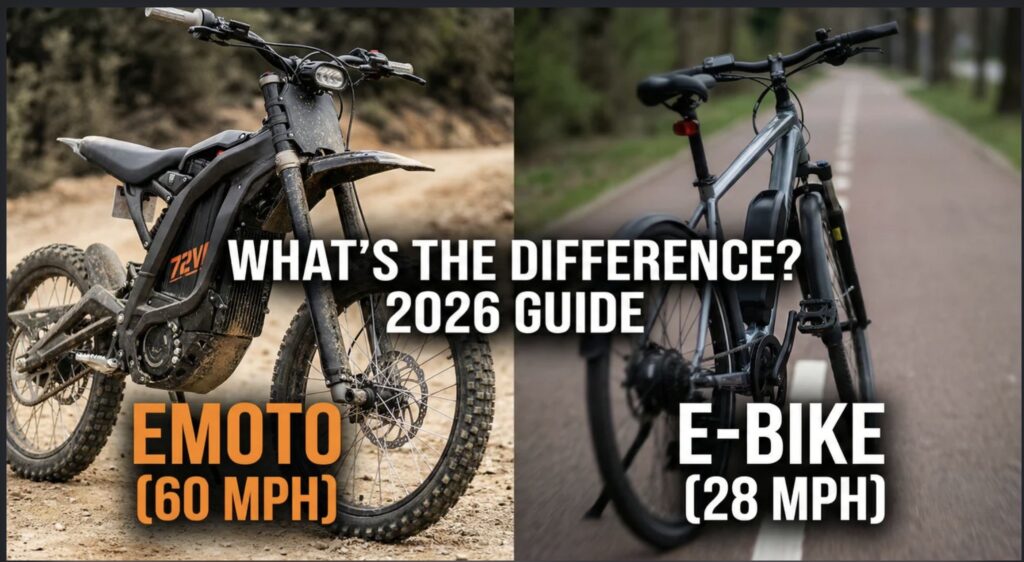
1. The E-Bike (Bicycle)
Legal Limit: Max 750W motor, Max 28 mph (Class 3).
Key Feature: Must have functional pedals.
Where to Ride: Bike lanes, streets, some trails.
2. The Emoto (The Sweet Spot)
Performance: 3kW – 15kW peak power.
Top Speed: 30 mph – 60 mph.
Key Feature: Foot pegs (no pedals), long-travel suspension (200mm+), lightweight frame (<140 lbs).
Where to Ride: OHV Parks, Private Land, Tracks.
3. The Electric Motorcycle
Performance: 20kW+ power.
Top Speed: 80 mph+.
Key Feature: Heavy chassis (>250 lbs), requires M1 license and insurance.
Where to Ride: Highways and Public Roads.
More on E-Bikes on Coastside Buzz
Senator Becker Hosts E-Bike Safety Webinar Covering Education, Enforcement and Legislation ~ Takeaways: No Cohesive State Law, No Data, No Enforcement Funding; February 11, 2026