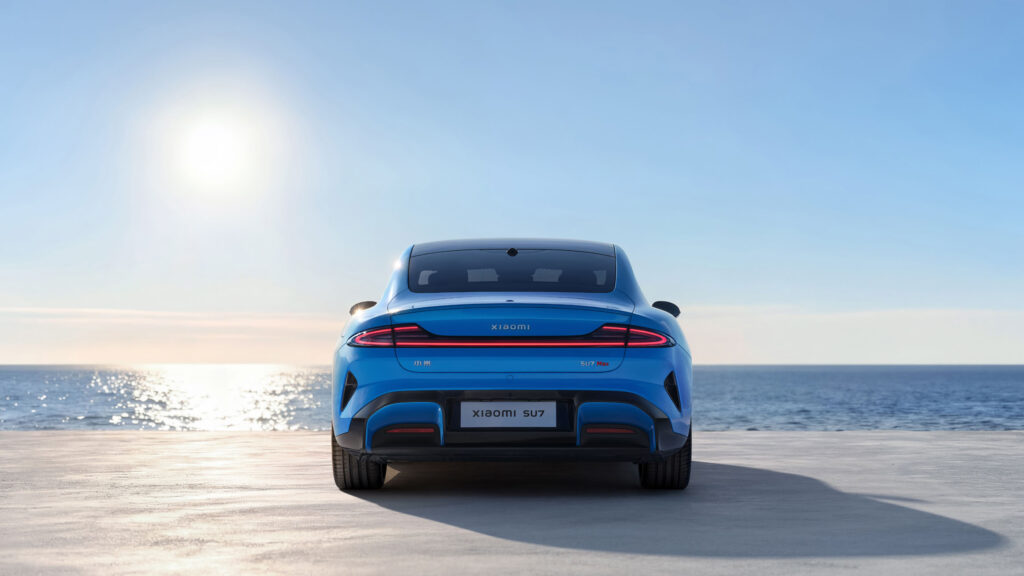
Xiaomi has filed new specifications of the second-generation of the SU7, especially related to its ranges, in China’s Ministry of Industry and Information Technology (MIIT) latest catalogue, released on Monday.
The company’s co-founder and CEO Lei Jun said on Tuesday that Xiaomi has stopped producing the first generation SU7 after 370,000 units, as the launch of the second one is scheduled for April.
The refreshed fully electric sedan — which will be available in three different variants — opened for pre-sale on January 7, with a starting price of 229,900 yuan (equivalent to $33,100).
The new MIIT regulatory filing revealed that the Gen-2 SU7 will be offered in three battery pack options: 73 kWh, 96.3 kWh, and 101.7 kWh.
The model will deliver a total of nine different CLTC range configurations, between 630 km and 902 km of range — equivalent to between 391 and 560 miles.
For the Standard variant, the CLTC range will increase from 700 km to 720 km (from 435 to 447 miles), while the Pro version’s distance will surge from 830 km to 902 km (from 516 to 560 miles).
The range of the upcoming sedan’s most expensive trim, Max, will jump from 800 km to 835 km — or from 497 to 519 miles.
While all trims will be equipped with a dual-chamber air suspension system, Xiaomi will extend the air suspension and Continuous Damping Control (CDC) shock absorber package — a formerly Max-only feature — to the Pro variant.
The entire SU7 lineup will see its V6 and V6s units substituted by the new V6s Plus “super motor,” increasing the Standard and Pro versions’ maximum combined power from 220 kW (299 hp) to 235 kW (320 hp) and Max’s from 495 kW (673 hp) to 507 kW (690 hp).
The company will upgrade the refreshed model’s tire setup from a uniform 245mm width to a staggered 245mm front/265mm rear combination and make four-piston front brake calipers standard across all variants.
Apart from the Gen-2 SU7, the brand also plans to launch the SU7L version of its first model and the YU8 and YU9 extended-range electric SUVs — which were all spotted in China last month — in 2026.
Previously Confirmed Specs
In early January, Xiaomi unveiled the Gen-2 SU7 and announced several of its details, including its electrical architecture.
Both the Standard and Pro trims of the refreshed model will be equipped with a 752V silicon carbide high-voltage platform, 352V more than the previous generation’s.
With its electrical system upgraded from 871V to 897V, the Max version will be able to gain up to 670 km (416 miles) of range — previously 510 km (317 miles) — in 15 minutes.
The new iteration will also deliver 700 TOPS of assisted-driving computing power, representing a 38% jump from the previous maximum of 508 TOPS.
The revamped sedan also includes now LiDAR, 4D millimeter-wave radar, and the company’s end-to-end Hyper Autonomous Driving (HAD) across the entire lineup.
With new exclusive exterior and interior colors — named ‘Capri Blue’ and ‘Dark Night Black’, respectively — the Gen-2 SU7 will feature a redesigned two-color steering wheel, center console, seat, and ambient light.
SU7 Sales
Xiaomi launched the first iteration of the SU7 in March 2024, marking its entrance into the automotive and EV industries.
Within the first few days of the sedan’s debut, the Chinese company secured more than 40,000 units.
A high-performance variant — named SU7 Ultra — went on sale a year ago, priced from 529,900 yuan, equivalent to $76,500.
Within ten minutes of the trim’s launch, the automaker secured 6,900 pre-orders of the model and achieved its annual target of 10,000 units within two hours.
Last year, Xiaomi delivered 258,164 SU7 units, according to data released last month by the China Passenger Car Association (CPCA).
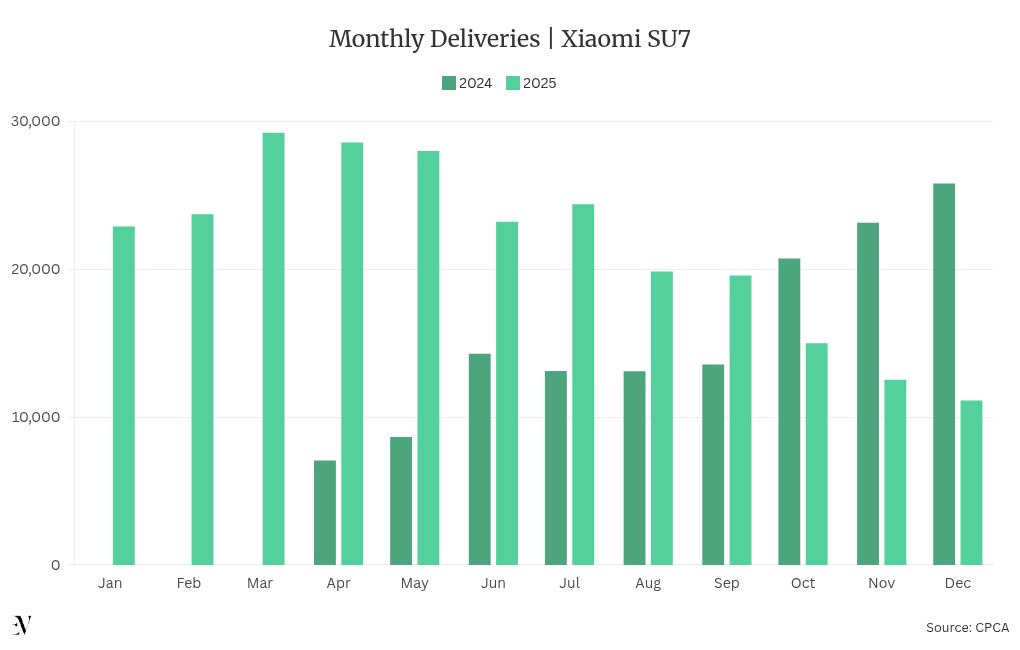
It became the best-selling premium EV sedan in China, surpassing the direct competitor Tesla Model 3, which achieved 200,361 yearly registrations in the country.
However, the SU7 Ultra’s sales have been declining significantly since last September, achieving its worst-ever result last December, with 45 units.
The performance led the brand to disband the variant’s dedicated sales team at the end of January, as reported last Wednesday by the Chinese media outlet Lanjinger.
Xiaomi Sales
In the full 2025 year, Xiaomi sold a total of 411,837 electric vehicles in its domestic market, surpassing its final target of 400,000 vehicles.
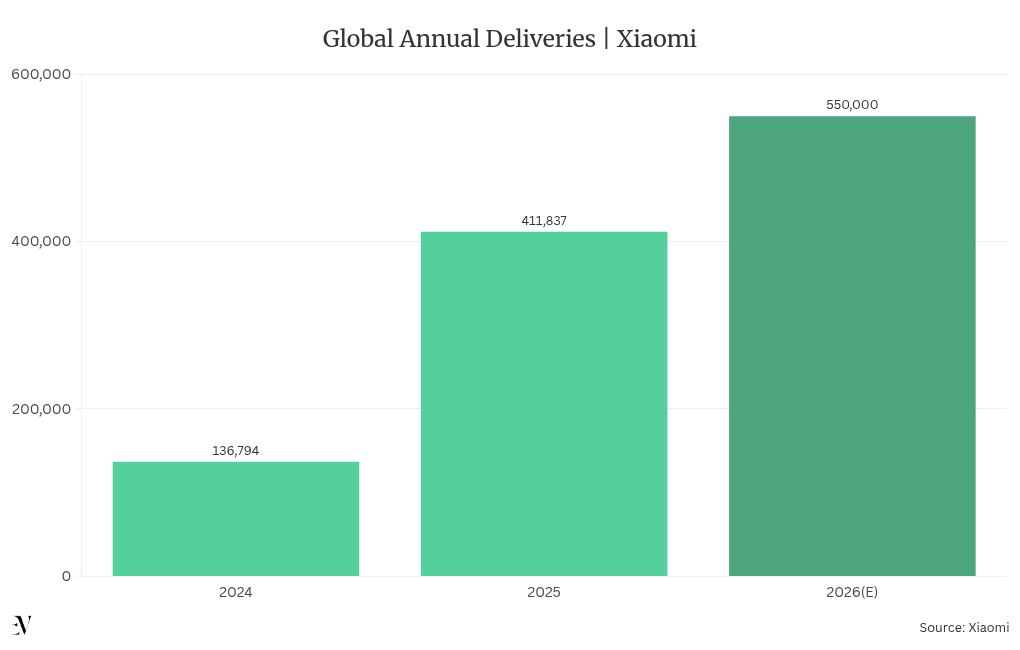
Initially, the Chinese tech giant set a 300,000-unit sales goal for 2025, but it was revised twice throughout the year.
Last month, the company delivered “over 39,000” vehicles — the exact number will be disclosed by the country’s Passenger Car Association (CPCA) later this month.
The figures surged 70.3% year-over-year, but fell by about 20% compared to last December, marking the company’s weakest result since last August.
This year, Xiaomi has set a delivery target of 550,000 EVs, up 34% from 2025.
The latest edition of the MIIT’s catalogue also revealed that the upcoming Nio ES9 — which is set to become China’s largest SUV — will offer a CLTC range of up to 620 km, equivalent to 385 miles.