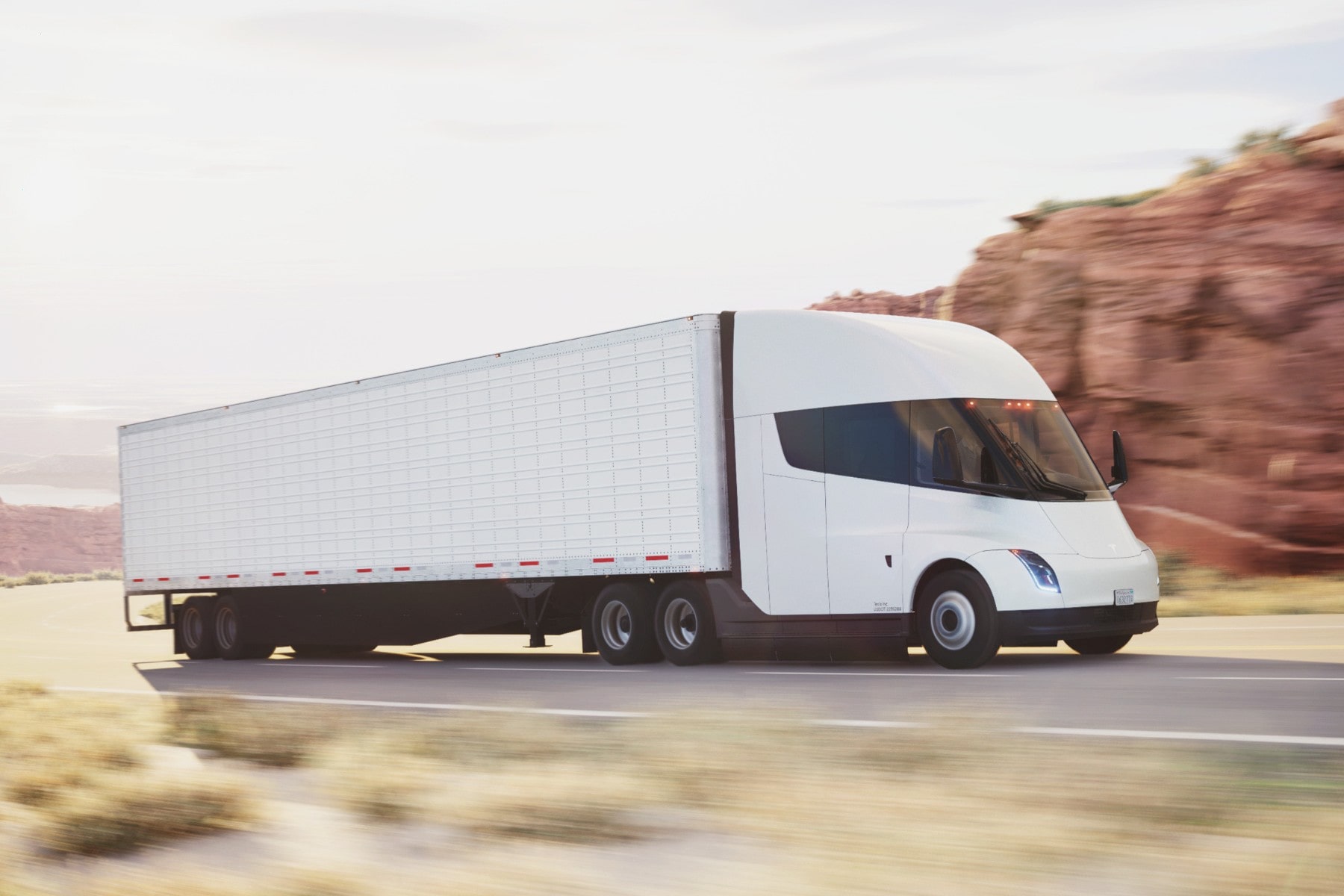
Tesla has updated its dedicated webpage for the all-electric Semi truck, without announcing the changes officially, as is typical. The update was first spotted by the US portal Electrek. As a result, some final specifications for the production version are now officially confirmed. As previously assumed, the Semi will be available in two variants with different battery sizes. However, Tesla has still not disclosed the exact battery capacity.
For the ‘Standard Range’ model, the website now states:
325 miles range at a gross vehicle weight of 82,000 pounds (equivalent to 523 kilometres at 37.2 tonnes)Tare weight under 20,000 pounds (equivalent to 9.07 tonnes)Energy consumption of 1.7 kWh/mile (equivalent to 1.1 kWh/km)Three independent motors on the rear axles with a combined power output of 800 kWCompatible with MCSCharging time: 60% charge in 30 minutesElectric power take-off (ePTO) with up to 25 kW
For the ‘Long Range’ model, Tesla states:
500 miles range (equivalent to 805 kilometres)Tare weight of 23,000 pounds (10.43 tonnes)Energy consumption of 1.7 kWh/mile (equivalent to 1.1 kWh/km)Three independent motors on the rear axles with a combined power output of 800 kW1.2 MW peak charging speedCompatible with MCSCharging time: 60% charge in 30 minutesElectric power take-off (ePTO) with up to 25 kW
These specifications refer to the revised Semi, which Tesla unveiled at its annual general meeting last November. The update was noticeable externally due to a new chassis, updated headlights, and improved aerodynamic features. Tesla confirmed production and the first deliveries in its latest annual report for 2026. The Semi is being manufactured at a new facility in Nevada.
In essence, the aforementioned official specifications were already circulating. They also allow for some deductions about the missing details. For instance, it is widely accepted that the Long Range version will likely feature a battery pack with around 900 kWh. The payload can also be estimated. Here’s a brief explanation: In the US, the Semi falls into the Class 8 truck category, with a maximum permissible gross vehicle weight of up to 80,000 lbs (approximately 36.3 tonnes). In the US, electric trucks are permitted to exceed this limit by an additional 2,000 lbs, equating to 37.2 tonnes. Recall that Tesla stated in 2022 that it had completed a demonstration run covering the maximum range of 500 miles with an 82,000-lb Semi—fully loaded.
Based on the stated tare weights of 20,000 and 23,000 pounds, and subtracting the average weight of a trailer (around 14,000 pounds or 6,350 kilograms), the remaining payload capacity would be roughly 48,000 or 45,000 pounds, equating to approximately 20 or just under 21 tonnes. This is an estimate. For comparison: The Mercedes eActros 600, designed for a gross combination weight of up to 44 tonnes, achieves a payload of around 22 tonnes with a standard trailer in the EU. The Renault E-Tech T 780 and its future Volvo sister model, each with a range of 600 kilometres, offer a net payload of 22.4 tonnes.
Incidentally, in the EU, the maximum permissible gross vehicle weight is 40 tonnes, although electric trucks in many EU countries are allowed to operate at a higher weight than diesel trucks. The European Commission has initiated a standardisation process to increase the permissible gross vehicle weight across Europe to 44 tonnes, compared to 40 tonnes for diesel vehicles. This is also of interest to Tesla. Since Tesla showcased the Semi at the IAA Transportation in Hanover in 2024, it is considered likely that the American manufacturer is planning a market launch for its electric truck in Europe.
One thing is clear: Tesla must still prove itself with its electric truck, as the Semi’s history has so far been marked by delays. Originally, the model was supposed to enter series production in 2019. To date, however, only a small number of pre-production vehicles have been built and delivered. Most are believed to be part of Tesla’s own fleet, with an additional 36 units confirmed in PepsiCo’s California fleet. Tesla began production of the first Semi units in the US in October 2022.
Meanwhile, there are still no official details regarding the price. Shortly after the prototype’s unveiling in 2017, Tesla quoted an “expected base price” of 150,000 dollars for the Semi’s base model. At the time, the longer-range variant was priced at 180,000 dollars, and a ‘Founders Series’ version was listed at 200,000 dollars. Since then, Tesla has not commented further on its pricing plans.
However, there are indications from a recently published article in the LA Times. According to the report, government documents suggest that the Tesla Semi will be sold at a regular price of around 260,000 US dollars (Standard Range) or 300,000 US dollars (Long Range). The LA Times claims to have seen these documents.
electrek.co, tesla.com, latimes.com