For years, electric mobility was surrounded by recurring doubts about where and how to charge a vehicle. However, that barrier began to break when Chargebox decided to offer concrete and visible answers for charging electric cars to travel to the Atlantic Coast.
In 2019, at the Sheraton in Pilar, the company inaugurated its first charging point. At that time, few understood the scope of the initiative.
From there, a process began that marked a shift towards a cleaner transportation model in Argentina.
A growing network connecting destinations
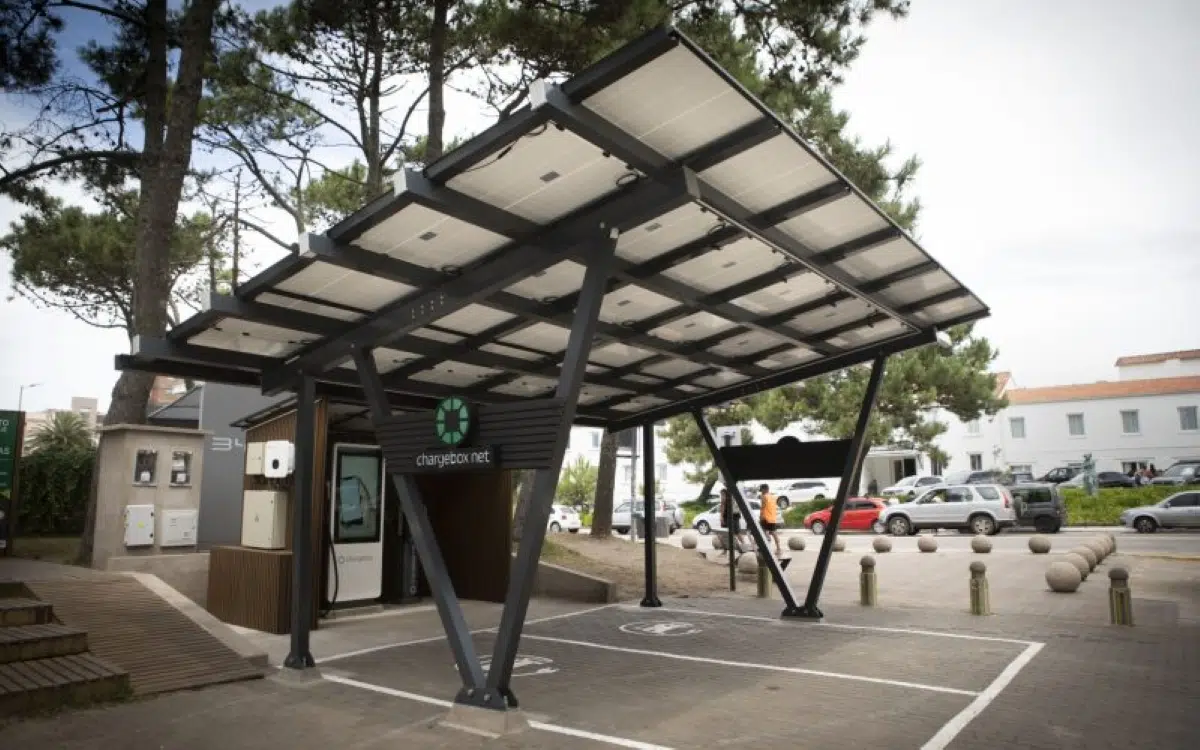
With the goal of building the largest public charging network in the country, Chargebox recently reached its 100th point. This milestone is located in Pinamar, at the intersection of Av. Bunge and Noctilucas, with access via Av. de las Artes.
The new station features a triple charging system, combining a fast charger of 60 kW with CCS2 connectors and a semi-fast one of 22 kW with type 2 socket.
Additionally, the space operates 24 hours a day throughout the year, facilitating mobility for both residents and tourists.
 The new way to boost sustainable tourism. Photo: Revista Estilo Propio.
Clean energy serving tourism
One of the most notable aspects of the new point is its supply through solar energy. The solar carport allows generating an average of 1,292 kWh monthly.
That volume is equivalent to about 22 hours of fast charging or nearly 29 full charges of average batteries. Thus, the infrastructure not only reduces emissions but also optimizes resources.
The project was developed in partnership with the Pinamar Electric Cooperative, strengthening the link between electric mobility and sustainable tourism.
A new opportunity for sustainable tourism
The expansion of the Chargebox network brings direct environmental benefits. By facilitating the use of electric vehicles, it helps reduce the emissions associated with transportation, one of the main CO₂ generators.
Likewise, electric mobility decreases noise pollution and improves air quality in cities and tourist destinations. This is crucial in sensitive natural environments like the Buenos Aires coast.
On a social level, the network provides predictability and confidence to those considering adopting this technology, reducing the fear of change.
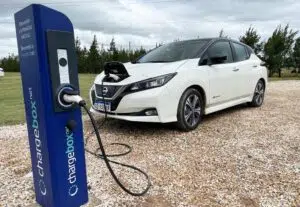 The new way to boost sustainable tourism. Photo: Economía sustentable.
Pinamar as a sustainable mobility hub
Pinamar already has six charging points and is establishing itself as a destination prepared for new forms of transportation. This infrastructure supports a development vision aligned with the protection of the natural environment.
Sustainable tourism stops being an abstract concept and translates into concrete actions. Fewer emissions imply a lesser impact on the forest, the sea, and the coastal landscape.
Thus, electric mobility integrates into the local ecosystem as a tool to protect the main economic engine of the region.
An irreversible path
As the network grows, so does the confidence in electric mobility. Charging a car is no longer a mystery, but an accessible possibility.
In this way, Chargebox not only installs chargers but builds a new paradigm. A future where traveling, even to the Coast, is compatible with the care of the planet.