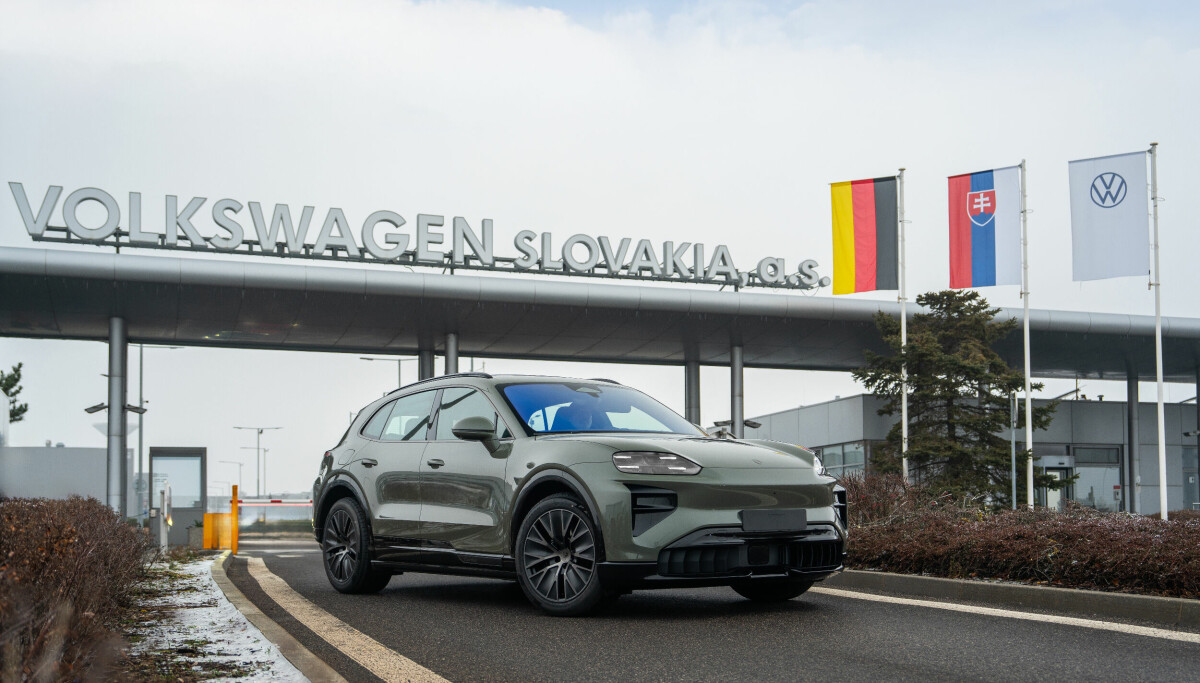
The Swiss army knife within the VW Group’s production network is actually a Slovak one. While in Germany, individual locations like Emden or Zwickau now only build one type of drive, or the factories on the Iberian Peninsula are focusing more on small electric cars, the plant in Bratislava has been covering all sizes of various brands for years. At times, models like the VW up and the Audi Q7 were produced here in parallel. Although the small cars have since left Bratislava, Passat, Superb, Touareg, Q7, Q8, and Cayenne are still rolling off the production line here.
Company sources also told AMS that those responsible on site had hoped for a quick comeback after the end of small car production. However, in the internal competition, the plant in Palmela prevailed and received the contract for the future ID.1. Nevertheless, the value of the Eastern European plant is likely to increase further in the future, not least with the launch of the electric Cayenne. So what distinguishes the Slovak army knife?
Batteries for the E-Cayenne are being produced in Slovakia
A battery module production facility is being established in Horná Streda, which is more reminiscent of cleanroom logic than traditional assembly. A high degree of automation, real-time data, and an analysis centre are intended to ensure the series ramp-up of the Cayenne Electric.
When you first enter the factory on the western edge of Bratislava, it takes a moment to grasp the dimensions. More than two million square metres of space, a press shop, three body shops, three paint lines, three assembly areas. Internally, Volkswagen speaks of segments, but in fact, there are three factories under one roof. By volume, Bratislava is the second largest VW plant in Europe after Wolfsburg. The technical capacity is around 450,000 vehicles in three-shift operation, without weekend work or special measures. In recent years, the actual utilisation has stabilised between 330,000 and 340,000 units. However, the decisive factor is less the sheer number than the underlying principle: Bratislava is designed to permanently handle complexity – not temporarily, but as a normal state.
From assembly plant to multi-brand anchor
The history of the site is closely linked to the strategic decisions of the group. In 1991, Volkswagen took over the then Bratislava automobile works, and in 1992, production of the Passat B3 began. In 2026, Volkswagen Slovakia will celebrate its 35th anniversary. The Passat marks not only the beginning but also the present. With the ninth generation, the model returned to the site in 2023 after 20 years. At the beginning of 2024, production was completely withdrawn from Emden.
For the East Frisian plant, the Passat was the car par excellence for decades – its departure had not only an industrial but also a symbolic impact there. The fact that the group now manufactures this classic exclusively in Slovakia is more than a logistical shift. It is a visible sign of how the focus in the European production network is shifting.
The decisive turning point for Bratislava, however, occurred as early as 2002. With the so-called Colorado project, the joint production of the VW Touareg and Porsche Cayenne on a technical platform began, later supplemented by the Audi Q7. “That was the beginning of our development as a multi-brand plant,” said Wolfram Kirchert, chairman of the management board of Volkswagen Slovakia. A volume plant gradually became a group anchor for large vehicles. In 2013, a state-of-the-art press line was put into operation, and in 2016, the western part of the plant was expanded with a new assembly building and a large logistics centre for Porsche. From 2017, the Cayenne was fully manufactured in Bratislava – including the highest levels of customisation.
We are supplied daily by over 100 suppliers from more than 40 countries. Around 1,300 lorries a day, over 48,000 part numbers – this is one of the reasons why Bratislava is one of the most complex plants in the entire group.
Symbolism and calculation
The fact that the Cayenne, even in its all-electric variant, is being built in Bratislava is hardly surprising at first glance. The model history, the existing infrastructure, and the experience speak for it. At the same time, the decision is not without its signalling effect. The Porsche plant in Leipzig, where the Macan is already rolling off the production line, would have gladly taken the contract. That Porsche nevertheless decided on Bratislava shows the importance the location holds across the group. This is not about national sensitivities, but about industrial logic. The Cayenne has been closely linked to Bratislava for over two decades, the processes are well-established, the depth of production is high, and the variety of variants is mastered.
Albrecht Reimold, board member for production and logistics at Porsche, put it clearly: “Bratislava is today the central hub for our Cayenne.” With the Cayenne Electric, Porsche is now integrating the third drive form at this location. The crucial point is that all variants run on one line. Combustion engines, plug-in hybrids, and electric vehicles are not separated but deliberately manufactured together. The underlying logic is sober: volume fluctuations can thus be actively balanced, and investments can be efficiently utilised across the entire mix. For a manufacturer whose sales development is heavily dependent on regional markets, this flexibility is a central lever.
Register now: Digitalisation – Smarter automation
This livestream will provide a reality check on smart factory tech – what’s truly delivering on the shopfloor and where automation is finally paying off.
Width as a core competence
Today, Bratislava manufactures eight models for four group brands, with the battery-powered Cayenne adding a ninth in 2026. Around 60 percent of the volume is accounted for by large SUVs, with the rest distributed between the Passat and Superb. The balance is also evident in the drive systems. Only about half of the vehicles are purely combustion-powered, with the rest being mild or plug-in hybrids. This breadth is no accident, but the result of a deliberate location strategy. While other plants are increasingly being specialised – for example, on electric models or specific vehicle segments – Bratislava acts as a balancing location within the network.
Kirchert refers to this in terms of ‘three factories under one roof’. The press shop, body shop, paint shop, and assembly are organised in such a way that different models and drive systems can run through the system in parallel. This requires not only technology but above all process discipline. Variety must not become a source of error. In Bratislava, it is part of the design.
Depth of production and industrial robustness
A key stability factor is the high depth of production. A large part of the outer skin is manufactured in the in-house press shop, especially for the aluminium SUV models. The main press operates with a pressing force of over 91,000 kilonewtons, with tool change times of around four minutes considered a benchmark within the group. For Kirchert, this is not an end in itself. Short set-up times are a prerequisite for economically running different models on one line.
In body construction, the latest joining technologies are used: laser and plasma welding, flow drill screwing, clinching, and friction element welding. They are necessary to produce aluminium mixed construction bodies with high demands on rigidity, acoustics, and crash performance. The paint shop brings the different bodies back together before they go into assembly. There, all drive and equipment variants run over a common line, are put into operation, tested, and then handed over to sales.
How Porsche builds the body of the new electric Cayenne
The electric Porsche Cayenne is being produced at the Volkswagen plant in Bratislava. The body construction is highly automated, the material mix is complex, and the platform is newly conceived. A tour through a production in its ramp-up phase.
Logistics as a stress test
The complexity of the plant is particularly evident in logistics. Over 100 suppliers from more than 40 countries supply the site. Around 1,300 trucks are handled daily. About 50 percent of the parts come from nearby supplier parks and are delivered just-in-sequence or just-in-time. With more than 48,000 part numbers, Bratislava is at the top of the group. Kirchert therefore speaks of one of the most complex plants in the entire group – not only because of the multi-brand structure but also because of the high product and variant diversity.
This complexity will increase with the E-Cayenne Electric. The high-voltage batteries come from the Porsche Smart Battery Shop in Horná Streda, Slovakia, and are delivered just-in-sequence to the line. Development in Weissach, parts production in Horná Streda, assembly in Bratislava. Even if the value stream runs across several countries, it remains tightly timed.
The electric Cayenne as a system test
The Cayenne Electric is less a single model and more a system test. In the new platform hall, the skateboard-like chassis is created, the battery is structurally integrated and forms the basis of the vehicle. The process is supported by driverless transport systems and digital control. Each vehicle carries an RFID chip that stores all relevant production data. A multifunction tester monitors key parameters such as software versions or battery temperature. In a kind of ‘mission control’, the data comes together, and deviations become immediately visible.
Reimold emphasises the importance of this digital safeguarding for the series launch. Thanks to the new electronics architecture, software versions can be uploaded significantly faster than in previous generations. Each vehicle leaves the factory with the latest software version – an advantage for quality and customer experience. New technologies such as inductive charging are also industrially secured in Bratislava, including their own test stands.
I was here in Bratislava myself for several years. Anyone who has experienced how this plant deals with complexity understands why we are taking this step here.
People as a critical factor
Around 12,500 employees work at Volkswagen Slovakia, plus about 3,500 external staff. 650 of these are at the components plant in Martin. Around 15,000 people move around the site daily. The location is thus not only the largest industrial employer in the region but also one of the largest in the country. In Slovakia, where the automotive industry accounts for more than half of industrial value creation, Volkswagen Slovakia is considered systemically relevant.
The labour market in the Bratislava region is tense. Kirchert points out that the plant is increasingly recruiting workers from countries of the former Soviet Union. Russian language skills often serve as a connecting element, which is why work instructions in assembly are sometimes found in Cyrillic script. The employees are supported with language and qualification programmes, and many have established themselves permanently. The plant manager is particularly proud of the remarkably low turnover rate and absenteeism.
Even though Volkswagen Slovakia is the largest site in terms of volume, number of employees and industrial importance, the plant is in competition: in addition to Volkswagen, Stellantis, Kia and, in the future, Volvo also produce in Slovakia. The presence of other OEMs increases the pressure to retain workers and further optimise processes.
German influence, local touch
During the tour of the Slovak plant, the German influence is still noticeable. Signage, work instructions, process logic – much is clearly shaped by German production standards and the German language. At the same time, it is clear that local expertise is being consciously developed in Bratislava. Managers, engineers and specialists increasingly come from the region. The site is no longer just a recipient of directives, but an active co-designer within the group network.
In the past five years, Volkswagen has invested more than 1.2 billion euros in the Slovakian sites, and since 1991, the investments have totalled over six billion euros. For Kirchert, this is a clear commitment to industrial production in the country. For the group, it is insurance against uncertainties at other locations.
A versatile tool with weight
Bratislava is not a specialist in the narrow sense. The plant is designed to master different things simultaneously: large and smaller volumes, various brands, multiple drive types, high customisation. The Passat from Emden, the award for the E-Cayenne, the integration of the electric drive into the line – all these decisions have symbolic character. They show that Bratislava not only keeps pace within the Volkswagen group but also supports it. While other locations tailor and focus, Bratislava keeps the system flexible. This is precisely where its value lies – for Volkswagen, for the group brands, and for Slovakia itself.