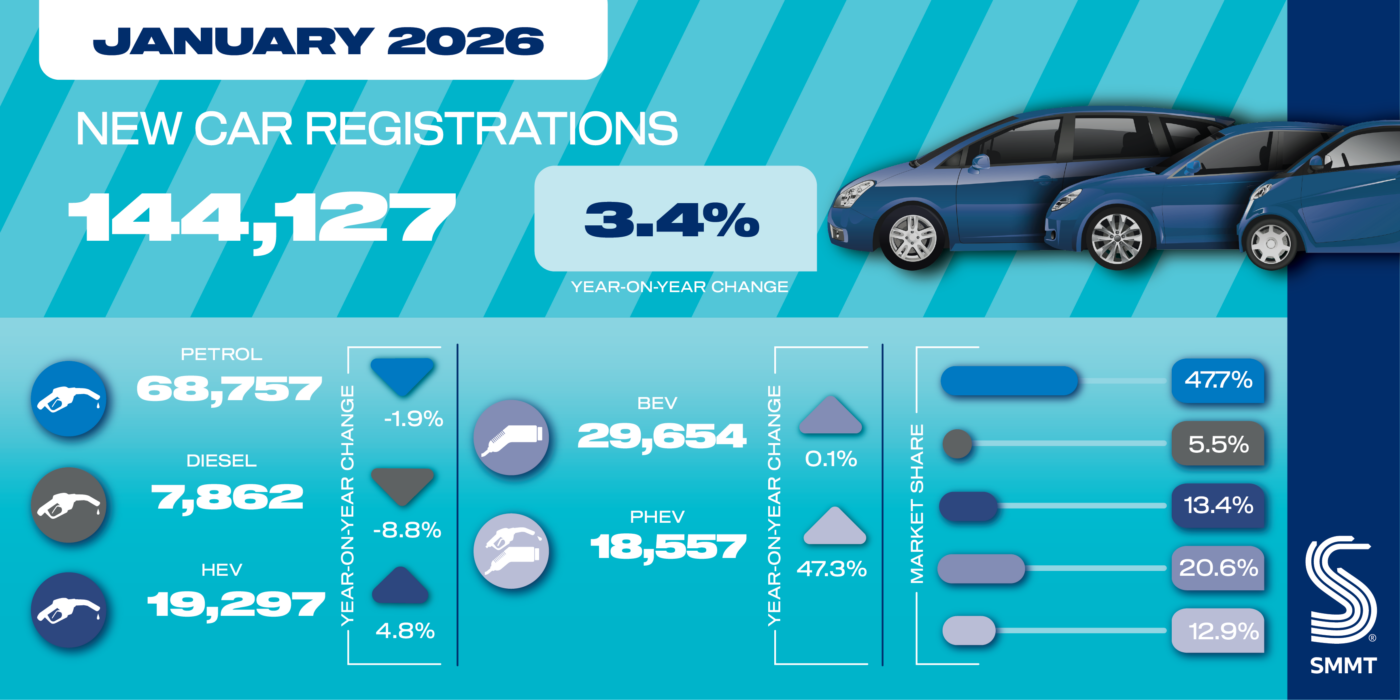
Across all drive types, registrations in the UK rose 3.4% year-on-year to 144,127 units in January, according to new data published by the Society of Motor Manufacturers and Traders (SMMT). That represents the strongest January performance since before the pandemic in 2020. However, not all drive types saw such growth.
Battery-electric vehicle registrations increased only marginally by 0.1% to 29,654 units. That means BEVs accounted for just 20.6% of the total market, marking the lowest monthly share since April 2025. The SMMT attributed the softer share partly to a strong January 2025 comparison, when demand was brought forward ahead of new tax measures introduced in April last year, as well as to elevated BEV registrations towards the end of 2025 as manufacturers sought to meet regulatory targets.
At the same time, plug-in hybrids again recorded the strongest growth among electrified powertrains, with registrations rising 47.3% year-on-year to secure a 12.9% market share. Hybrid electric vehicles also grew, up 4.8% and representing 13.4% of the market.
Looking ahead, the SMMT’s updated market outlook forecasts new car registrations to grow by 1.4% in 2026 to reach 2.048 million units, an upward revision compared with projections published in October. Battery-electric vehicles are now expected to account for 28.5% of registrations over the full year, supported by wider model availability, improving driving range and the reintroduction of government support through the Electric Car Grant.
Nevertheless, the country’s EV share would remain below the 33% market share mandated for 2026. Mike Hawes, Chief Executive of the SMMT, remains cautiously positive.
“Britain’s new car market is building back momentum after a challenging start to the decade. It is also decarbonising more rapidly than ever and, despite a January dip in EV market share, the signs point to growth by the end of the year,” he said, adding: “The pace of the transition, however, may be slowing and is certainly behind mandated targets.”