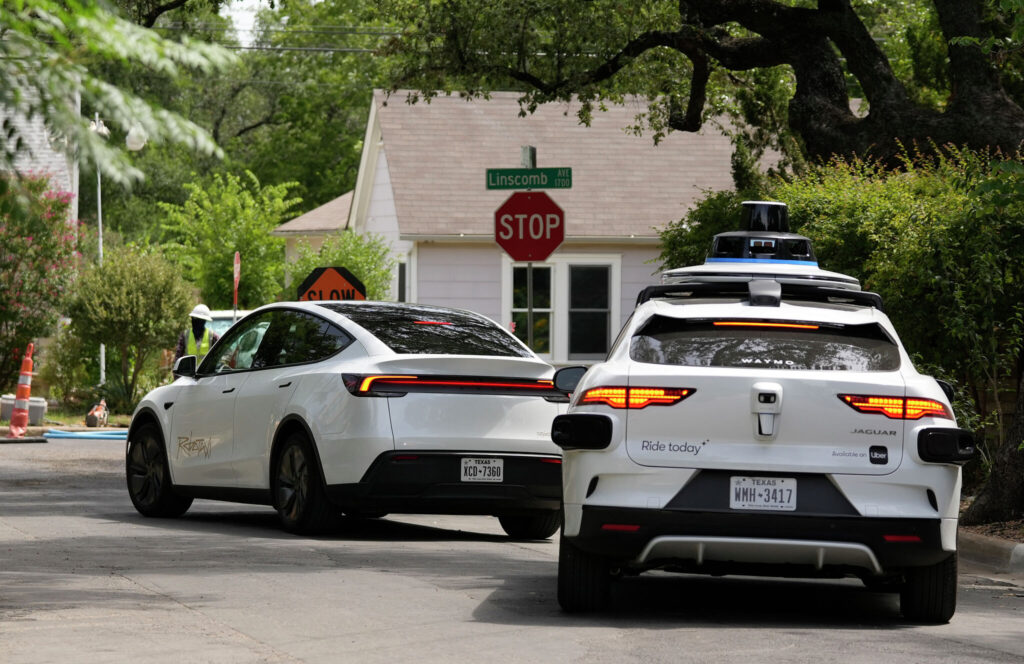
A Tesla robotaxi, left, and a Waymo autonomous vehicle are seen in July on a residential street in Austin. Both companies testified Wednesday during a U.S. Senate hearing on the safety and regulation of autonomous vehicles.
Jay Janner/Austin American-Statesman
Amid multiple federal investigations into their safety and compliance with traffic laws, self-driving automakers Tesla Inc. and Waymo urged Congress on Wednesday to help speed the deployment of autonomous vehicles.

Both companies testified at a U.S. Senate Commerce Committee hearing called to examine whether the federal government should establish national standards for autonomous vehicles. Committee leaders argue that a patchwork of state laws has slowed adoption and made it difficult for companies to scale operations across state lines.
Article continues below this ad
“The United States is locked in a global race with Chinese AV companies for the future of autonomous driving, a trillion-dollar industry comparable in strategic importance to flight and space travel,” Waymo said in written testimony ahead of the meeting.
Lars Moravy, Tesla’s vice president of vehicle engineering echoed that sentiment in his testimony Wednesday, saying nations like China will shape the technology and global market for it if the U.S. does not ease deployment requirements.
Texas revised its 2017 AV framework during the most recent legislative session, though the new regulations will not be enforceable until May 28, according to the Texas Department of Motor Vehicles. New federal regulations could potentially override state laws. In a U.S. House committee hearing last month, representatives discussed possible legislation to bar states from policing the technology at all.
“It is important that we homogenize them for purpose-built AVs so that we have certainty and we have a path forward that is consistent across all 50 states,” Moravy told the committee.
Article continues below this ad
Tesla Inc.’s Gigafactory Texas is seen in September 2025. The Austin-based automaker operates major manufacturing facilities in Texas and California, along with vehicle plants in China and Germany, and is planning another factory in Mexico.
Jay Janner/Austin American-Statesman
Multiple members also emphasized the importance of bringing not only development but vehicle production and manufacturing capability to the U.S.
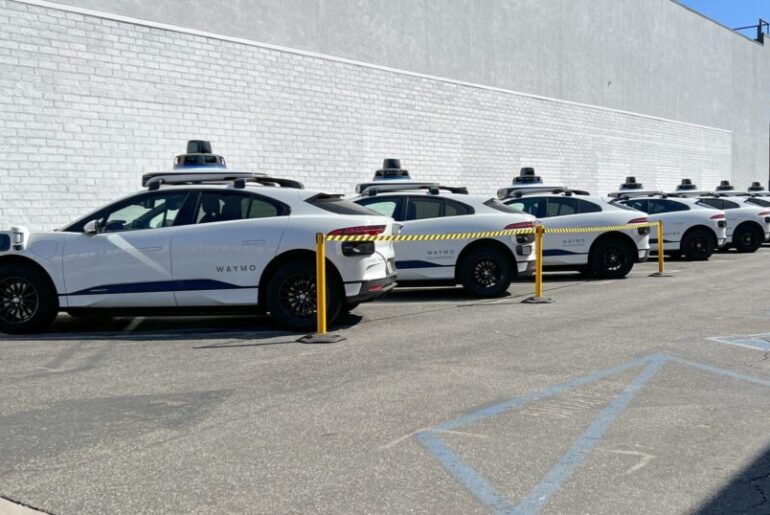
Waymo develops its self-driving technology in the U.S. and installs the systems on vehicles here, but the vehicles themselves are not manufactured domestically. The company uses mainly Jaguar vehicles that are built in the United Kingdom and Austria. Waymo also has driver-support agents based in the U.S. and the Philippines, a company representative said Wednesday, a fact several senators called “unacceptable.”
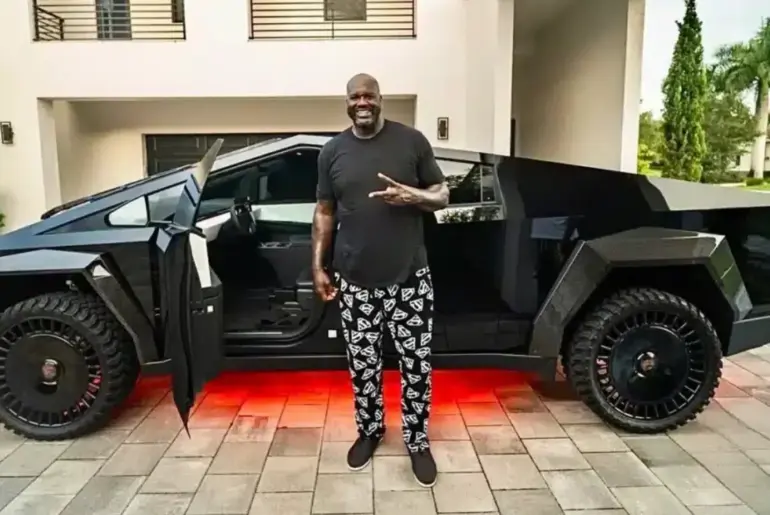
Moravy said about 95% of Tesla’s autonomous vehicles are built in the U.S., and the company hopes to increase that to 100%. While Tesla operates major manufacturing facilities in Texas and California, it also has vehicle factories in China and Germany and has discussed plans to open another in Mexico.
Article continues below this ad
Safety scrutiny
Both companies, which began operating robotaxis in Austin last year, have faced increased scrutiny after reports and videos surfaced showing erratic driving behavior, including crashes and incidents involving school buses and pedestrians.
Last week, the U.S. National Highway Traffic Safety Administration opened a new probe into Waymo after the company reported that one of its vehicles struck a child near her elementary school in California. The child walked away from the incident, which Waymo voluntarily reported to the agency.
Mauricio Peña, Waymo’s chief safety officer, told the committee that the car’s autonomous vehicle technology “mitigated harm” and responded faster than tests indicate a human driver could have.
Article continues below this ad
The investigation into last week’s crash comes on top of ongoing probes of Waymo’s robotaxis illegally driving past stopped school buses in Austin and Atlanta.
Austin ISD says its stop-arm camera footage shows Waymo vehicles illegally passing stopped school buses at least 24 times since the start of the school year. The school district’s police department has issued more than 7,000 school bus traffic safety violations so far this school year.
Peña said the company has evaluated the recorded events and is working with the school district to collect data and lighting patterns to better inform its technology. Austin ISD said it did allow Waymo, owned by Google parent company Alphabet Inc., to conduct data collection with school buses on Dec. 8 but had not met with the company since then.
The National Highway Traffic Safety Administration has also opened several investigations into Austin-based Tesla, including the company’s robotaxi operations in Austin and its Full Self-Driving system, which is available in all of the EV maker’s consumer vehicles. Tesla has claimed FSD “will drive you almost anywhere with your active supervision, requiring minimal intervention” but does not make the car self-driving.
Article continues below this ad
Tesla’s robotaxis use similar technology and feature nine cameras on the vehicle to monitor its surroundings. Safety monitors are also still in front-passenger seats of virtually all robotaxis operating in Austin. Several senators pounced on Tesla’s “lack of redundancy” in comparison to Waymo, which uses 29 different cameras as well as lidar and radar to detect its surroundings.
Moravy said human drivers rely on sight alone to drive everyday and robotaxis should too.
Committee Chairman Sen. Ted Cruz, R-Texas, said he believes self-driving vehicles are a “total gamechanger” for safety and autonomy.
Article continues below this ad
“I am thrilled for the day that I can send an AV to take my girls where they need go and I don’t have to worry about a man in the front seat who might do something violent,” Cruz said Wednesday. “I think there’s a lot of parents who share exactly the concern that I have, and I think that’s an enormous safety improvement.”