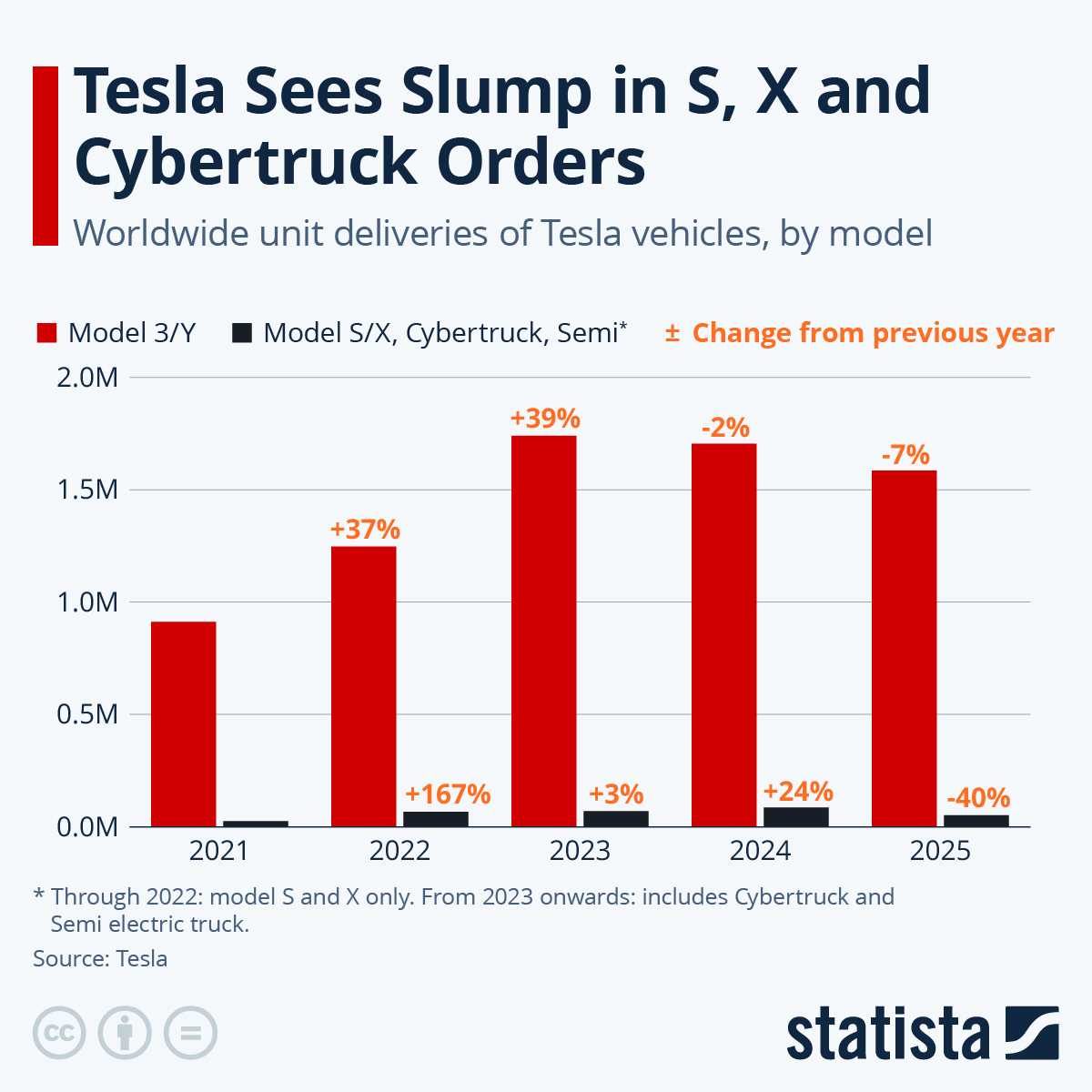
During Tesla’s latest results presentation, CEO Elon Musk confirmed that the electric car company will discontinue its Model S and Model X in Q2 2026. The decision comes amid weakening demand at the top end of Tesla’s range. Our infographic based on Tesla figures shows that deliveries of the Model S, Model X and Cybertruck fell 40 percent year-on-year in 2025. Tesla still sells far more of its mass-market staples, the Model 3 and Model Y, but even those weren’t immune, posting a 7 percent global decline versus 2024, while the brand’s appeal has fallen even more sharply in Europe.
Since 2023, Tesla has stopped reporting Model S/X deliveries separately, bundling them with the Cybertruck and the Semi under the label “Other Models.” That opacity has pushed analysts and media outlets toward rough triangulation. Cox Automotive estimates global Cybertruck sales at just under 39,000 units in 2024, sliding to roughly 20,000-20,200 in 2025. On that basis, the Cybertruck likely accounted for about 45-50 percent of “Other Models” in 2024 and around 40 percent in 2025, with the remainder split between the Model S/X and a small number of Semi trucks.
What Tesla plans to do with the freed-up production capacity is quite striking. Musk says the Fremont (California) production lines currently used for the Model S/X will be replaced by a facility intended to build Optimus, Tesla’s humanoid robot, part of an ambition to produce up to one million robots per year. Musk first unveiled Optimus at Tesla AI Day 2021, pitching it as a machine designed to take over physically demanding, repetitive, or dangerous tasks – starting in factories and, later, in homes. Yet the project is not fully living up to its hype: Musk has recently acknowledged that Optimus has not reached the promised productivity and is currently operating at about half the speed of a human.
Still, investor appetite suggests the broader humanoid-robotics bet is accelerating. In 2025, funding for humanoid robot startups reached $2.65 billion, more than the total invested from 2018 through 2024 combined. The message from capital markets is clear: humanoid robotics is shifting from a cautious experiment to a technology investors increasingly view as commercially ready.
You can find the original article written by Matthias Janson here (in German).