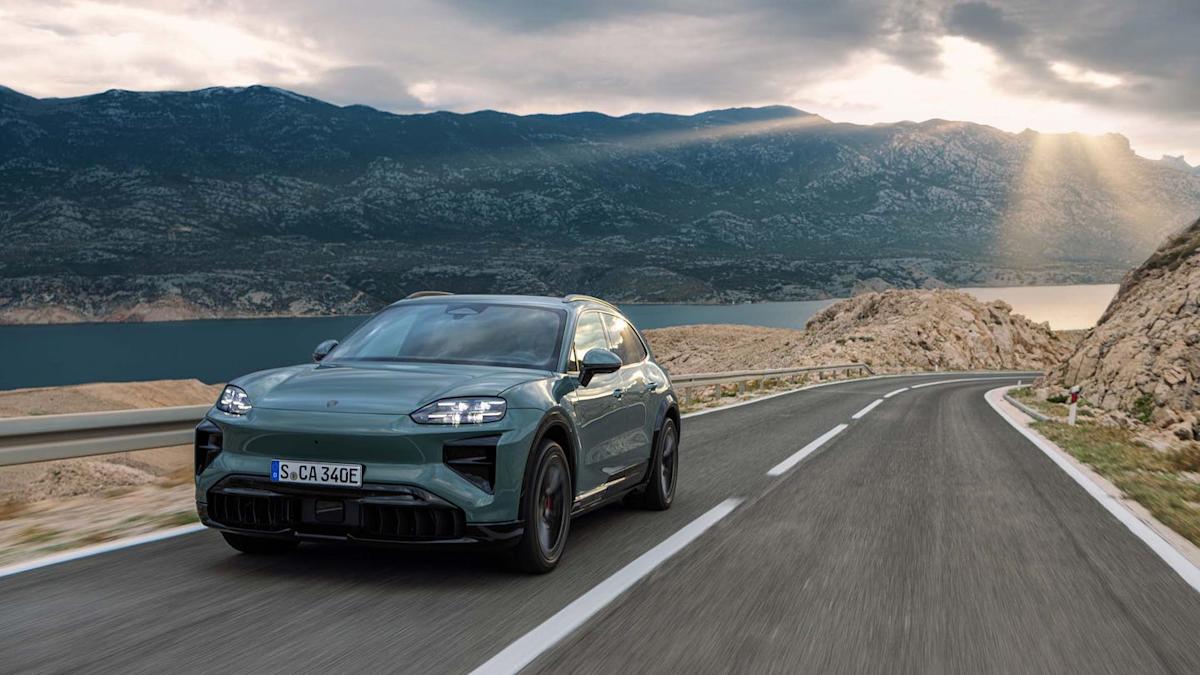
V-8-like rumble? Check. Massive, mass-defying acceleration? Check. Business as usual for the Porsche Cayenne Turbo, then. Well, not quite: I’ve never ridden in a Cayenne that can launch to 60 mph in under three seconds, that’s for sure. The new all-electric Porsche Cayenne Turbo can do exactly that, according to Porsche. That feat isn’t altogether surprising, given that the fourth-generation Cayenne Turbo boasts a furious peak output of 1140 horsepower.
Porsche isn’t ready to let us behind the wheel of a production model just yet. That will come later this year. But for now, in what is a very, very protracted launch phase for the new car, it has taken us to the home of the Cayenne: not Zuffenhausen, Germany, but the giant VW Group manufacturing plant in Bratislava, Slovakia. Here, on a test track normally used for quality control, I find myself bracing hard against the Cayenne EV’s center console as our grinning test driver flings the car into a long, banked corner at nearly 100 mph. The lateral grip generated by something so heavy is startling; the acceleration afterward onto the main straightaway is absolutely epic.
Porsche
It’s difficult not to see the new Cayenne as a car of numbers. That headline power figure, and the fact that it has the largest screen area of any Porsche ever, are the company’s foremost claims. Less mentioned, but equally startling, is a curb weight of nearly three tons.
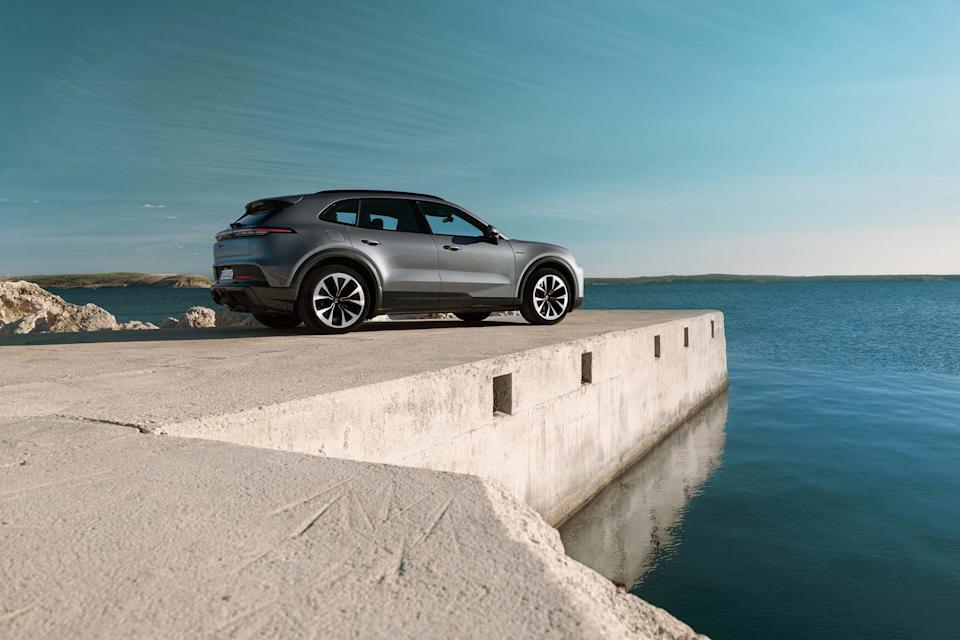
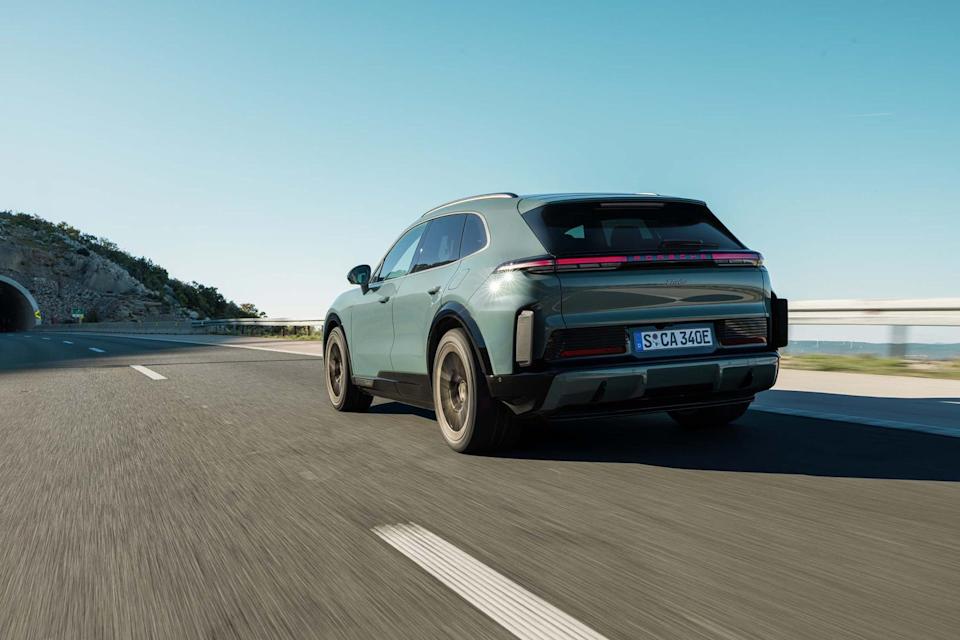
The electric Cayenne doesn’t really feel like a traditional SUV, just as, from the outside, with its low roofline and proportions exaggerated by enormous optional 22-inch wheels (20s and 21s also will be available), it’s more like a cross between the previous Cayenne and a high-performance station wagon. Inside, it’s hushed, very screen-heavy, and suitably premium in feel, while the new generation of seats feels comfortable yet supportive on initial acquaintance. Not only are they heated, but various touch points in the vehicle also get the warm-up treatment. As for the artificial sound, there are two options. Sport mode has a deep, sci-fi effect like a Taycan played back at half speed. Sport Plus brings the V-8 effect. It’s amusing, at first, although I suspect I’d quickly tire of it.
manuel hollenbach – Car and Driver
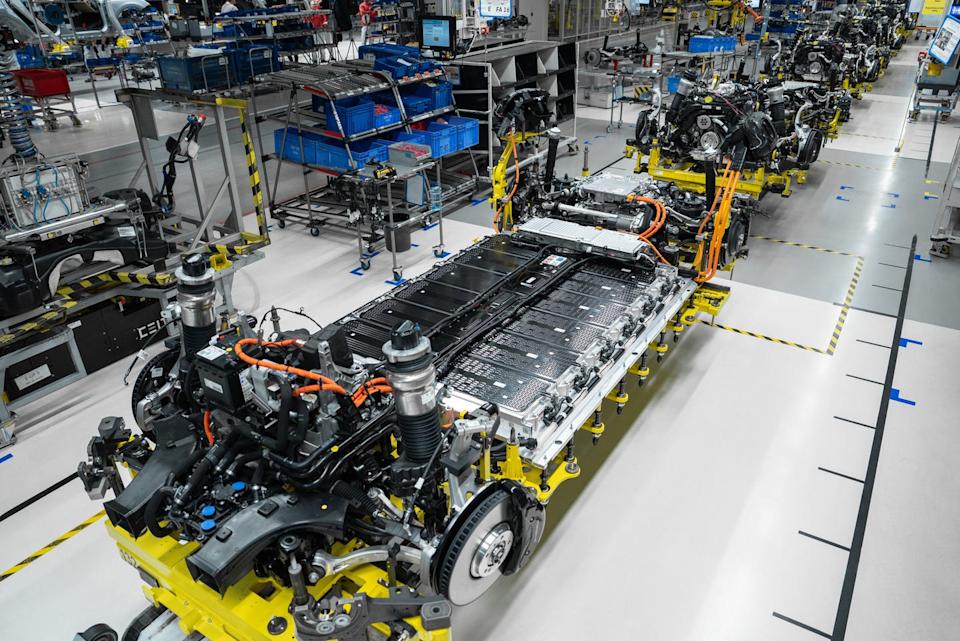
Less dramatic, but no less interesting, was the visit to Porsche’s new battery module production plant in nearby Horná Streda. In the clean, quiet, sterile facility—like something from I, Robot—a largely automated process takes pouch-type cells and builds them up into the finished battery pack, consisting of six modules mounted crossways, with a delicate cooling layer applied on either side.
Those completed battery packs—long, flat, relatively thin alloy boxes—find their way to the VW manufacturing plant in Bratislava, where Wolfsburg has been constructing cars since early 1992. The huge site currently makes eight different vehicles, including the Audi Q7, VW Touareg, and the current Porsche Cayenne. The VW Group has invested $1.4 billion here in the last five years but has the ability to adapt to the market as well as try to dictate it. At this factory, both third- and fourth-generation versions of the Cayenne are made not just under the same roof, but on the same line.
Porsche is just ramping up production of the new Cayenne in a brand-new, state-of-the-art production hall full of menacing-looking robots, where the skateboard chassis is constructed. They then pass over the road on a covered line into the main body shop, where they are built up into finished monocoques that are recognizable as a Cayenne. The really clever part is that in the same building, the chassis for the outgoing model is also constructed, and will continue to be for many years to come, as Porsche fully intends to offer internal-combustion, hybrid, and EV variants. These bare-metal chassis are then moved back to the giant assembly hall, where they emerge from the roof of the building onto the line. Every day, around 180 Cayennes, 120 Cayenne coupes, and currently 12 new versions are completed on this line, but Porsche expects those numbers to shift in ratio considerably once the new variant is on sale. The crucial factor is by how much: If the market takes to the Cayenne EV in a big way, there will be more of the high-tech chassis dropping in from the sky; if not, expect to see many more outgoing third-gen models emerging into the Slovakian daylight at the end of the line.
Porsche
➡️ Skip the lot. Let Car and Driver help you find your next car.
You Might Also Like