The auto unit of the Chinese tech giant Xiaomi announced on Sunday that it delivered “over 39,000” vehicles in the first month of 2026, marking the weakest result since August.
The figures rose by 70.3% compared to a year ago, when deliveries of the YU7 had not yet started.
Compared with December, last month’s figures fell by about 20% month over month.
Xiaomi did not disclose the exact number of vehicle deliveries, only indicating that it stood between 39,000 and 40,000 units.
The exact number of EVs delivered in China last month will be disclosed by the country’s Passenger Car Association later in January.
Between September and December, the company had consistently delivered more than 40,000 vehicles per month.
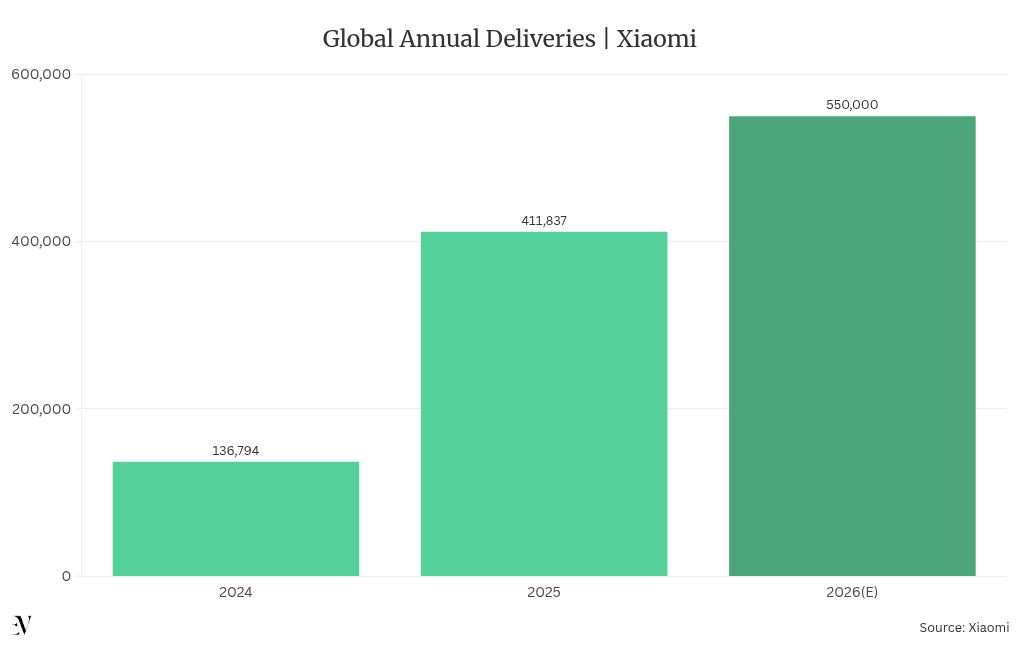
Last year, Xiaomi registered a total of 411,837 EVs in the Chinese market, surpassing its final target of 400,000 vehicles.
At the beginning of 2025, the firm aimed to deliver 300,000 units, but the guidance was revised twice throughout the year.
Last month, Xiaomi‘s co-founder and CEO Lei Jun announced a 550,000-unit target for this year, up 34% from 2025.
In September, the company opened its Europe R&D and Design Center in Munich, Germany, as it prepares to enter the European market next year.
Upcoming Models
Local media outlet 36Kr reported late last year that Xiaomi planned to debut four models in 2026, including a new iteration of the fully electric SU7 sedan, to launch in April, and an executive version of the model, the SU7L.
Before this new variant, the company launched the SU7 Ultra exactly a year ago.
The upcoming SU7L sedan and the YU8 and YU9 extended-range electric SUVs have been recently spotted in China.
According to the 36Kr report, the two SUVs will feature five- and seven-seat configurations, respectively, with the latter set to debut in the first half of the year.
Next-Gen SU7
Ahead of its April debut, the second-generation of Xiaomi‘s SU7 model opened for pre-sale on January 7, with a starting price of 229,900 yuan — equivalent to $33,100.
The new fully electric sedan will be available in three different variants: Standard, Pro, and Max.
The next-generation model has recently entered the “final preparation stage”, with display vehicles set to reach dealerships before the Chinese New Year, ahead of its launch.
Two weeks ago, the new SU7 Max variant reached a driving distance of 4,264 km – equivalent to 2,650 miles – in a 24-hour endurance test. It surpassed the 2025 record of 3,961 km (2,461 miles) held by XPeng’s updated P7 sedan.
Launched in March 2024, the first-generation SU7 was Xiaomi‘s debut model, marking its entrance into the EV industry.
Last year, the tech giant sold 258,164 units of its fully electric sedan in its domestic market, surpassing Tesla Model 3’s sales (200,361), data released by CPCA showed.
The SU7 model has retained the highest resale value – 86.1% – since its launch when compared to other models in its domestic market, such as the Model 3 (75.3%).
YU7 Model
After the debut of its first EV model, Xiaomi launched the fully electric YU7 mid-size crossover SUV last June.
According to CPCA, a total of 153,673 units of this model were sold.
Of this total, 39,089 were delivered only in December 2025, accounting for around 77.9% of the brand’s EV volume that month.
Although positioned as a direct competitor to Tesla‘s Model Y, the YU7 captured less than one-third of the US giant’s SUV’s 538,994-unit volume last year.
Xiaomi has been ramping up production on the YU7, alongside the SU7 model, for which delivery waiting times reached up to 52 weeks.
The firm is expanding its EV plant in Beijing and, according to a recent report by the Chinese media outlet Lanjinger, it has been able to reduce waiting times by up to two months.
Earlier this month, Xiaomi followed in Tesla‘s footsteps and implemented a seven-year financing incentive for its YU7 model in China.
The offer allows customers to acquire the SUV with a down payment starting from 49,900 yuan ($7,200) and minimum monthly installments of 2,593 yuan ($370) until the last day of February.
The strategy has become widespread among Chinese automakers, with Li Auto and XPeng offering similar promotions.