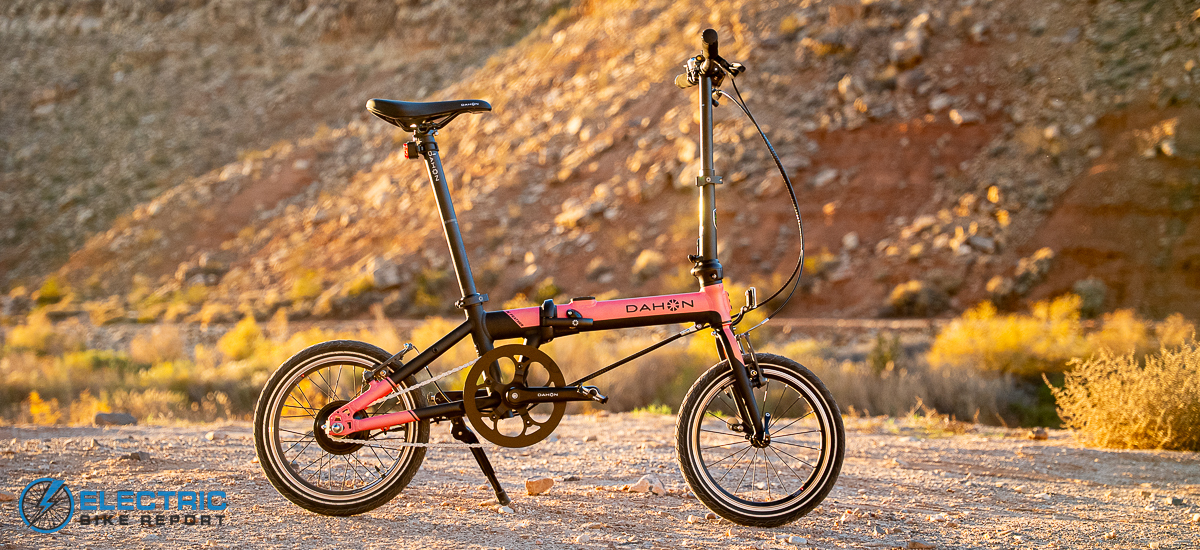
Ride quality is an overall measure of how a bike feels to ride. It encompasses sizing, suspension, stability, motor engagement, the bike’s user interface, etc. With such a minimalist approach, the K-Feather was easier to evaluate than many more complicated e-bikes; we found its ride quality to be right in line with its design and purpose.
Dahon makes the K-Feather in a single frame size (with four color options) suitable for riders between 4’ 7” and 6’ 0”. I am just below the ceiling of that recommended range at 5’ 11”, and I found it comfortable, though I could tell its range of adjustability was near its limits.
With the telescoping stem at its highest position and the extended seatpost near its apex, I had a comfortable, if moderately aggressive, forward-leaning riding position. I opted for a slightly lower-than-usual saddle position to balance comfort and pedal efficiency, and overall, the ride felt sporty and enjoyable.
Handling was a highlight; the K-Feather’s light frame and 16” wheels make it feel airy and agile. Steering was quick and responsive (some might say relatively twitchy) due to its narrow 560 mm handlebars, but the light foam grips were soft and comfortable.
Interestingly, while the bike does not have any form of suspension, the ride felt surprisingly smooth and softer than I expected.
It’s possible that the 1.5”-wide tires absorbed some bumps and roughness, but I believe the frame—and possibly the Deltech support cable between the bottom bracket and junction of the top tube and head tube—helped to reduce jarring vibrations. This feature is exclusive to Dahon e-bikes, and advertised to increase frame rigidity and pedal efficiency.
In terms of overall operation, it really doesn’t get simpler! Instead of a display and control panel, the bike has a single on/off button with a colored light ring to indicate battery charge. The single-speed drivetrain requires no shifting, so the only handlebar-mounted controls are the brake levers and a small bell.
As I touched on in the Speed Test section above, motor engagement is smooth and natural. Pedaling requires light to moderate effort due to the motor’s relatively low power output and the single-speed drivetrain, but the experience feels intuitive and responsive. The pedal assist provides a helpful boost without overpowering the rider’s effort, so pedaling the K-Feather still feels very much like riding an analog bike.
The bike is extremely feature-light, with no fenders, cargo rack, or other accessories; only a kickstand and two battery-operated lights come along with the bike. I appreciate Dahon’s minimalistic approach, but integrated lighting would make the K-Feather feel more complete as an e-bike.
In terms of its folding feature, the K-Feather breaks down quickly, though there is a slight learning curve to the handlebars. The bike’s telescoping stem is marked with a recommended height for folding. When collapsed, its stem and handlebars are sandwiched by the frame halves, which are held together by a magnet and metal plate. We measured the folded bike at roughly 29”L x 18.5”W x 24”H.
All in all, the K-Feather takes a relatively utilitarian approach to its function and folding. It’s a straightforward product that’s comfortable and extremely easy to learn and use, making it great for new riders and those seeking an uncomplicated mobility tool.